Need help?
Do you have a question about the Bosch AP-F06 and is the answer not in the manual?
Step-by-step instructions for safely removing the glove box assembly to access the cabin filter.
Guide on detaching the old cabin filter and inserting the new Bosch filter, noting airflow direction.
This document provides comprehensive installation guidelines for Bosch cabin filters, specifically for part number AP-F06 (0986 AF7 015). It serves as a detailed manual to guide users through the process of replacing their vehicle's cabin filter, ensuring a safe and correct installation. The primary function of this product is to filter the air entering the vehicle's cabin, thereby improving air quality for occupants by removing dust, pollen, and other airborne particles.
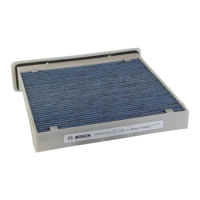
The Bosch cabin filter is an essential component of a vehicle's heating, ventilation, and air conditioning (HVAC) system. Its main function is to purify the air that circulates inside the car, protecting passengers from various airborne contaminants. By trapping particles such as dust, pollen, soot, and other allergens, the filter helps to maintain a healthier and more comfortable environment within the cabin. This is particularly beneficial for individuals with allergies or respiratory sensitivities. The filter also plays a role in protecting the HVAC system itself from accumulating debris, which can otherwise lead to reduced efficiency and potential damage over time. The "AIR FLOW" arrow prominently displayed on the filter indicates the correct direction for installation, ensuring that air passes through the filter media as intended for optimal performance. Incorrect installation, such as reversing the filter, can compromise its effectiveness and potentially lead to poor air quality inside the vehicle.
The installation process for the Bosch cabin filter is designed to be straightforward, with an estimated installation time of 5-10 minutes, although some cases may require tools and additional time. The guide emphasizes the importance of safety, advising users to park their vehicle in a safe place with the engine and air conditioner turned off before beginning the replacement.
The installation procedure is broken down into two main sections:
How to remove the glove box: This section details the steps required to access the cabin filter housing, which is typically located behind the glove box.
Removing and installing the cabin filter: Once the glove box is removed, the cabin filter becomes accessible.
The guide includes important "Attention" notes to highlight critical aspects of the installation. It clarifies that the work procedure is an example and may vary across different vehicles, advising users to consult their vehicle's instruction or maintenance manual for specific details. It also reiterates the significance of the "AIR FLOW" arrow on Bosch filters, noting that other genuine or aftermarket products might use "TOP UP" to indicate the same orientation. Users are strongly cautioned against unreasonable work that could damage the vehicle or cause personal injury, recommending consultation with a local workshop if they are not confident in performing the task.
The Bosch cabin filter is designed for periodic replacement to ensure continuous optimal performance and air quality. The recommended replacement interval is 1 year or 10,000 km, whichever comes first. However, the guide also advises checking and replacing the cabin filter sooner if the vehicle is frequently driven in heavily soiled areas, as environmental conditions can accelerate filter clogging. This proactive approach to maintenance helps to prevent a decrease in air quality and potential strain on the HVAC system.
A crucial maintenance feature highlighted in the guide is that used cabin filters cannot be cleaned and reused. This emphasizes that once a filter has accumulated contaminants, its filtration capacity is compromised, and attempting to clean it will not restore its effectiveness. Therefore, replacement with a new filter is the only recommended maintenance action. This ensures that the vehicle's occupants consistently benefit from clean, filtered air and that the HVAC system operates efficiently without undue stress from a clogged filter. Regular replacement according to the recommended schedule is key to maintaining a healthy cabin environment and extending the lifespan of the vehicle's air conditioning and heating components.
 General
| Filtration Technology | Activated Carbon Block |
|---|---|
| Material | Plastic Housing |
| Type | Under Sink |
| Flow Rate | 0.5 GPM |
| Installation Type | Under Sink |

 To Next Page