English | 15
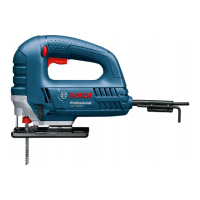
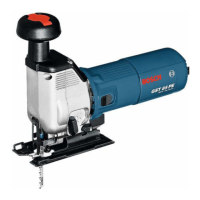
Jigsaw GST 90 E GST 90 BE
– In steel (unalloyed) mm 10 10
Max. cutting angle (left/right) ° 45 45
Weight according to EPTA-Procedure 01:2014 kg 2.3 2.6
Protection class
/II /II
The specifications apply to a rated voltage [U] of 230 V. These specifications may vary at different voltages and in country-specific models.
Noise/Vibration Information
GST 90 E GST 90 BE
Noise emission values determined according to EN62841-2-11.
Typically, the A-weighted noise level of the power tool is:
Sound pressure level dB(A)
86 84
Sound power level dB(A)
97 95
Uncertainty K dB
5 5
Wear hearing protection
Vibration total values a
h
(triax vector sum) and uncertainty K determined according to EN62841-2-11:
Cutting boards with saw bladeT144DF:
a
h,B
m/s
2
8.5 4.5
K m/s
2
1.5 1.5
Cutting sheet metal with saw bladeT118A:
a
h,M
m/s
2
8.5 6.5
K m/s
2
1.5 1.5
The vibration level and noise emission value given in these
instructions have been measured in accordance with a
standardised measuring procedure and may be used to com-
pare power tools. They may also be used for a preliminary
estimation of vibration and noise emissions.
The stated vibration level and noise emission value repres-
ent the main applications of the power tool. However, if the
power tool is used for other applications, with different ap-
plication tools or is poorly maintained, the vibration level
and noise emission value may differ. This may significantly
increase the vibration and noise emissions over the total
working period.
To estimate vibration and noise emissions accurately, the
times when the tool is switched off or when it is running but
not actually being used should also be taken into account.
This may significantly reduce vibration and noise emissions
over the total working period.
Implement additional safety measures to protect the oper-
ator from the effects of vibration, such as servicing the
power tool and application tools, keeping their hands warm,
and organising workflows correctly.
Assembly
u Pull the plug out of the socket before carrying out any
work on the power tool.
Inserting/changing the saw blade
u When fitting or changing the saw blade, wear protect-
ive gloves. Blades are sharp and can become hot when
used for prolonged periods of time.
Selecting the saw blade
You will find an overview of recommended saw blades at the
end of these operating instructions. Only use saw blades
with single lug shank (T shank). The saw blade should not be
longer than required for the intended cut.
Use a narrow saw blade when sawing tight curves.
Inserting the saw blade (seefigure A)
u Clean the shaft on the saw blade before inserting it.
Adirty shaft cannot be securely fixed in place.
Press the SDS lever(8) forward to the stop and hold it
down. Push the saw blade(10), with the teeth in the cutting
direction, into the saw blade receptacle (13) until it clicks
into place.
Make sure when inserting the saw blade that the back of the
saw blade is in the groove on the guide roller (9).
u Check that the saw blade is seated securely. A loose
saw blade can fall out and lead to injuries.
Removing the saw blade (seefigureB)
Push the SDS lever(8) all the way forwards and remove the
saw blade(10).
Bosch Power Tools 1 609 92A 4V4 | (23.04.2019)



 To Next Page