Need help?
Do you have a question about the Bosch KIL82NSE0G and is the answer not in the manual?
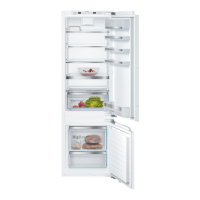
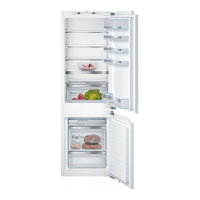
This document describes a Bosch refrigerator, providing comprehensive information on its function, usage, and maintenance.
The refrigerator is designed for chilling and freezing food, as well as making ice cubes, in private households and enclosed domestic environments. It is intended to be fully fitted into a kitchen. The appliance can operate at altitudes up to 2000 meters above sea level. It is suitable for use by children aged 8 and over, and by individuals with reduced physical, sensory, or mental abilities, or lack of experience/knowledge, provided they are supervised or instructed on safe usage and understand potential dangers. Children above three and under eight years old may load and unload the fridge-freezer.
The appliance features a refrigerator compartment and a freezer compartment. The refrigerator compartment is designed for storing meat, sausage, fish, dairy products, eggs, prepared meals, and pastries. Its temperature can be set between 2 °C and 8 °C, with lower temperatures extending food freshness. The air circulation within the refrigerator compartment creates different chill zones: the coldest zone is between the arrow stamped on the side and the shelf underneath, ideal for highly perishable foods like fish, sausages, and meat. The warmest zone is at the very top of the door, suitable for foods that do not spoil easily, such as hard cheese and butter, allowing cheese to release its aroma and butter to remain spreadable. An "OK" sticker (if included) helps verify if the refrigerator compartment maintains temperatures of +4 °C or colder, as recommended for food safety.
The freezer compartment is used for storing frozen food, freezing fresh food, and making ice cubes. Long-term storage of food should be at -18 °C or lower, as these low temperatures slow down or stop spoilage. The temperature in the freezer compartment is influenced by the refrigerator compartment's temperature settings; warmer refrigerator settings lead to warmer freezer temperatures. The appliance also includes a Super function, which intensifies cooling in both compartments. This function should be activated 4 to 6 hours before placing 2 kg or more of food to be frozen, to maximize freezing capacity. When the Super function is active, increased noise may occur. After approximately 50 hours, the appliance automatically reverts to normal operation.
An alarm system is integrated to alert users if the appliance door is left open for an extended period. A warning tone sounds, and an indicator light illuminates. After 10 minutes, the interior lighting will flash.
The appliance is operated via a control panel, which allows users to configure functions and view the operating status. To switch on the appliance, it must first be electrically connected. If previously switched off via the control panel, the power button needs to be pressed and held for three seconds. The appliance then begins to cool, and the desired temperature can be set.
For the refrigerator compartment, the temperature is adjusted by repeatedly pressing the ">" button until the desired setting is displayed. The recommended temperature is 4 °C. The freezer compartment temperature is indirectly set by adjusting the refrigerator compartment temperature.
The Super function is activated by pressing the "super" button, which then illuminates. To switch it off, the "super" button is pressed repeatedly until the temperature display shows the required temperature. The door alarm can be silenced by closing the door or pressing the ">" button.
When storing food in the refrigerator compartment, it is advised to only store fresh and undamaged items, covered or in air-tight packaging. Food should not be placed in direct contact with the back wall to ensure proper air circulation and prevent freezing. Hot food and drinks should be cooled down before being placed in the appliance. Users should also observe best-before or use-by dates. Fruit and vegetable containers are provided for storing fresh produce in their packaging. Chopped items should be covered or stored in air-tight packaging. Some fruits and vegetables sensitive to cold (e.g., pineapple, bananas, citrus fruits, cucumbers, courgettes, peppers, tomatoes, and potatoes) should be stored outside the appliance at temperatures of approximately 8 °C to 12 °C to retain quality and aroma. Door racks are adjustable and can be removed and re-inserted as needed. An egg tray is included for safe egg storage.
For freezing food, only fresh and undamaged items should be frozen, preferably in portions. Cooked food is more suitable for freezing than raw food. Vegetables should be washed, chopped, and blanched before freezing, while fruits should be washed, pitted, and optionally peeled, with sugar or ascorbic acid solution added. Suitable foods for freezing include baked items, fish, seafood, meat, game, poultry, eggs (without shells), cheese, butter, quark, ready meals, and leftovers. Foods unsuitable for freezing include lettuce, radishes, eggs in shells, grapes, raw apples and pears, yoghurt, sour cream, crème fraîche, and mayonnaise. Food should be packed in air-tight packaging, with air squeezed out, and labeled with contents and date of freezing to prevent freezer burn and loss of flavor. Larger quantities of fresh food should be stored at the bottom, close to the back panel, for quicker freezing.
Defrosting frozen food should be done carefully to prevent bacterial growth. Animal-based foods should be defrosted in the refrigerator compartment. Bread can be defrosted at room temperature. Foods for immediate consumption can be prepared in the microwave, oven, or on the hob. Refreezing food that has defrosted or started to defrost is not recommended unless it has been cooked first, and such items should not be stored for the maximum period.
Regular cleaning and servicing are crucial for the appliance's long-term efficiency. Inaccessible points should be cleaned by Customer Service.
The refrigerator compartment defrosts automatically. Condensation droplets or frost may form on the rear panel due to functional reasons, but these run through a condensation channel into a drainage hole and evaporate, so they do not need to be wiped away. The condensation channel and drainage hole should be cleaned regularly (e.g., with a cotton bud) to ensure proper drainage and prevent odors.
The freezer compartment does not defrost automatically and requires regular manual defrosting to prevent excessive ice buildup, which impairs refrigeration and increases power consumption. To defrost the freezer compartment:
For general cleaning, the appliance should be switched off and disconnected from the power supply. All food should be removed and stored in a cool place (with ice packs if available). If there is hoarfrost, it should be allowed to defrost. All fittings and accessories should be removed. The appliance, fittings, accessories, and door seals should be cleaned with a dishcloth, lukewarm water, and a pH-neutral washing-up liquid, then thoroughly dried with a soft cloth. Fittings should then be re-inserted, the appliance reconnected, and food returned. Steam or high-pressure cleaners should not be used, and rinsing water should not drip into lighting or controls. Hard scouring pads, abrasive detergents, or cleaning products with high alcohol content should be avoided, as they can damage surfaces. Fittings and accessories should never be cleaned in a dishwasher.
Shelves can be removed by lifting them at the front and pulling them out. Door racks are removed by lifting them. The front of the fruit and vegetable container can be removed by pressing in the snap-in hooks on the side and turning it.
In case of a power failure, the appliance's temperature will rise, reducing storage time and frozen food quality. Users should open the appliance as little as possible and avoid placing additional food inside. Food quality should be checked immediately after a power failure; defrosted food hotter than 5 °C should be discarded. Slightly thawed food can be cooked or fried and then consumed or refrozen.
The appliance has a self-test function to identify faults. To perform a self-test:
When taking the appliance out of operation for an extended period, it should be switched off, disconnected from the power supply, all food removed, defrosted, cleaned, and the door left open to ensure ventilation and prevent mold formation.
For disposal, valuable raw materials can be recycled. The appliance should be unplugged, the power cord cut, and disposed of in an environmentally friendly manner according to local regulations. Shelves and containers should be left inside to prevent children from climbing in. The tubes of the refrigerant circuit or insulation should not be damaged.
 General
| Category | Refrigerator |
|---|---|
| Energy Efficiency Class | A++ |
| Height | 177.2 cm |
| Noise Level | 36 dB |
| Color | White |
| Freezing Capacity in 24 Hours | 4 kg |
| Climate Class | SN-T |
| Installation Type | Built-in |
| Control Type | Electronic |
| Number of Shelves | 4 |
| Freezer Star Rating | 4 |
| Door Hinge | Reversible |


 To Next Page