
 Need help?
Do you have a question about the Bosch LBB 1920/00 and is the answer not in the manual?
Details input options (XLR, DIN, Cinch), phantom power, and individual channel controls like volume, tone, and speech filter.
Explains blocking, serial, and mixing priority modes for input channels, allowing flexible audio routing and control.
Covers XLR interconnection, insertion/cascade modes, VOX-activated emergency input, and relay outputs.
Describes the DIN microphone level output, tape output, and 24 VDC output for external devices.
Lists front panel features including LED indicators, power button, tone/bass/volume controls, and headphone selection.
Details back panel features like mains switch, interconnection switch, headphone jack, and various input/output connectors.
Provides details on mains power, battery power voltage, and current consumption for the pre-amplifier.
Lists performance metrics such as frequency response, distortion, bass/treble control, and channel separation.
Details specifications for mic/line inputs, connectors, sensitivity, impedance, and signal-to-noise ratios.
Covers dimensions, weight, mounting options, and operating/storage temperature ranges.
The LBB 1920/00 Plena Universal Pre-Amplifier is a versatile and high-performance unit designed for public address systems, offering a comprehensive set of features at a competitive cost. It is equipped with four mono-input channels, each offering flexible connectivity and control options to suit a wide range of audio requirements.
At its core, the LBB 1920/00 serves as a central hub for managing and amplifying audio signals from multiple sources. Each of the four input channels is designed for universal use, accommodating both microphone and line-level signals. Users can select between a balanced 3-pin XLR connector, a balanced 5-pin DIN connector with a priority contact, or a line-level stereo cinch connector (which is internally converted to mono). This flexibility ensures compatibility with various audio equipment, from microphones to media players.
A key feature of the pre-amplifier is its advanced priority management system. Three distinct priority modes are available for the input channels: blocking, serial, and mixing. In blocking mode, the first activated input channel takes precedence, muting all other active channels. Serial mode establishes a hierarchical priority, where channel 1 overrides channels 2, 3, and 4; channel 2 overrides channels 3 and 4; and channel 3 overrides channel 4. For situations requiring simultaneous audio, the mixing mode allows any input channel to be mixed into the master output, irrespective of its priority setting. This granular control over channel interaction is crucial for complex public address scenarios, such as announcements over background music or multi-source presentations.
The pre-amplifier also incorporates a multifunctional interconnection point, which significantly enhances its versatility. This point can be configured for insertion or cascade operation. In insertion mode, an external sound processing device, such as an equalizer, can be seamlessly integrated into the audio chain. Cascade mode allows for the expansion of the system by connecting multiple LBB 1920/00 units, effectively increasing the number of available input channels to 8, 12, or more. This scalability makes the unit suitable for both small and large-scale installations.
Furthermore, the interconnection input can be internally switched to function as an emergency input. When configured this way, it features a signal level detector (VOX) that automatically activates the emergency channel upon detecting an audio signal. This emergency input overrides all other channels, ensuring that critical announcements or alerts are always heard. It also bypasses the master volume control, guaranteeing that emergency messages are delivered at a predetermined level.
For enhanced system integration, the LBB 1920/00 includes priority and emergency relay outputs. The emergency input, when activated by VOX, can trigger an external relay, which can be used to activate other equipment or override local volume controls in different zones. An overload-protected 24 VDC output is also provided, capable of powering external relays without the need for an additional power supply, simplifying installation and reducing costs.
Each input channel on the LBB 1920/00 offers independent control, allowing for precise audio adjustments. Users can individually manage the volume and tone (bass and treble) for each channel. A selectable speech filter is also available per channel, designed to reduce the bass content of speech signals. This feature significantly improves intelligibility, making announcements clearer and easier to understand, especially in acoustically challenging environments.
Microphone inputs are equipped with a phantom power supply, enabling the use of condenser microphones without external power sources. Each channel also features a balanced, direct output on XLR, which bypasses the channel's individual controls. This direct output is useful for sending unprocessed audio signals to other devices or for recording purposes.
The master output channel, or any of the input channels, can be monitored using a headphone connector and an LED meter. This allows operators to precisely check audio levels and quality before broadcasting, ensuring optimal sound delivery.
For additional output flexibility, a microphone-level output is available on the DIN connector, running parallel to the balanced XLR master output. This provides a convenient signal for connecting to a mixing desk or a microphone input channel of a mixer amplifier, such as the Plena LBB 19xx/10. A dedicated tape output is also included for recording purposes.
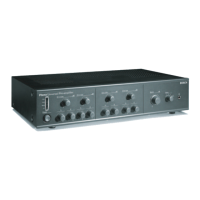
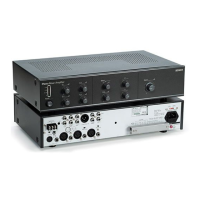
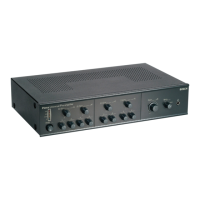
The front panel of the unit provides intuitive controls, including a power button, LED power level bar, and a green LED for power-on indication. Four treble control knobs, four bass control knobs, four channel volume control knobs, a master volume control knob, and a headphone channel selection knob are all easily accessible, allowing for quick and efficient adjustments during operation.
While the LBB 1920/00 is designed for robust and reliable operation, certain features contribute to its ease of maintenance and long-term usability. The inclusion of a mains voltage switch on the back panel allows for safe power management during installation or servicing. The unit's internal design and component selection are geared towards durability, minimizing the need for frequent repairs.
The comprehensive array of input and output connectors, including XLR, DIN, and cinch, ensures broad compatibility and simplifies troubleshooting by providing clear connection points. The direct outputs per channel and the various master outputs offer multiple points for signal testing, aiding in fault diagnosis.
The ability to cascade multiple units not only expands functionality but also offers a modular approach to system design, potentially simplifying maintenance by allowing individual units to be serviced or replaced without disrupting the entire system. The overload-protected 24 VDC output for external relays also contributes to system stability by preventing damage from power surges.
Overall, the LBB 1920/00 Plena Universal Pre-Amplifier is a well-rounded device that combines advanced audio processing capabilities with user-friendly controls and robust connectivity, making it an ideal solution for a wide range of public address applications.
 General
| Line inputs | 2 |
|---|---|
| Microphone inputs | 2 |
| Master volume | Yes |
| Mains switch | Yes |
| Acoustic feedback | Yes |
| Priority relay output | Yes |
| Headphones output | Yes |
| Total Harmonic Distortion | <1% |
| Type | Amplifier |
| Mains voltage | 100-240V AC, 50/60Hz |
| Speaker outputs | 4-16Ω |
| Distortion | <1% @ rated output power |
| S/N (flat / weighted) | >70dB / >75dB |
| Music Connector | Phoenix |
| Tone control | Yes |
| Loudspeaker outputs | 4-16Ω |
| Loudspeaker Connector | Phoenix |
| Priority Connector | Phoenix |
| Signal-to-Noise Ratio | >70dB |
| Output Impedance | 4-16Ω |
| Power Supply | 100-240V AC, 50/60Hz |


 To Next Page