EasyManua.ls Logo

Bosch MCP72GPW/01 - User Manual

Bosch MCP72GPW/01
114 pages
Go to English
Print Icon
To Next Page IconTo Next Page
Loading...
Register your new Bosch now:
www.bosch-home.com/welcome
de Gebrauchsanleitung
en Instruction manual
fr Mode d’emploi
it Istruzioni per l’uso
nl Gebruiksaanwijzing
da Brugsanvisning
no Bruksanvisning
sv Bruksanvisning
fiyttöohje
es Instrucciones de uso
pt Instruções de serviço
el Οδηγίεςχρήσης
tr Kullanımkılavuzu
pl Instrukcjaobsługi
uk Інструкціязексплуатації
ru Инструкцияпоэксплуатации
ar

M C P7..

Table of Contents

Question and Answer IconNeed help?

Do you have a question about the Bosch MCP72GPW/01 and is the answer not in the manual?

Overview

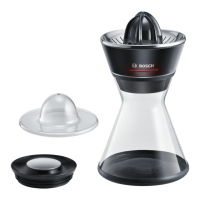
This document describes the Bosch MCP7 citrus press, a household appliance designed for extracting juice from citrus fruits like lemons, oranges, and grapefruits. It is intended for domestic use only, processing normal quantities of food within typical household operating times. The appliance should not be used for processing other substances or objects. It must only be used indoors at room temperature and up to 2000 m above sea level, with approved genuine parts and accessories.

Important Safety Information:

The instruction manual must be read carefully, followed, and kept for future reference. If the appliance is passed on to someone else, these instructions must be included. The manufacturer is not liable for any damage resulting from failure to observe the instructions for correct use. Children aged 8 years and above, and persons with reduced physical, sensory, or mental capabilities or lack of experience and/or knowledge, may use the appliance if supervised or instructed on safe use and if they understand the associated hazards. Children under 8 years of age must be kept away from the appliance and its connecting cable and are not permitted to operate it. Cleaning and user maintenance should not be performed by children unless they are 8 years or older and supervised. Children must not play with the appliance.

Risk of Electric Shock and Fire:

The appliance must be connected to an alternating current power supply via a correctly installed earthed socket. Ensure the protective conductor system of the domestic electrical installation is correctly installed. Connect and operate the appliance only according to the specifications on the rating plate. Do not use the appliance if the power cord or the appliance itself is damaged. Repairs, such as replacing a damaged power cord, must only be carried out by authorized customer service to prevent hazards. Do not place the appliance on or near hot surfaces (e.g., hobs). The power cord must not come into contact with hot parts or be pulled over sharp edges. Never immerse the motor unit in liquids, hold it under running water, or clean it in a dishwasher. Do not use a steam cleaner. Do not use the appliance with damp hands. After each use, when unsupervised, before assembly, disassembly, cleaning, or in case of an error, the appliance must always be disconnected from the mains. Before replacing accessories or additional parts that move during operation, the appliance must be switched off and disconnected from the power supply. Never manually move the pressing cone or drive shaft.

Risk of Suffocation:

Do not allow children to play with packaging material.

Risk of Injury:

The glass carafe is not heat-resistant. Do not pour hot liquids into it.

Important:

The appliance must be thoroughly cleaned after each use or after it has not been used for an extended period.

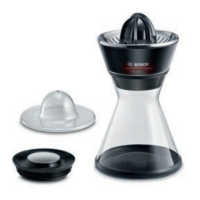
Overview of Components (refer to Figure A):

  1. Motor unit:
    • a. Drive shaft
    • b. Mains cable
    • c. Cable clip
    • d. Operation indicator (model-dependent)
    • e. Button for discharge valve
    • f. Supporting feet
  2. Collecting tray:
    • a. Spout
    • b. Discharge valve
  3. Filter insert
  4. Pressing cone:
    • a. Plastic (model-dependent)
    • b. Metal (model-dependent)
  5. Cover
  6. Glass carafe 1.0 litre:
    • a. Lid
    • b. Saucer
  7. Operating instructions

Before First Use:

Before using the new appliance, it must be fully unpacked, cleaned, and assembled.

  1. Remove the motor unit, glass carafe, and all accessories from the packaging.
  2. Remove all packaging material.
  3. Check all parts for completeness (refer to Figure A/B).
  4. Inspect all parts for visible damage. Never operate a damaged appliance.
  5. Thoroughly clean and dry all parts before first use.

Preparing the Citrus Press and Glass Carafe (refer to Figure C):

  1. Insert the collecting tray into the motor unit. Ensure the discharge valve is not blocked by any foreign object before insertion.
  2. Place the filter insert into the collecting tray and rotate until it clicks into place.
  3. Position the pressing cone on the drive shaft. Never manually move the pressing cone/drive shaft.
  4. Place the glass carafe on the saucer. The saucer provides anti-slip protection and noise reduction.
  5. Place the prepared citrus press onto the glass carafe until the opening is sealed tightly.

Operation with Glass Carafe (refer to Figure D):

For pressing larger quantities of juice (e.g., fresh orange juice). The juice is collected in the glass carafe, which has a capacity of approximately 1.0 litre. Stop pressing before the juice reaches the bottom edge of the motor unit.

  1. Position the prepared citrus press with the glass carafe on a stable, level work surface.
  2. Connect the mains cable to the socket.
  3. Place halved citrus fruits with the cut surface on the pressing cone and press down. The citrus press starts automatically. The pressing cone rotates clockwise or anticlockwise, changing direction when the fruit is released and pressed again. If excessive pressure is applied, the cone changes direction rapidly; reduce pressure until it rotates normally.
  4. Press a maximum of 10 fruits (approx. 2 kg) consecutively. Then pause until the motor unit reaches room temperature before resuming.
    • To obtain optimal juice yield, repeat the pressing procedure several times.
    • Empty the filter insert of coarse pulp and seeds if necessary.
  5. To switch off, reduce pressure on the pressing cone; the appliance switches off automatically.
  6. Disconnect the mains cable from the socket.
  7. Remove the citrus press from the glass carafe. The discharge valve closes automatically.
  8. For storage (e.g., in the refrigerator), seal the glass carafe with its lid.
  9. Remove the lid to pour out the juice.

Operation without Glass Carafe (refer to Figure E):

For pressing smaller quantities of juice (e.g., lemon juice for baking or seasoning fish). The juice is collected in the collecting tray, which has a capacity of approximately 100 ml (equivalent to about 2 medium-sized lemons). Stop pressing before the juice reaches the top edge of the collecting tray.

  1. Position the prepared citrus press on a stable, level work surface.
  2. Connect the mains cable to the socket.
  3. Press citrus fruits as described for use with the glass carafe.
  4. Disconnect the mains cable from the socket.
  5. Use the juice directly via the spout or pour it into a container.

Care and Daily Cleaning (refer to Figure F):

The appliance must be thoroughly cleaned after each use. Risk of Electric Shock: Disconnect the mains cable before cleaning. Never manually move the pressing cone/drive shaft. Never immerse the motor unit in liquid or clean it in a dishwasher. Risk of Injury: The glass carafe is not heat-resistant. Do not pour hot liquids into it. Caution: Do not use cleaning agents containing alcohol or spirits. Do not use sharp, pointed, or metal objects. Do not use abrasive cloths or cleaning agents.

Before cleaning:

  1. Remove the motor unit from the glass carafe.
  2. Remove the pressing cone, filter insert, and collecting tray. Motor unit: Wipe with a soft, damp cloth and dry. Accessories: Clean individual parts with detergent solution and a soft cloth or sponge. The glass carafe, lid, saucer, collecting tray, filter insert, both pressing cones, and the cover can also be cleaned in the dishwasher.

Storage (refer to Figure G):

Always clean the appliance and dry all parts before storage.

  1. Fully assemble the citrus press and place it on the glass carafe.
  2. Replace the cover.

Disposal:

Dispose of packaging in an environmentally friendly manner. The appliance is marked according to European Directive 2012/19/EU concerning used electrical and electronic appliances (WEEE). The directive provides a framework for the return and recycling of used appliances applicable throughout the EU. Consult your specialist retailer for current disposal facilities.

Guarantee:

The guarantee conditions for this appliance are defined by the local representative in the country of purchase. Details can be obtained from the dealer or directly from the local representative. Proof of purchase is required for any guarantee claims. Subject to change.

Simple Troubleshooting:

  • Problem: Juice runs out of the citrus press when used without the glass carafe.
    • Cause: Discharge valve blocked by a foreign object.
    • Remedy: Stop pressing. Remove pressing cone, filter insert, and collecting tray from motor unit. Remove foreign objects from the discharge valve. Reassemble and resume.
    • Cause: Filter insert is full.
    • Remedy: Stop pressing. Remove pressing cone and filter insert from motor unit and clean. Reassemble and resume.
  • Problem: Glass carafe overflows during pressing.
    • Cause: Too many fruits pressed.
    • Remedy: Stop pressing. Clean and dry all parts. Reassemble and place on empty glass carafe. Resume pressing.
  • Problem: Pressing cone changes rotation direction rapidly.
    • Cause: Pressure on the pressing cone is too high.
    • Remedy: Reduce pressure until the pressing cone rotates normally.

If problems cannot be resolved, contact the hotline. Telephone numbers are provided on the last pages of the instructions.
Bosch MCP72GPW/01 Specifications

General IconGeneral
BrandBosch
ModelMCP72GPW/01
CategoryJuicer
LanguageEnglish

Related product manuals