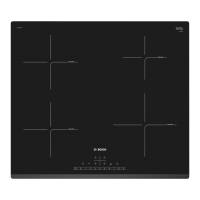
Need help?
Do you have a question about the Bosch PIV975DC1E and is the answer not in the manual?
Read the manual carefully, keep instructions, appliance and product info safe, do not connect damaged appliance.
Appliance for preparing meals/drinks, under supervision, in domestic environment, up to 4000m altitude.
May be used by children aged 8+ or people with reduced abilities if supervised and instructed.
Covers fire, burn, and injury risks. Highlights safe operation and precautions, including handling hot surfaces and metal objects.
Details common causes of appliance damage and provides tips on how to avoid them, covering stains, scratches, and overheating.
Instructions for environmentally friendly disposal of packaging materials.
Tips for reducing energy consumption during cooking, such as selecting correct cookware and using lids.
Details materials and characteristics of suitable cookware for induction hobs, including ferromagnetic properties.
Ensuring correct cookware size and flat bases for optimal detection and performance on the hob.
Explains the benefits and changes associated with induction technology compared to conventional hobs.
Details the symbols and functions of the touch buttons on the control panel.
Shows the layout of cooking zones and their corresponding power levels and dimensions.
Describes single-circuit and tri-circuit cooking zones and how they activate with cookware.
Explains the meaning of the 'H' and 'h' indicators for hot and warm cooking zones.
Instructions for cleaning the hob surface before first use, recommending a damp cloth and specific cleaning agents.
Overview of induction technology benefits including time and energy savings, and improved heat control.
Guidance on selecting suitable cookware for induction hobs, directing users to website for more information.
Procedure for turning the hob on and off, including the ReStart function.
How to select and adjust power levels for cooking zones, including QuickStart function.
Advice on various cooking techniques, energy efficiency, and a table of recommended power levels and times.
Allows programming a cooking time after which the zone automatically switches off.
A separate timer function (0-99 minutes) that does not automatically switch off cooking zones.
A stopwatch function that displays elapsed time since activation.
Temporarily heats up large volumes of water faster than standard power levels.
Heats up pans more quickly than standard settings, available for all cooking zones.
How to switch the keep-warm function on and off for melting chocolate or keeping meals warm.
Automatically maintains constant temperature for precise cooking without manual adjustments.
Provides ideal temperature levels and functions for preparing various dishes.
Specifies recommended cookware for the PerfectFry Sensor function and where to purchase it.
Step-by-step guide to switching the PerfectFry Sensor on and off.
Table showing ideal temperature levels and times for various dishes when using the PerfectFry Sensor.
How to switch the childproof lock on, off, and activate automatic locking.
Locks the control panel for cleaning to prevent accidental setting changes.
Automatically switches off a cooking zone if operated continuously for an extended period.
Details configurable basic settings for the appliance, such as childproof lock and signal tones.
Steps to access basic settings, change values, and save configurations.
How to cancel and not save any modifications made to the basic settings.
Instructions on how to conduct a cookware test to check suitability for the cooking zone.
Step-by-step guide to test cookware with water, interpret results for heating efficiency.
Information on suitable and unsuitable cleaning agents and products for the appliance.
Procedure for cleaning the hob surface after use, including using a glass scraper.
Instructions for cleaning the frame or surround of the hob.
Important warnings and notes related to fault codes and troubleshooting.
Details faults, causes, and troubleshooting steps based on display panel error codes.
Explanation of normal noises and vibrations that may occur during appliance operation.
Guidelines for environmentally friendly disposal of the old appliance.
Information on obtaining spare parts and contacting customer service.
How to find and note the E-Nr. and FD numbers for service inquiries.
Recipe and recommended settings for melting chocolate.
Recipes and settings for heating and keeping lentil stew warm.
Recipe and recommended settings for preparing Béchamel sauce.
Recipes and settings for cooking rice pudding with and without a lid.
Recipe and recommended settings for cooking rice.
Recipe and recommended settings for roasting pork loin.
Recipe and recommended settings for preparing crêpes.
Recipe and recommended settings for deep-fat frying frozen chips.
This document describes an induction hob, providing comprehensive information on its functions, usage, and maintenance.
The induction hob utilizes induction technology for cooking, offering benefits such as time and energy savings, improved heat control, and easier cleaning compared to conventional hobs. Heat is generated directly in the cookware, making the cooking process more efficient.
The appliance is designed for preparing meals and drinks in private households and enclosed domestic spaces, under supervision. It should not be used with external timers or separate remote controls unless specifically designed for such operation (EN 50615 compliant). Users with active implantable medical devices should consult their doctor regarding compliance with relevant directives and safety standards. Children aged 8 and over, and individuals with reduced physical, sensory, or mental abilities, may use the appliance if supervised and instructed on safe use. Children under 8 should be kept away from the appliance and its power cable. Cleaning and user maintenance by children should only be performed if they are at least 15 years old and supervised.
To prevent damage, users should monitor cooking processes, especially when using oil or fat, to avoid fires. In case of a grease fire, the appliance should be switched off and the fire covered with a lid or fire blanket, never water. Flammable objects should not be placed on or near the cooking surface. Combustible items or aerosol cans should not be stored in drawers directly beneath the hob. Hob covers and protective grilles are not recommended as they can cause accidents. The hob should be switched off after every use using the main switch, rather than waiting for automatic switch-off.
The appliance and its parts, particularly the hob surround, can become hot during use, posing a burn risk. Caution is advised to avoid touching heating elements, and young children should be kept away. Metal objects should not be placed on the hob as they can become very hot. Improper repairs are dangerous and should only be carried out by trained specialist staff using genuine spare parts. A damaged power cord or cracked surface requires immediate disconnection from the fuse box to prevent electric shock. Steam or high-pressure cleaners should not be used for cleaning. Electrical appliance cables should not come into contact with hot parts of the appliance. Long, pointed metallic objects should not be stored in drawers below the hob to prevent electric shock from contact with the fan.
Saucepans may jump due to liquid between the base and hotplate, so hotplates and saucepan bases should be kept dry. Icy-cold cookware from the freezer should not be used. When cooking in a bain marie, the cooking container should not directly touch the bottom of the water-filled pot, and only heat-resistant cookware should be used. Packaging material should be kept away from children to prevent suffocation. Small parts should also be kept away from children to avoid choking hazards.
Packaging materials are environmentally compatible and recyclable. Users should sort individual components by type for separate disposal. To save energy, select a cooking zone that matches the size of the pan, centering the cookware on the hob. Cookware with a base diameter equal to the hotplate's diameter is ideal. Unsuitable cookware or incompletely covered cooking zones consume more energy. Covering saucepans with suitable lids significantly reduces energy consumption. Lids should be lifted as infrequently as possible, and glass lids are recommended to allow visibility into the pan without lifting. Pots and pans with flat bases are more energy-efficient. Use cookware appropriate for the quantity of food, as large items with little food require more energy. Cook with minimal water, and turn down the power level early to avoid wasting energy.
Cookware suitable for induction cooking must have a ferromagnetic base that is attracted by a magnet and matches the cooking zone size. If cookware is not detected, try a smaller cooking zone. All cookware bases should be perfectly flat and smooth. A "Cookware test" function is available to check suitability. Recommended cookware includes stainless steel in a sandwich design, enamelled steel, cast iron, or special induction cookware made of stainless steel. Cookware with partially ferromagnetic bases or aluminium content may not heat evenly or sufficiently. Cookware made from thin steel, glass, clay, copper, or aluminium is not suitable. Adapter plates between the hob and cookware should not be used. Empty cookware or thin-based cookware should not be heated, as it can become very hot.
The control panel features touch buttons for various functions. The main switch (①) turns the hob on/off. Other symbols include wipe protection ( ), childproof lock (8), settings range (0123...), PowerBoost/PanBoost (boost), Timer (ن), Switch-off timer ( ), Count-up timer ( ), Keep-warm function (75555), PerfectFry Sensor (เ), and Select a cooking zone (+). Displays for cooking zones and activated functions light up depending on the hob's status. The control panel should be kept clean and dry, and cookware should not be placed near displays or sensors to prevent overheating.
The manual provides a diagram of cooking zones (A, B, C, D) with their diameters and highest power levels, including PowerBoost values. For example, a Ø 18 cm zone (A) has a power level 9 of 1,800 W and a PowerBoost of 3,100 W. Some zones are single-circuit, while others are tri-circuit, automatically adjusting to cookware size.
Each cooking zone has a residual heat indicator. 'H' indicates the zone is hot, and 'h' indicates it is warm. Users should not touch a cooking zone if its residual heat indicator is lit.
Before initial use, remove any leftover packaging and wipe the surface with a damp cloth. Recommended detergents can be found on the official website.
To switch on the hob, touch the main switch (①). An audible signal sounds, symbols for cooking zones and functions light up, and "0.0" appears next to cooking zones. The hob is then ready for use. The ReStart function allows the hob to operate with previously set settings if switched on within four seconds of being switched off. To switch off, touch the main switch (①) until displays go out. If all cooking zones are off for more than 20 seconds, the hob automatically switches off.
Cooking zones have 17 power levels (1 to 9 with intermediate values). To set a power level, touch the symbol for the desired cooking zone, then select the power level in the settings area. If no cookware is present or suitable, the selected power level flashes, and the cooking zone switches off after a period. The QuickStart function automatically detects cookware placed on the hob before it's switched on, selecting the corresponding cooking zone. Users then select the power level within 20 seconds, or the hob switches off.
Stir puree, cream soups, or thick sauces occasionally. Preheat at power level 8-9. When cooking with a lid, reduce power once steam escapes. Keep a lid on cookware after cooking until serving. Follow manufacturer instructions for pressure cookers. Avoid overcooking to preserve nutrients; use the kitchen timer for optimal cooking times. Ensure oil does not smoke. Brown food in small portions. Use oven gloves if cookware reaches high temperatures. Energy-efficient cooking recommendations are provided in the "Saving energy" section. A table provides recommended power levels and cooking times for various foods, noting that times may vary based on food type, weight, thickness, and quality.
The hob offers a Switch-off timer, Timer, and Count-up timer.
This function heats large volumes of water more quickly than power level 9. It is available for all cooking zones, provided no other cooking zone in the same group is in use. To switch on, select a cooking zone, touch "boost", and the "b." display lights up. To switch off, select the cooking zone, touch "boost", and the "b." display goes out, returning to power level 9. The function may automatically switch off to protect electronic elements.
This function heats pans more quickly than power level 9. It is available for all cooking zones, provided no other cooking zone in the same group is in use. Only cold pans with a completely flat, thin base should be used. Do not place a lid on the pan and never leave pans unattended during heating. To switch on, select a cooking zone, touch "boost" twice, and "Pb." lights up. To switch off, select the cooking zone, touch "boost", and "Pb." goes out, returning to power level 9. This function automatically switches off after 30 seconds to prevent high temperatures.
This function melts chocolate or butter and keeps meals warm. To switch on, select a cooking zone, touch "75555" within 10 seconds, and "Lo" lights up. To switch off, select the cooking zone, touch "75555", and "Lo" goes out.
The PerfectFry Sensor is suitable for cooking sauces, pancakes, frying eggs, vegetables, or steaks, maintaining a controlled temperature. Instead of manually adjusting power levels, users select a target temperature, and sensors measure and maintain the cookware temperature. This function is available on cooking zones marked with the "เ" symbol. Advantages: The temperature is automatically kept constant, oil does not overheat (preventing burning), and the cooking zone only heats as necessary, saving energy. Temperature Levels: Five temperature levels (120 °C to 215 °C) are provided for various cooking tasks, from boiling sauces to high-temperature grilling. Recommended Cookware: Special cookware designed for this function is available from customer service or retailers. Other cookware can be used, but achieved temperatures may vary. Switching on: Place empty cookware on the zone, select the zone and touch "เ". Within 10 seconds, select the temperature setting. The function starts, "เ" flashes until the target temperature is reached, then a signal tone sounds and "เ" stops flashing. Add frying fat and food. If cooking with more than 250 ml oil, add oil and wait a few seconds before adding food. Switching off: Select the cooking zone and touch "เ". The function is deactivated. Recommendations for Cooking: A table provides ideal temperature levels and cooking times for various dishes (meat, fish, egg dishes, vegetables, frozen products, sauces), noting that times depend on amount, condition, and quality of food.
The hob has a childproof lock to prevent accidental switching on. Switching on: With the hob off, touch the main switch (①), then touch and hold "8" for 4 seconds. The "8" display lights up for 10 seconds, and the hob is locked. Switching off: With the hob off, touch the main switch (①), then touch and hold "8" for 4 seconds. The lock is released. Automatic Childproof Lock: This can be activated in the "Basic settings" to automatically lock the hob every time it's switched off.
This function locks the control panel for cleaning, preventing inadvertent adjustments. It does not affect the main switch. To switch on, press " ". A warning tone sounds, " " lights up, and the control panel remains locked for 35 seconds. A signal tone sounds 5 seconds before the appliance switches off. To switch off early, touch " ". The control panel is unlocked.
If a cooking zone operates continuously for an extended period without settings changes, the safety function activates, displaying "F8" and switching off the zone. The time (1 to 10 hours) depends on the selected power level. Press any button to switch on the cooking zone.
Users can configure basic settings to meet their needs. Overview: Settings include Childproof lock (Manual, Automatic, Switched off), Signal tones (Confirmation and fault signals off, fault signal only, confirmation signal only, all signals on), Energy consumption display (Switched off, Switched on), Automatic switch-off of cooking zones (Switched off, 1-99 minutes), Duration of timer end signal tone (1-10 seconds, 30 seconds, 1 minute), Power limitation (Switched off, 1000W-4500W, Maximum power), Cookware test (Not suitable, Not optimal, Suitable), and Restoring factory settings (Individual settings, Factory settings). Accessing Basic Settings: With the hob off, touch the main switch (①), then press and hold " " for 4 seconds within 10 seconds. Touch " " to access settings, then touch " " repeatedly to navigate. Select the desired setting in the settings area, then touch and hold " " for 4 seconds to save. Discarding Changes: Touch the main switch (①) to discard all changes.
This function tests cookware quality, which influences cooking speed and results. Before testing, ensure cookware base size matches the cooking zone. To perform the test:
Regular cleaning and maintenance ensure efficient operation. Cleaning Products: Suitable cleaning products and glass scrapers can be obtained from customer service, retailers, or the official website. ATTENTION! Unsuitable cleaning products can damage surfaces. Never use unsuitable products or clean the hob while it is hot, as this can cause marks. Unsuitable products include undiluted detergent, dishwasher detergent, abrasive cleaning products, aggressive cleaning products (oven spray, stain remover), abrasive sponges, and high-pressure or steam jet cleaners. Cleaning the Hob: Clean the hob after every use to prevent burnt-on residues. The hob must be cold, but do not let it cool down if it has sugar stains, rice starch, plastic, or aluminum foil. Remove heavy soiling with a glass scraper, then clean with a glass ceramic cleaning agent, following its instructions. Special sponges for glass ceramic are recommended. Keeping cookware bases clean helps maintain the hob surface. Cleaning the Hob Surround: If the hob frame is dirty, clean it with hot soapy water and a soft cloth. Do not use a glass scraper. Dry with a soft cloth.
Minor faults can often be rectified by the user. Warnings: If "E" appears, press and hold the sensor for the respective cooking zone to read the fault code. If a fault code is not listed, disconnect the hob from power, wait 30 seconds, and reconnect. If the display reappears, contact technical after-sales service. If an error occurs, the appliance does not switch to standby mode. The hob may temporarily reduce power to protect electronic parts from overheating or surge currents.
Old Appliance Disposal: Valuable raw materials can be recycled. Unplug the appliance, cut the power cord, and dispose of it environmentally friendly. Information on disposal methods is available from specialist dealers or local authorities. The appliance is labeled according to European Directive 2012/19/EU (WEEE) for the return and recycling of used appliances.
Function-relevant genuine spare parts are available from Customer Service for at least 10 years from the market placement date. Warranty information is available from after-sales service, retailers, or the website. When contacting Customer Service, provide the product number (E-Nr.) and production number (FD) from the appliance's rating plate (found on the certificate or lower section of the hob, or via basic settings).
Recommended settings for test institutes using specific cookware sets.
 General
| Hob type | Zone induction hob |
|---|---|
| Product color | Black |
| Hob width size | 90 cm |
| Top surface type | Glass-ceramic |
| Appliance placement | Built-in |
| Cooking zone 1 type | Regular |
| Cooking zone 3 type | Extra large |
| Cooking zone 4 type | Simmer |
| Cooking zone 5 type | Large |
| Cooking zone 1 boost | 3100 W |
| Cooking zone 1 power | 1800 W |
| Cooking zone 1 shape | Round |
| Cooking zone 3 boost | 3700 \\ 4400 \\ 5500 W |
| Cooking zone 3 power | 2200 \\ 2600 \\ 3300 W |
| Cooking zone 4 boost | 2200 W |
| Cooking zone 4 power | 1400 W |
| Cooking zone 5 boost | 3700 W |
| Cooking zone 1 diameter | 180 mm |
| Cooking zone 1 position | Left rear |
| Cooking zone 2 position | Left front |
| Cooking zone 3 diameter | 210 \\ 260 \\ 320 mm |
| Cooking zone 3 position | Central rear |
| Cooking zone 4 diameter | 145 mm |
| Cooking zone 4 position | Right rear |
| Cooking zone 5 diameter | 210 mm |
| Cooking zone 5 position | Right front |
| Number of cooking zones | 5 zone(s) |
| Cooking zone 1 power source | Electric |
| Control type | Touch |
| Built-in display | Yes |
| Control position | Front |
| Number of power levels | 17 |
| Connected load (electric) | 10800 W |
 Weight and Dimensions
| Cord length | 1.1 m |
|---|---|
| Installation compartment width | 560 mm |
| Installation compartment height | 55 mm |
| Installation compartment depth (max) | 500 mm |
| Installation compartment depth (min) | 490 mm |


 To Next Page