Need help?
Do you have a question about the Bosch PSB 650 RE and is the answer not in the manual?
Read all safety warnings and instructions to prevent electric shock, fire, or injury.
Match plugs to outlets, avoid earthed surfaces, protect from rain/wet.
Stay alert, use PPE, prevent unintentional starting, proper dress.
Wear ear protection for impact drilling, use auxiliary handle, hold tool correctly.
Instructions for removing and mounting chucks on specific models.
Detailed steps for replacing drill chucks on specific models.
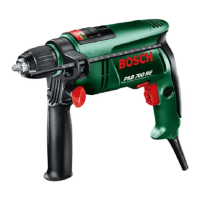
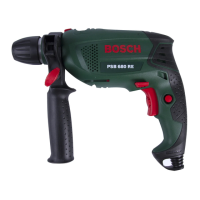
This document describes the Bosch PSB series impact drills, including models PSB 650 RE, PSB 6500 RE, PSB 650 RA, PSB 750 RCE, and PSB 750 RCA. These power tools are designed for impact drilling in brick, concrete, and stone, as well as for drilling in wood, metal, and plastic. Models with electronic control and right/left rotation are also suitable for screwdriving and thread-cutting.
The impact drill is equipped with a keyless chuck for quick and easy tool changes. For models PSB 750 RCE and PSB 750 RCA, the drill spindle is automatically locked when the On/Off switch is not pressed, facilitating tool insertion and removal. For models PSB 650 RE, PSB 6500 RE, and PSB 650 RA, the spindle lock button must be pressed to lock the drill spindle for tool changes.
The machine features a "Drilling/Impact Drilling" selector switch, allowing the user to choose between drilling and impact drilling modes. For screwdriving operations, the selector switch should be set to the "Drilling" symbol.
A rotational direction switch is provided to reverse the rotation of the machine, which is useful for loosening screws or nuts. This switch cannot be actuated while the On/Off switch is pressed.
The On/Off switch controls the machine's operation. Pressing and holding it starts the machine. A lock-on button allows continuous operation without holding the On/Off switch. To switch off the machine, the On/Off switch is released, or if locked, briefly pressed and then released.
Speed and impact frequency can be variably adjusted depending on how far the On/Off switch is pressed. Additionally, a thumbwheel for speed preselection (models PSB 750 RCE/PSB 750 RCA) or a thumbwheel for electronic speed preselection (models PSB 650 RE/PSB 6500 RE/PSB 650 RA) allows the user to preselect the required speed/impact frequency, even during operation. This preselection depends on the material and working conditions and can be determined through practical testing.
An auxiliary handle is included to ensure a secure and low-fatigue working posture. It can be adjusted to any desired position by loosening and tightening a wing bolt.
For precise drilling, a depth stop can be adjusted to set the required drilling depth. The depth stop is inserted into the auxiliary handle, and its knurled surface must face downward. The distance between the drill bit tip and the depth stop tip corresponds to the desired drilling depth.
Certain models (PSB 650 RA/PSB 750 RCA) are equipped with an extraction device with a dust collector for dust and chip extraction. This device helps reduce dust-related hazards, especially when working with materials like concrete, brick, stone, wood, metal, and plastic. The dust collector has a level indicator to show when it needs to be emptied.
When operating the impact drill, it is crucial to observe all safety warnings and instructions to prevent electric shock, fire, or serious injury. The work area should be kept clean and well-lit, and children and bystanders should be kept away. Power tools should not be operated in explosive atmospheres.
Electrical safety is paramount. Power tool plugs must match the outlet, and adapter plugs should not be used with earthed power tools. Body contact with earthed surfaces should be avoided. Power tools should not be exposed to rain or wet conditions, and the cord should not be abused. When operating outdoors, an extension cord suitable for outdoor use should be used. In damp locations, a residual current device (RCD) protected supply is recommended.
Personal safety measures include staying alert, wearing eye protection, and using other personal protective equipment like dust masks, non-skid safety shoes, hard hats, or hearing protection. Unintentional starting should be prevented by ensuring the switch is in the off-position before connecting to power or carrying the tool. Adjusting keys or wrenches should be removed before turning the power tool on. Users should maintain proper footing and balance and dress properly, avoiding loose clothing or jewelry.
For impact drilling, ear protectors should be worn due to noise exposure. The auxiliary handle must always be used. When performing operations where the cutting accessory may contact hidden wiring or the tool's own cord, the power tool should be held by insulated gripping surfaces to prevent electric shock. Appropriate detectors should be used to locate utility lines.
The power tool should be switched off immediately if the tool insert jams, as this can cause high reaction torque and kickback. The machine should always be held firmly with both hands for secure guidance. Workpieces should be secured with clamping devices or a vice. The workplace should be kept clean, especially when working with light alloys, as dust from these materials can burn or explode. The machine should be allowed to come to a complete stop before being placed down.
For models with dust extraction, the device should be used whenever possible, and good ventilation should be provided. A P2 filter-class respirator is recommended. The dust/chip extraction should only be used when working with concrete, brick, and brickwork, as wood or plastic chips can cause clogging. Metallic materials should not be worked with the extraction device mounted due to fire hazard from hot metal chips.
To optimize dust extraction, ensure the device faces flush against the workpiece or wall. Always work with maximum speed when using the extraction device. After reaching the desired drilling depth, pull the drill bit out before switching off the impact drill. The extraction device must always have the filter element mounted to prevent dust/chips from entering the power tool. The filter element and dust protection ring should be checked regularly and replaced if damaged or worn.
When working with screwdriver bits, a universal bit holder should always be used, and only screwdriver bits that fit the screw head should be selected.
After prolonged periods of working at low speed, the machine should be allowed to cool down by running it for approximately 3 minutes at maximum speed with no load. The power tool should only be applied to the screw/nut when it is switched off to prevent the tool insert from slipping off.
Before performing any maintenance or cleaning work on the machine, the mains plug must be pulled. For safe and proper working, the machine and its ventilation slots should always be kept clean.
If the machine malfunctions despite careful manufacturing and testing, repairs should be carried out by an authorized Bosch power tool after-sales service center. When ordering spare parts or corresponding with service centers, the 10-digit article number from the machine's type plate should always be provided.
The dust collector on models with extraction devices should be emptied when the extraction force diminishes or the level indicator is full. To do this, press the release button and remove the dust collector. The dust collector should be cleaned, and the filter element should be cleaned by gently striking or tapping it. The filter element should be checked for damage and replaced as required. When reassembling the filter element, ensure the rubber gasket is correctly inserted.
The drill chuck can be replaced if necessary. For keyless chucks, the short end of an Allen key is clamped into the chuck, and the chuck is loosened or tightened by turning the Allen key. For models with a spindle lock button, the button must be pressed while loosening or tightening the chuck. The drill chuck must be tightened with a specific torque of approximately 25-35 Nm.
Regular maintenance of power tools is essential. Users should check for misalignment or binding of moving parts, breakage of parts, and any other conditions that might affect the tool's operation. Damaged power tools should be repaired before use. Cutting tools should be kept sharp and clean to prevent binding and ensure easier control.
The vibration emission level and noise levels are measured according to EN 60745 standards. This information can be used to compare tools and assess exposure. Additional safety measures to protect the operator from vibration effects include maintaining the tool and accessories, keeping hands warm, and organizing work patterns.
The machine, accessories, and packaging should be sorted for environmental-friendly recycling. In EC countries, power tools that are no longer usable must be collected separately and disposed of in an environmentally correct manner, not with household waste, in accordance with European Guideline 2002/96/EC for Waste Electrical and Electronic Equipment.
 General
| Soft grip | Yes |
|---|---|
| Input power | 650 W |
| Output power | 338 W |
| Power source | AC |
| AC input voltage | 230 V |
| AC input frequency | 50 Hz |
| Torque (max) | 9 N⋅m |
| Idle speed (max) | 50 RPM |
| Impact rate (high speed) | 48000 bpm |
| Drilling diameter in wood (max) | 30 mm |
| Drilling diameter in steel (max) | 12 mm |
| Drilling diameter in concrete (max) | 16 mm |
 Weight and Dimensions
| Weight | 1700 g |
|---|

 To Next Page