Need help?
Do you have a question about the Bosch SMS68M02AU and is the answer not in the manual?
Prevent children from playing with or operating the appliance. Keep them away from detergents.
Description of the childproof lock is found in the envelope.
Secures appliance against unintentional cancellation. Activated/deactivated via button B.
Remove food remnants, place utensils securely, openings down, allow drainage, do not obstruct spray arms.
Upper basket height adjustable in 3 stages. Includes height details for appliance heights 81.5 cm and 86.5 cm.
Pour detergent into dispenser. Close cover until lock engages. Dosage based on manufacturer's instructions.
Steps to turn on the appliance: turn on tap, close door, switch on, select programme, press start.
Filters keep foreign objects from pump. Clean after each cycle. System: coarse, fine, microfilter.
Check nozzles for blockages. Unscrew upper/lower arms. Clean under running water.
Food remnants can block pump. Disconnect power, remove filters, scoop water, remove pump cover.
Covers issues like appliance not starting due to fuse, plug, or door not shut.
Addresses issues like sluggish spray arm, difficult door opening (child lock), door not closing, dispenser cover issues.
Issues with changing settings after programme starts, or programme not finishing.
Indicates tap off, supply interrupted, hose kinked, or filter blocked.
Caused by blocked/kinked waste water hose, blocked pump, or programme not ended.
Covers unusual foam, appliance stops, knocking/rattling, striking noises.
Covers food residue, tea/lipstick residue, dull/discoloured glasses, plastic parts discoloured, rust spots, utensils not dry.
Connect according to instructions. Disconnect power prior to installation. Ensure correct electrical connection.
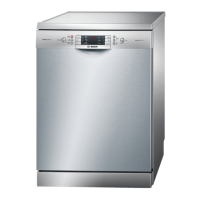
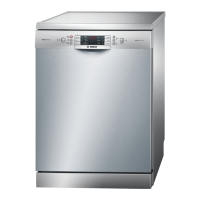
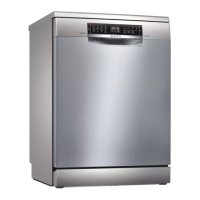
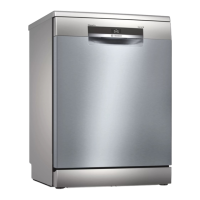
This document describes a Bosch dishwasher, detailing its functions, usage, and maintenance.
The dishwasher is designed for domestic use, specifically for washing household dishes. It incorporates an AquaSensor, an optical measuring device that assesses the turbidity of the rinsing water. If the water is clean, it can be reused for the next rinse bath, reducing water consumption by 3–6 liters. If the water is too turbid, it is drained and replaced with fresh water. In automatic programs, the AquaSensor also adjusts the temperature and running time based on the degree of soiling.
The appliance features a water damage protection system, which functions only when the power supply is connected. This system helps prevent leaks and water-related damage.
For optimal cleaning and drying, the dishwasher automatically adjusts the rinse program when combined detergent products are used.
Control Panel and Display: The control panel includes an ON/OFF switch, program buttons, a door opener, timer programming, additional options, a START button, a "Check water supply" display, a rinse-aid refill indicator, and a digital display. The digital display shows the remaining running time, error codes (E:01 to E:30), and settings.
Program Selection: Users can select a suitable program based on the type of utensils and degree of soiling. The manual provides an overview of programs, including Pots and Pans 70°, Intensive 65°, Auto 45°–65°, Normal 45°, Quick 45°, and Prerinse. Each program has specific duration, energy consumption, and water consumption data.
Additional Options: Several additional options can be selected:
Loading the Dishwasher: Before loading, large food remnants should be removed, but pre-rinsing under running water is not necessary. Utensils should be placed securely, with openings facing down, and at an angle to allow water to drain. Care should be taken not to obstruct the rotation of the spray arms. Very small utensils should not be washed in the machine to prevent them from falling out of the baskets.
Unloading the Dishwasher: To prevent water from dripping onto lower basket items, it is recommended to unload the appliance from the bottom up.
Basket Adjustment: The height of the upper utensil basket can be adjusted in three stages to create more space in either the upper or lower basket. This feature accommodates different sizes of dishes and cookware.
Cutlery Drawer: Cutlery should be arranged in the cutlery drawer as illustrated for easier removal after washing. The drawer can be taken out for convenience.
Folding Spikes: Some models feature folding spikes in the baskets, which can be folded down to improve the arrangement of pans, bowls, and glasses.
Detergent and Rinse Aid: Commercially available liquid or powder detergents, or tablets (TABS), can be used. If phosphate-free detergents are used with hard tap water, white deposits may occur, which can be remedied by adding more detergent. The graduated detergent dispenser helps in adding the correct amount of powder or liquid detergent.
Rinse aid is essential for stain-free utensils and clear glasses. The rinse-aid refill indicator lights up when a refill is needed. The amount of rinse aid dispensed can be adjusted from r:00 (off) to r:06. If streaks or water stains appear, the setting should be adjusted.
Childproof Lock: The appliance can be secured with a childproof lock (button lock) to prevent unintentional program cancellation or operation by children. This lock is activated by holding down the 'B' button for approximately 4 seconds until 'CL' appears on the digital display. It is deactivated by holding the 'B' button again until 'CL' disappears. The childproof lock (door lock) is also described, which prevents the door from being opened by children.
Timer Programming: The start of a program can be delayed in 1-hour steps up to 24 hours. This is set using the timer programming button and the digital display.
Interrupting and Terminating Programs: A running program can be interrupted by switching off the appliance. The program is saved and can be resumed by switching it back on. To terminate a program (reset), the START button should be pressed for approximately 3 seconds.
Overall Condition: Regular inspection and maintenance help prevent faults. Users should check spray arms for grease and limescale deposits. If deposits are found, the appliance should be run with detergent in the highest rinsing temperature program without utensils. The appliance should be cleaned with suitable detergents/appliance cleaners. The door seal should be regularly cleaned with a damp cloth. The front of the appliance and fascia should be wiped with a damp cloth and a little washing-up liquid. Steam cleaners should not be used.
Filters: The filters keep large foreign objects out of the pump. They should be checked for residue after each washing cycle. The filter system consists of a coarse filter, a flat fine filter, and a microfilter. The filter cylinder can be unscrewed, and the system removed for cleaning under running water. It should be re-installed in reverse sequence, ensuring arrow marks align.
Spray Arms: Limescale and contaminants can block nozzles and bearings on the spray arms. Users should check for blockages and clean the spray arms under running water. The upper and lower spray arms can be unscrewed and removed for cleaning.
Waste Water Pump: Large food remnants not retained by the filters can block the waste water pump, preventing water from being pumped out. If this occurs, the appliance should be disconnected from the power supply, filters removed, and any water scooped out. The pump cover can then be prised off, and any foreign objects removed from the inner compartment. The cover should be replaced and pressed down to engage.
Protection Against Frost: If the appliance is in a room with a risk of frost (e.g., a holiday home), it should be completely emptied. This involves turning off the tap, disconnecting the supply hose, and draining water.
Troubleshooting: The manual provides a troubleshooting guide for common faults, such as the appliance not starting, lower spray arm rotating sluggishly, door issues, inability to change settings, unusual foam formation, knocking/rattling noises, filling valves making striking noises, food residue on utensils, tea or lipstick residue, and dull/discolored glasses. It advises users to disconnect the appliance from power and turn off the tap if an error code is displayed. For complex issues, customer service should be contacted.
Waste Disposal: Both packaging and old appliances contain valuable recyclable materials. Individual parts should be disposed of separately according to type. Plastic parts are identified with international abbreviations (e.g., >PS< polystyrene) for sorting. Old appliances should be disposed of according to European guideline 2002/96/EC (WEEE) for electrical and electronic equipment.
 General
| Type | Freestanding |
|---|---|
| Capacity | 13 place settings |
| Noise Level | 44 dB |
| Dimensions (H x W x D) | 845 x 600 x 600 mm |
| Programs | 6 |
| Size | Full Size |
| Colour | Stainless Steel |
| Water Consumption | 9.5 litres per cycle |
| Features | AquaSensor |


 To Next Page