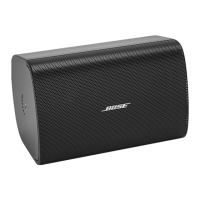
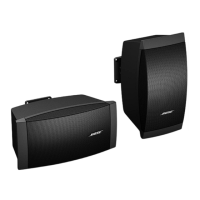
The Bose FreeSpace® Model 32SE Surface-Mount Environmental Loudspeaker is a robust audio device designed for both indoor and outdoor applications, particularly in environments requiring compliance with fire and evacuation system standards. It is an environmental version of the Pro Model 25 surface mount loudspeaker, meeting European requirements for loudspeakers in dry, damp, and wet environments, as well as UL1480 requirements for fire and evacuation/voice warning systems in wet conditions.
Function Description:
The primary function of the Model 32SE loudspeaker is to provide high-quality sound reproduction in various environments, including those with challenging weather conditions. It is available in three variations: 70V/32W, 100V/32W, and 4 Ohms passive, offering flexibility for different audio system configurations. The loudspeaker utilizes a single 4.5-inch environmental driver per enclosure, ensuring consistent sound delivery. Its design incorporates a metal grille, similar to the Model 25, for protection and aesthetic integration. For the 70V and 100V variations, a Model 32 transformer is internally mounted, with access covered by an aluminum plate and gasket to ensure terminal safety and water sealing.
Important Technical Specifications:
- External Dimensions (Single Speaker): 9.12" x 6" x 5.6" (23 cm x 15 cm x 14 cm)
- External Dimensions (Packed System): 7.3" x 14.2" x 10.3" (18.5 cm x 36.1 cm x 26.2 cm)
- Weight (Single Speaker): 5.0 lb (2.3 kg)
- Weight (Packed System): 11.0 lb (5 kg)
- Transducer Complement: One 4.5" environmental driver per loudspeaker
- Internal Cabinet Volume: 180 cu in (2.94 liters), not including 0.25 liter displaced by mounted driver
- Port Description: Two oval ports located on one side of the driver
- Total Port Area: 0.97 sq in (6.3 sq cm)
- Port Length: 3.5 in (8.9 cm)
- Resonance Frequency: 80 Hz
- Impedance:
- 70V Units: 130 Ohms @ 70V, 32W from 70 Hz - 15 kHz
- 100V Units: 250 Ohms @ 100V, 32W from 70 Hz - 15 kHz
- Passive Units: 4 Ohms
- Power Handling: 32W (VRMS) continuous per IEC 268-5 for a duration of 100 hours
- Sensitivity:
- 87 dB-SPL, 1W, 1m (speech)
- 85 dB-SPL, 1W, 1m (music)
- Speaker Housing Color: Arctic white or black
Usage Features:
The Model 32SE loudspeaker is designed for surface-mount installation, making it versatile for various architectural and environmental settings. Its compliance with European and UL1480 standards for fire and evacuation systems in wet environments highlights its suitability for critical public address and warning applications where reliability in adverse conditions is paramount. The availability of 70V, 100V, and passive variations allows for integration into different audio distribution systems, from constant voltage commercial installations to standard low-impedance setups. The packed system includes two loudspeakers, necessary hardware, brackets, and an owner's manual, facilitating a complete installation.
Maintenance Features:
The service manual outlines detailed disassembly and assembly procedures for various components, although it explicitly states that the Bose® Model 32SE loudspeaker contains no user-serviceable parts and recommends referring servicing to authorized warranty service stations or factory service to prevent warranty infractions.
Disassembly/Assembly Procedures:
- Grille Removal: Involves using a small flat-blade screwdriver or scribe to gently pry the metal grille from the baffle. Care must be taken to grasp the metal portion, not the polypropylene.
- Grille Replacement: Ensures the Bose® logo on the nameplate aligns with the print on the back of the cabinet before fitting the grille into the baffle with gentle pressure.
- Driver Removal: Requires removing the grille, then three screws holding the driver in place. Wires should be cut as close to the driver terminals as possible, noting polarity.
- Driver Replacement: Involves stripping wires, soldering them to the replacement driver observing polarity, aligning the driver with the baffle to ensure the gasket provides an airtight seal, and securing it with screws.
- Baffle Removal: After grille removal, six screws holding the baffle are removed. The baffle can then be pulled away from the cabinet, often by using the ports as a grasping area. If difficult, the driver can be removed first. All old sealing material must be removed.
- Baffle Replacement: Involves aligning the port side of the baffle to the left side of the cabinet (when facing the front), sliding it into place, securing it with screws, and removing any excess sealant.
- Crossover Assembly Removal (Passive Variation): Requires baffle removal, noting and cutting wires close to the crossover assembly terminals, then removing two screws securing the assembly to the baffle.
- Crossover Assembly Replacement (Passive Variation): Involves aligning and securing the crossover assembly to the baffle, then soldering wires according to the wiring diagram.
- Terminal Strip Removal (Passive Variation): After baffle removal, two screws securing the terminal strip to the rear of the cabinet are removed, and wires are cut close to the terminals.
- Terminal Strip Replacement (Passive Variation): Involves stripping wires from the driver and crossover assembly, soldering them to the rear of the terminal strip observing polarity, and securing the terminal strip to the cabinet, ensuring the gasket provides an airtight seal.
- Transformer Removal (70/100V Variation): Requires baffle removal, loosening two screws for the junction box cover, sliding the cover off, removing two screws securing the transformer, and lifting the transformer out. Driver wiring from the transformer should be noted and cut close to the terminals.
- Transformer Replacement (70/100V Variation): Involves soldering transformer wires to driver terminals according to the wiring diagram, aligning and securing the transformer to the cabinet, and then aligning and securing the junction box cover.
Test Procedures:
- Phase Test (4 Ohm Passive Variation Only): Apply +6 Vdc to input terminals, observing polarity. The loudspeaker cone should move outward.
- Air Leak Test:
- 4 Ohm passive units: Apply 6 Vrms, 80 Hz signal.
- 70/100V variation units: Apply 30 Vrms, 80 Hz signal.
- Listen for hissing or sputtering noises around the driver, front baffle, and rear input terminals. Repair any leaks.
- Rub and Tick Test:
- 4 Ohm passive units: Apply 6 Vrms, 80 Hz signal.
- 70/100V variation units: Apply 30 Vrms, 80 Hz signal.
- Listen for rubbing or ticking noises from the driver. Distinguish from normal suspension noise by displacing the cone slightly. Replace defective drivers.
- Power Sweep Test:
- 4 Ohm passive units: Apply 6 Vrms, 80 Hz signal.
- 70/100V variation units: Apply 30 Vrms, 80 Hz signal.
- Sweep the signal generator from 80 Hz up to 3 kHz, listening for buzzes, rattles, or extraneous noises (whooshing from the port around 80 Hz is acceptable).
- Reduce input level to 4 Vrms (4 Ohm passive) or 14 Vrms (70/100V units) and continue sweeping up to 5 kHz, listening for any buzzes, rattles, or extraneous noises. Replace drivers with buzzing noises and redress any wires causing noise.
The service manual also includes detailed part lists for the loudspeaker, electrical components for the passive variation crossover assembly, and packaging, along with exploded views and a schematic diagram for the passive crossover. The product is covered by a five-year limited warranty.

 Need help?



 To Next Page

 General