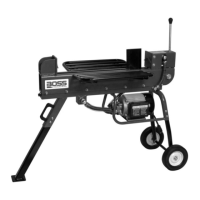
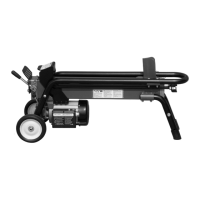
This document is an owner's manual for a BOSS Industrial Dual Action Electric Log Splitter, specifically Model No. ED16T21, rated at 16 tons. It provides comprehensive instructions for assembly, operation, and maintenance, emphasizing safety throughout.
Function Description
The BOSS Industrial Dual Action Electric Log Splitter is designed to split wood logs efficiently. Its primary function is to convert raw logs into smaller, more manageable pieces, typically for firewood or other uses. The "dual action" feature implies that the splitting wedge can operate in both forward and reverse directions, allowing for continuous splitting without needing to return the wedge to its starting position after each split. This design aims to enhance efficiency and reduce cycle time. The log splitter is powered by an electric motor, making it suitable for household use with a standard 115-volt, 60 Hz, 20-amp electrical circuit. It is intended for splitting wood logs only and should not be used for any other purpose to prevent injury or damage.
Usage Features
The log splitter is designed for single-operator use, with a designated "operator zone" to ensure safety and efficient access to controls. Before operation, users must ensure the machine is placed on a flat, dry, solid surface, and the wheels are blocked to prevent movement. Lubrication of the beam area where the splitting wedge slides is recommended for smooth operation. The control handle has three positions: FORWARD to engage the wedge for splitting, NEUTRAL to stop the wedge movement, and REVERSE to retract the wedge for splitting another log. The operator uses their right hand to control the handle, while the left hand can stabilize the log until the wedge makes contact.
The manual stresses the importance of not forcing the log splitter. If a log cannot be split within 3 seconds of continuous pressure, the operator should release the control handle to avoid permanent damage to the tool and voiding the warranty. Instead, the log should be repositioned, split from another end, or a smaller piece should be attempted from the border. It is crucial to release the handle lever just before the cylinder fully extends or retracts to prevent the valve from squeezing, which can lead to pressure buildup and require restarting the tool. The log splitter is not designed for splitting oversized or extremely hard logs beyond its recommended capacity.
Safety is paramount, with strict guidelines against placing hands or feet near moving parts, straddling the machine, or attempting to split multiple logs simultaneously. Bystanders, children, and pets must be kept at least 25 feet away from the operating area. The machine should only be operated in daylight or under good artificial light, and the work area must be kept clean of split wood and debris to prevent tripping hazards. The log splitter is also equipped with a towing hitch and safety chains, allowing for transportation behind a vehicle, though speed limits and proper attachment procedures must be followed.
Maintenance Features
Regular maintenance is crucial for the log splitter's optimal performance and longevity. Before each use, the operator must check the hydraulic oil level using the dipstick, ensuring it is within the specified range when the oil is cold. The log splitter is shipped without hydraulic fluid, so it must be filled before initial use, with AW32 hydraulic oil being highly recommended. The reservoir tank has a capacity of 3.5 gallons, and users may need more oil than this capacity for initial filling as the system (cylinder, valve, pump, and hoses) will draw a significant amount. After filling, the hydraulic system needs to be bled by cycling the wedge through its full extension and retraction 12 times to expel trapped air. Overfilling the reservoir should be avoided, as expanding fluid can overflow.
The manual recommends sharpening the splitting wedge periodically with a fine-toothed file to remove burrs or crushed areas. The machine should be cleaned regularly with an oiled rag to prevent rust, especially on the wedge and beam. All nuts, bolts, and hydraulic fittings must be checked for tightness before each operation. Hydraulic oil should be changed every 100 hours of use by draining the old fluid from the reservoir and refilling it. Used hydraulic fluid and engine oil must be disposed of at approved recycling centers. The tires are D.O.T. certified, and their pressure should be maintained at 30 psi, never exceeding the manufacturer's recommended psi.
For off-season storage, the log splitter should be stored in a clean, dry indoor area, switched off and unplugged. It should be allowed to cool for 5 minutes after use. The power supply cable needs protection from heat, sunshine, aggressive liquids, and sharp edges. The machine should be thoroughly cleaned and wiped with an oiled rag to prevent rust. Storing the unit outdoors or in damp, corrosive environments is not recommended. The manual also provides a troubleshooting guide for common issues like the motor failing to start, the splitter not splitting logs, or the wedge jerking, vibrating, or not moving, offering solutions such as checking oil levels, bleeding air, or contacting customer support.



 To Next Page
 General