4 5
Fingertip pulse oximetry
General description
Oxygen mixes with blood in the lungs and is transported in
blood mainly by hemoglobin. Chemically the oxygen molecule
combines loosely and reversibly with the heme portion of the
hemoglobin. The amount of oxygen that combines with the
hemoglobin is determined by the partial pressure of oxygen.
The amount of oxygen in blood, expressed as a percentage of
hemoglobin saturation is a measure of oxygen (SaO2) in the
artery and is estimated by a pulse oximeter as an SpO2 reading.
The amount of oxygen in blood (as measured by the pulse
oximeter SpO2 reading) is a very important physiological
parameter in respiratory and circulatory systems. Many respiratory
diseases reduce the oxygen-hemoglobin saturation in human
blood. Moreover, factors such as Automatic Organic Regulation
Malfunction caused by anesthesia, trauma resulting from major
surgery or medical examination, or other diseases due to virus or
bacteria can also cause a reduction in oxygen hemoglobin
saturation in arterial blood which can be detected by the pulse
oximeter through a low SpO2 reading. This can result in symptoms
such as depression, vomiting, and asthenia in patients.
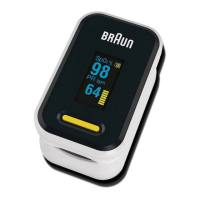
The ngertip pulse oximeter is a compact, low-power consumption,
portable device. When the index nger is inserted into the ngertip
photoelectric sensor, the display screen of the Braun Pulse oximeter
will show the measured value of %SpO2 and pulse rate as well as a
vertical bar graph showing the pulse amplitude.
Measurement principle
Pulse oximetry is based on the dierence in the selective
absorption of red light by oxygenated blood or oxyhemoglobin
(HbO2, which is bright red) as compared to deoxyhemoglobin
(Hb, which is dull red) or de-oxygenated blood. This selective
absorption is based on the Beer Lambert Law. A red (660nm)
and infrared LED (940nm) on the top portion of the prospective
clamp nger-type sensor emits light at these two frequencies.
The red light transmitted through the nger is selectively
absorbed by the oxygenated arterial blood and the remaining
light is detected by a photodetector on the lower portion of the
clamp nger. The infrared light then passes through the nger
without any selective absorption and is detected by the
photodetector on the lower side of the clamp. The transmitted
light captured by the photodetector is converted into a voltage
or current signal and then passed through signal conditioning
and ltering circuits using a microprocessor. %SpO2 is then
derived by analyzing the changes in the amplitude of these
pulsatile signals derived from the photodetector and calibrating
them using pulse scanning and recording technology. The pulse
rate is then derived from these associated waveforms.
Product description
1. OLED display 2. Finger clip
3. Power/Menu button 4. Lanyard
How to use your Braun Pulse oximeter
Installing and replacing batteries
(initial set up)
Push on the edge of the battery cover behind the arrows to
slide it from the device.
Install 2 AAA batteries.
Replace battery cover.
Taking a measurement
Press on top and bottom housing to open rubber nger clip.
English


 To Next Page
 Loading...