11
Exposure control
By pressing the button
marked"
+
1»
in the
center
of
the
filter
switch, you can film with
the automatic exposure
control
still in
operation, but with the
lens
aperture
1
stop
wider
open than normal. This
corrected
setting remains in effect
only
when
the
spring-loaded
button
is
pressed.
The
button should be used when the
more
important
elements in the scene you are
filming
are
in
shadow, and
other
areas
brightly
lit. This will usually
occur
when
filming
against the sun. The 'plus-one' ex-
posure
correction
device
is
also useful
when attempting to film
particularly
dark
subjects
in overcast conditions.
Meter battery
The
CdS automatic exposure
control
is
powered by two 1.35
volt
Mallory
PX
625
cells
. The battery
compartment
is in the
camera base and can
be reached by swing-
ing back the handgrip.
The compartment
catch can be opened
by using a coin in the
screw
slot. The plus
(+)
symbol on the
first battery to be in
serted
should face to-
wards the base of the
battery compartment,
the
+ symbol on the second cell should be
touching the end of the first battery; if the
cells are
incorrectly
inserted, the automatic
lens iris mechanism
will
not operate. Sym-
bols are provided in the battery
compart-
ment to show how the batteries should be
inserted
correctly.
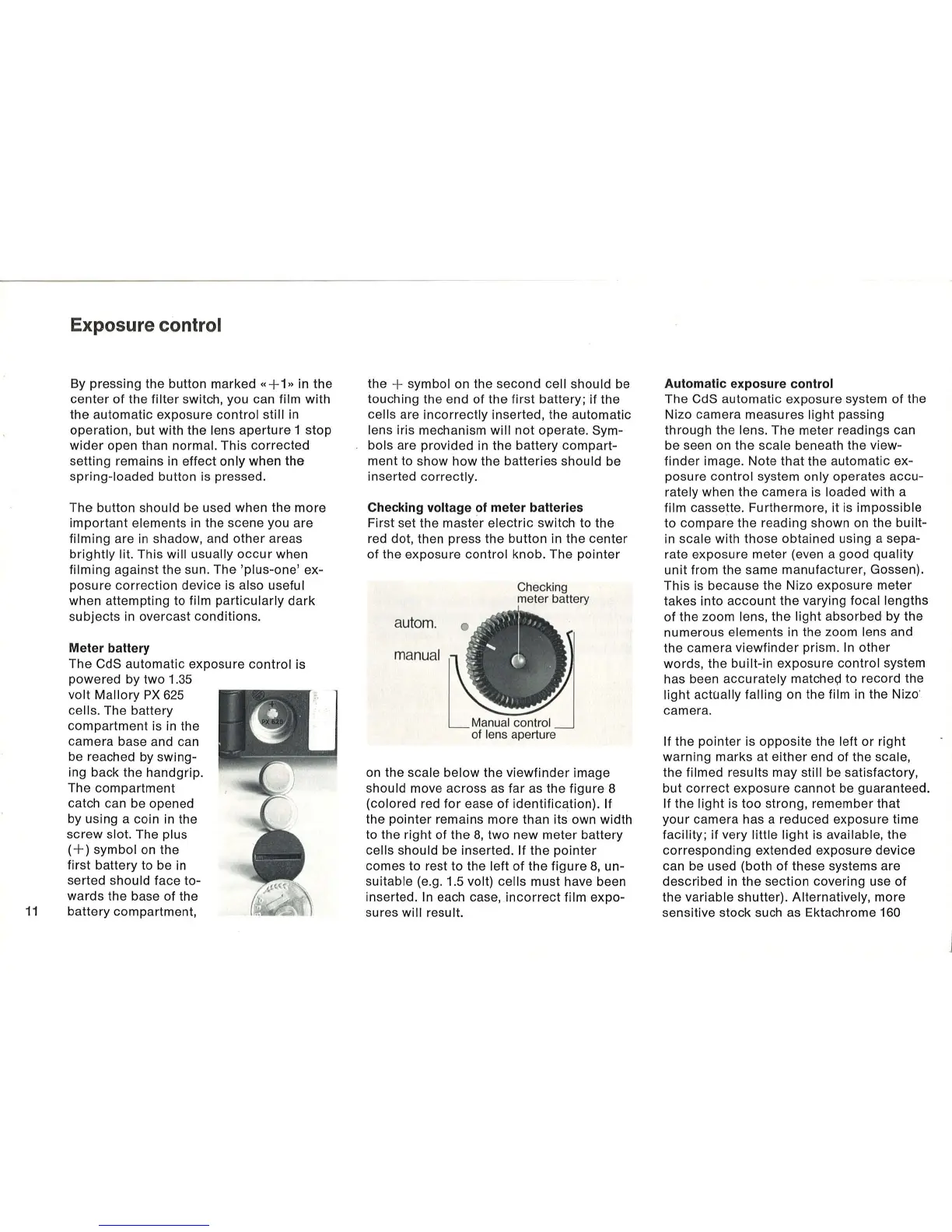
Checking voltage of meter batteries
First set the master
electric
switch to the
red dot, then press the button in the
center
of the exposure control knob. The pOinter
a
utom.
ma
nu
al
Checking
meter battery
on the
scale below the
viewfinder
image
should move across as
far
as
the
figure 8
(colored red
for
ease
of
identification). If
the pointer remains more than its own width
to the
right of the
8,
two new meter battery
cells should be inserted.
If
the
pointer
comes to rest to the left
of
the
figure
8,
un-
suitable (e.g. 1.5 volt) cells must have been
inserted.
In each case,
incorrect
film expo-
sures
will result.
Automatic exposure control
The CdS
automatic
exposure system of the
Ni
zo camera measures light passing
through the
lens. The meter readings can
be seen on the
scale beneath the view-
finder
image. Note
that
the automatic ex-
posure
control
system only operates accu-
rately when the camera
is
loaded with a
film cassette. Furthermore, it is impossible
to
compare
the reading shown
on
the
built-
in scale with those obtained using a sepa-
rate exposure meter (even a good
quality
unit
from the same manufacturer, Gossen).
This
is
because the Nizo exposure meter
takes into
account
the varying focal lengths
of the zoom lens, the
light
absorbed by the
numerous
elements in the zoom lens and
the camera
viewfinder
prism.
In
other
words, the
built-in exposure
control
system
has been
accurately
matcheQ to record the
light
actually falling on the film in the Nizo·
camera.
If the pointer is opposite the left or right
warning marks at
either
end of the scale,
the filmed results may still be satisfactory,
but
correct
exposure cannot be guaranteed.
If the
light
is too strong, remember that
your
camera has a reduced exposure time
facility; if very little
light
is
available,
the
corresponding
extended exposure device
can be used (both
of
these systems are
described in
the
section covering use of
the
variable shutter). Alternatively, more
sensitive stock such as Ektachrome
160


 To Next Page
 Loading...