may be used
or
the scene illuminated with
halogen floodlights.
Manual control
of
lens aperture
The automatic system can be switched
off
and any desired aperture setting selected
by hand.
The
exposure
control
knob must
first be turned from
«automatic» to «manu-
al».
The pointer on the exposure scale in
the
viewfinder
will now respond to rotary
movement of
t~e
control
knob.
In
this way the exposure values calculated
by the automatic system can be corrected,
for
example if the most
important
part of
the scene
is
considerably
lighter
or
darker
than the surroundings.
The
light
emitted by
the
object
to be filmed should then be
measured with the automatic exposure sy-
stem by bringing the camera much
closer,
or
else by zooming in on the
object
before
taking a reading, so that the
surroundings
are eliminated. The iris setting recorded by
the exposure meter in the
viewfinder
should
then be selected by hand.
Example: The automatic exposure system
indicates figure
16
when filming a
subject
in the
middle
of
an
area covered with snow
and in
bright
sunlight. If the scene is
actu-
ally filmed at this exposure setting, the sub-
ject
will be far too dark, as the camera
will
expose the surrounding snow area
correct-
ly. In
other
words, the exposure requires
correction
for best resu Its.
Another
example: When filming subjects
against the
lig'ht, they will normally appear
as
silhouettes;
if
you wish to bring
out
the
full details of
your
subject
on the screen,
turn round before starting to
film and mea-
sure exposure 'with the
light'. Select this
exposure
value manually and then film
your
scene against the light.
Always remember to return the exposure
control
knob from «manual» to «automatic»
after you have
completed
a specially ex-
posed shot
0;
this kind.
In
most cases requiring additional expo-
sure, the
«plus 1
II
control
(described in the
previous section)
will
normally
enable the
desired
results to be obtained.
Rangefinding and focusing
Viewfinder eyepiece adjustment
(diopter compensation)
Before
the through-the-Iens rangefinding
system can be used, the viewfinder must be
adjusted to
suit
the cameraman's eyesight
(as with binoculars). The eyepiece of the
Nizo camera is provided with a
knurled
ring. Turn this ring'until the horizontal divi-
sion across the center to the rangefinder
appears
perfectly
sharp. This
wHI
be easier
if the camera is kept pointed at a
plain
background (walls, sky). The
adjustment
can be carried
out
at any focal length
or
focus
setting.
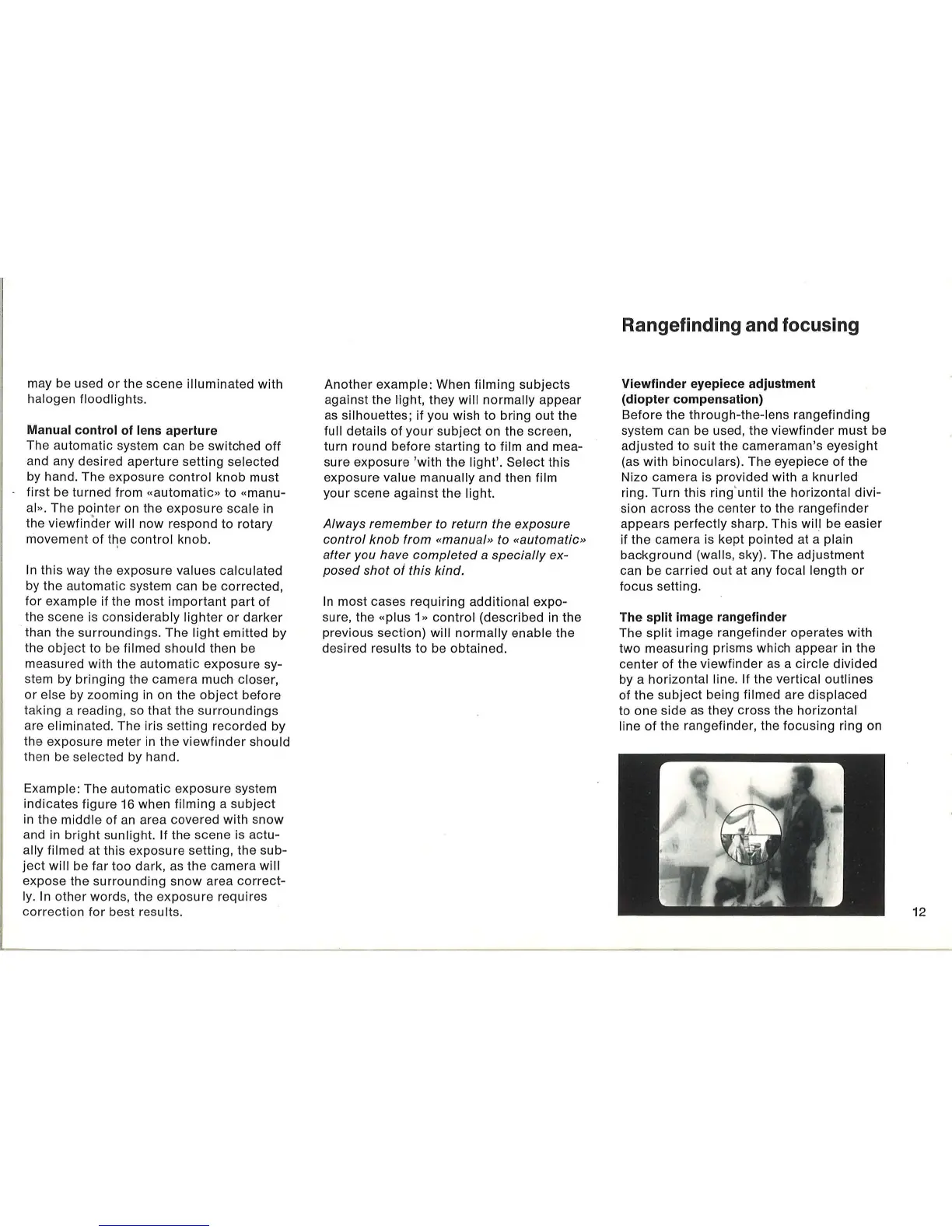
The split image rangefinder
The
split
image rangefinder operates with
two measuring prisms which
appear in the
center
of the viewfinder
as
a
circle
divided
by a
horizontal line.
If
the vertical
outlines
of the
subject
being filmed are displaced
to
one
side as they cross the horizontal
line
of the rangefinder, the focusing ring on
12


 To Next Page
 Loading...