ed
firmly
to the
tripod
or
rested on
the
handgrip
on
a surface free from vibration.
The time-lapse intervals should then be ad-
justed - longer
or
shorter
- to
suit
light
conditions. As
in
still photography,
an
approximate estimate
of
exposure is usual-
ly
sufNcient, since long exposures are em-
ployed in
light
conditions
which rule
out
the possibility of
an
accidental
overexpo-
sure and indeed in which any extra
light
can only help to improve
picture
quality.
The automatic exposure
control
on
the
Nizo camera can
therefore
be allowed to
remain in operation.
After
filming
at
increased
exposure, do
not
forget to return the variable
shutter
lever
to its
normal
condition,
or
else the
first
frames
of
all
succeeding
shots
filmed
under
normal
light
conditions
will
be so severely
overexposed as to
appear
white on the
screen.
Automatic extended exposure system
If you none the less wish to employ the
automatic exposure control, place the
marking on filming speed switch 2 against
the setting «autom.
B»,
and remove the
lens hood from the
front
of the lens barrel.
In
these light
conditions
the lens hood
is
not
required in any case. Next, pull the
variable shutter lever past the detent button
into the shaded area, as
described
in the
preceding
section
of this manual.
If you now move the continuous-run
re
-
lease on the
opposite
s.ide of the camera
base
to
the
operating
position, the sepa-
rate automatic exposure system
will
deter-
mine the elapsed-time filming speed (rate
of exposure of individual frames). You will
appreciate
that
use of the automatic ex-
tended exposure
control
is
worthwhile
only
in
poor
light
conditions.
Warning:
Make
sure that the
window
below
the namepl'ate on the
front
of
the camera is
not obscured:
as
it conceals the special
automatic exposure
control
cell. This is
provided so
that
your
Nizo camera can (un-
like the normal
through-the-Iens exposure
measurement system) measure general
exposure levels
without
being unduly in-
fluenced by individual small-area
light
sources,
for
instance lamps
or
candles.
Synchronized sound recording
and filming
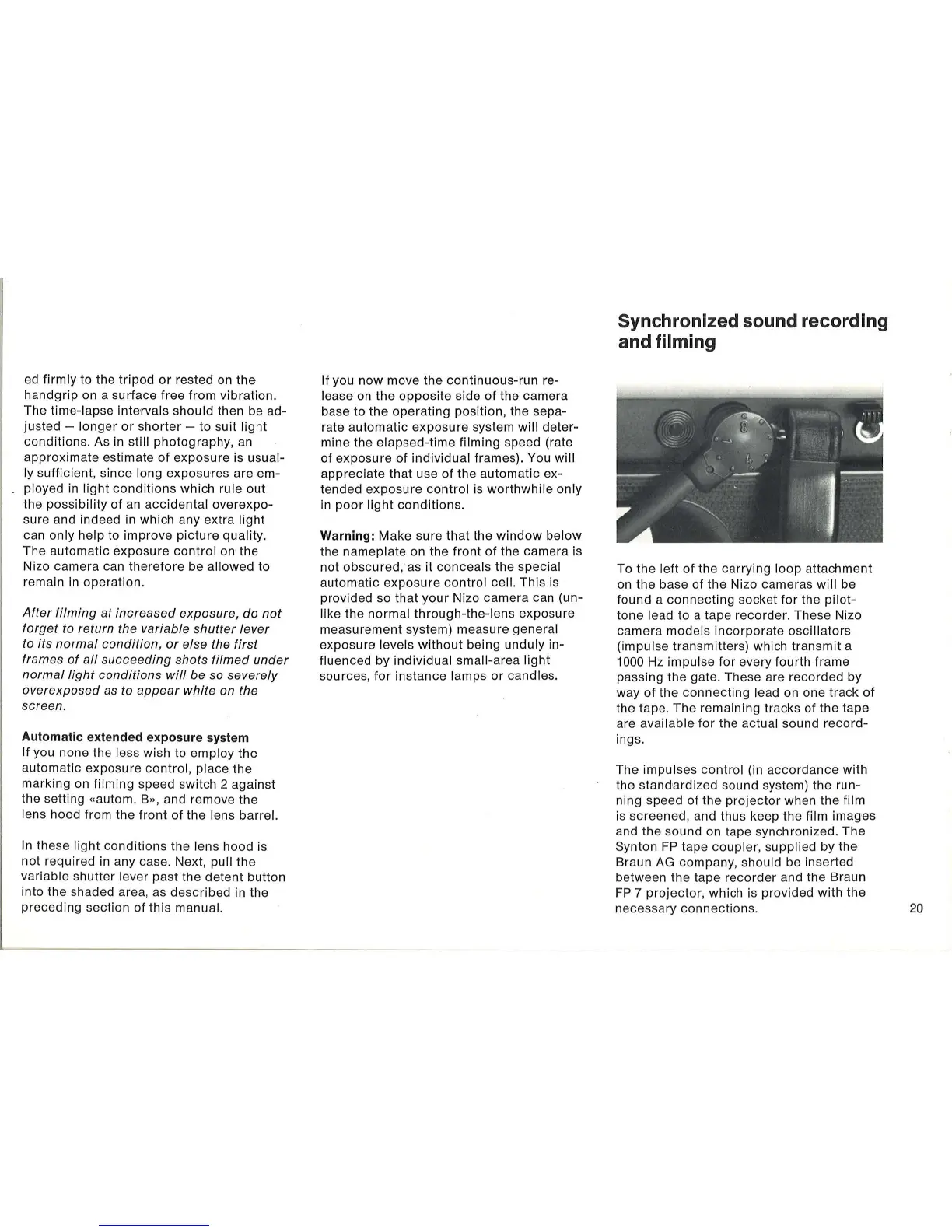
To the left of the carrying loop attachment
on the base of the Nizo cameras
will
be
found a
connecting
socket for the
pilot-
tone
lead to a tape recorder. These Nizo
camera models
incorporate
oscillators
(impulse transmitters) which transmit a
1000 Hz impulse
for
every fourth frame
passing the gate. These are recorded by
way of the connecting lead on one track
of
the tape. The remaining tracks of the tape
are available for the actual sound
record-
ings.
The impulses control (in
accordance
with
the standardized sound system) the run-
ning speed of the
projector
when the film
is screened, and thus keep the film images
and the sound on tape synchronized. The
Synton
FP
tape coupler, supplied by
the
Braun
AG
company, should be inserted
between the tape
recorder
and the Braun
FP
7
projector
, which is provided with the
necessary connections.
20


 To Next Page
 Loading...