Need help?
Do you have a question about the Breezy Ibis PowerDrive and is the answer not in the manual?
Explains the manual's purpose, contents, and how to use it effectively for safe wheelchair operation.
Guides users on obtaining additional support, contact details for dealers, and product safety information.
Defines warning, caution, and note symbols to ensure user understanding of potential risks and advice.
Advises on avoiding contact with hot motors and potential burns from sun-exposed parts.
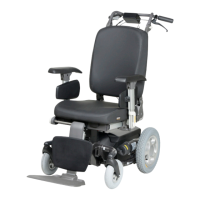
Identifies and labels the primary physical parts of the Ibis PowerDrive wheelchair.
Explains the operation of the On/Off key, throttle, speed button, and battery indicator.
Ensures safe operation by verifying tyre pressure, battery charge, and freewheel switch settings.
Details safe procedures for getting on and off the wheelchair, including handling foot supports.
Guides on using the throttle and speed button for forward, reverse, and controlled movement.
Provides critical safety advice for driving on slopes, inclines, and through curves or obstacles.
Details the use of the freewheel switch for manual pushing and its impact on the parking brake.
Outlines the possible adjustments for seat depth, width, backrest angle, and legrest for optimal comfort.
Presents a daily, weekly, monthly, and annual plan for maintaining the wheelchair's functionality.
Provides guidelines on battery type, charging procedures, and maintaining optimal battery health.
Explains the importance of correct tyre pressure for performance and wear, and tyre repair.
Offers instructions for safely cleaning the wheelchair, emphasizing caution with electronic components.
Details the meaning of symbols and markings affixed to the wheelchair for safety and identification.
Clarifies terminology like 'consumable part', 'defect', 'option', and 'warranty period'.
Outlines specific warranty periods for manual wheelchair, PowerDrive system, and seating components.
Recommends reading user information for B4Me products to ensure intended operation and performance.
Provides guidance on combining the device with other medical products and meeting safety requirements.
The Ibis PowerDrive is a wheelchair equipped with a power assistive system designed to reduce the manual effort required by a caregiver to drive the wheelchair and its user.
The Ibis PowerDrive has a maximum user weight capacity of 136 kg (21.4 st). Its total length is 1040 mm (40.9 inches) and total width is 595 mm (23.4 inches). The total weight, excluding batteries, is 60 kg (9.4 st), and including 31 Ah batteries, it is 82 kg (13 st). The wheelchair uses 31 Ah or 40 Ah batteries.
In terms of stability, it has a static stability of 15° downwards, 15° upwards, and 15° sidewards. The range for 31 Ah (C20) batteries is approximately 25 km (15.5 mi). The maximum safe slope for dynamic stability is 10°. It has a climbing capacity for obstacles (RWD) of 50 mm (2 inches) and a maximum speed of 6 km/h (4 mph).
Adjustments include a seat tilt adjustment of 15° and a seat angle adjustment of 0-6°. The effective seat depth ranges from 440 - 600 mm (17.3 - 23.6 inches), and the effective seat width from 400 - 540 mm (15.7 - 21.3 inches). Seat height (excluding cushion) varies from 365 mm to 470 mm (14.4 to 18.5 inches) depending on the setting, and seat height (including cushion) from 435 mm to 540 mm (17.1 to 21.3 inches). The backrest angle ranges from 89-118°, backrest height from 500 - 640 mm (19.7 - 25.2 inches), and lower leg length from 360 - 530 mm (14.2 - 20.9 inches). The minimum turning radius (RWD) is 790 mm (31.1 inches), and the ground clearance is 60 mm (2.4 inches).
Factors that negatively affect the distance range include obstacles, rugged terrain, driving on slopes, exposure to temperatures below freezing point, and frequent use of electronic adjustment options. Seat height specifications are given for a 0° seat angle with load.
The Ibis PowerDrive is activated using an On/Off key on the controller. Once activated, a battery indicator lights up, showing the battery condition with 10 lights (red: 30%, orange: 30-70%, green: 70-100% charge). If the battery charge is less than 20%, the batteries should be charged. A flashing battery indicator signals a general malfunction.
The power assistance function is controlled by a proportional operating throttle. Squeezing the left part of the throttle handle moves the wheelchair forward, with greater squeeze resulting in faster speed. Squeezing the right part of the throttle handle activates reverse. The maximum speed can be set using a stepless speed button on the controller. To brake, the throttle handle is released completely, and the wheelchair brakes automatically.
For transfers, the controller must be switched off, and the freewheel switch set to 'drive'. Foot supports can be folded up, calf plates swung to the side, and legrests swung to the side if possible. Armrests can be removed by tipping them downwards and then removing them, or folded back by pressing and folding to the rear. Any tray should be removed before folding back the armrest.
When driving up obstacles like kerbs, the user should drive straight up, slowly squeeze the throttle to go forward without changing direction, and maintain speed once the front wheels are on the sidewalk to allow the rear wheels to follow. For driving down obstacles, the user should drive straight to the edge of the sidewalk, slowly squeeze the throttle, and drive carefully down without changing direction.
Driving on slopes requires caution and concentration. Sudden, jerky movements, emergency stops, and changing direction on a slope should be avoided. The wheelchair should not be turned on a slope, and all adjustment options should be set to the neutral position when driving up a slope. Driving in reverse on a slope is not recommended. Driving on loose gravel or sandy surfaces on slopes should be avoided to prevent wheel slip. To prevent motor overheating, driving on slopes for extended periods should be limited. If a significant decrease in speed is noticed when driving up a slope, a less steep route should be taken. Speed should be controlled when driving downhill to prevent excessive acceleration.
When taking curves, speed should be decreased. The throttle handle should be kept engaged at the desired speed, and the push handle should be slightly pulled backwards from the direction of the turn (e.g., pulling the left push handle slightly backwards for a left turn).
The wheelchair can also be moved manually by pushing. This requires disengaging the motors using a freewheel switch, which has two positions: 'Drive' and 'Push'. The freewheel switch should only be operated by the attendant, not the user. It should never be set to 'push' on a slope, as this deactivates the automatic parking brake, allowing the wheelchair to roll down. The automatic parking brake only functions in the 'drive' position. After manual pushing, the freewheel switch should immediately be set back to 'drive'.
The wheelchair offers extensive settings for the seating system to ensure optimum body support. These settings, which must be carried out by qualified specialists (unless otherwise stated), include seat depth and width, backrest angle, armrest height, lower leg length, and footplate angle.
The wheelchair's lifespan depends on proper maintenance. For specific settings, maintenance, or repair, the dealer should be contacted, providing the model, year of manufacture, and identification number from the identification plate. The wheelchair should be serviced by a dealer annually, or every six months for intensive use.
Before each use, the user should check that the tyres are sufficiently inflated, the batteries are sufficiently charged (green lights on the battery indicator), and the freewheel switch is set to 'drive'. Clothing or accessories should be checked to ensure they do not come into contact with moving or rotating parts.
The wheelchair uses two 12V 'dry' gel batteries in series, which are fully sealed and maintenance-free. 'Wet' batteries should not be used. Battery capacity is reduced at low temperatures (roughly 75% in light frost, 50% below -5°C), which reduces the wheelchair's range. Batteries should be charged after each use and if the wheelchair is not used for an extended period. Under normal use, batteries should be charged every night, taking up to 12 hours to fully charge. The battery charger's display indicates when charging is complete. Batteries should always be fully charged, as not using them for extended periods or allowing them to become almost or completely depleted can damage them and risk an unintended standstill.
For charging, the wheelchair's controller should be switched off. The battery charger's plug is inserted into the charging connector on the controller, and the charger is activated. It is advised to mount a smoke detector in the charging area. Batteries should be disconnected for longer storage without usage.
Tyres must be kept at the correct pressure, indicated on the tyre's side. Castor wheels require a maximum of 2.5 bar, and drive wheels a maximum of 2.7 bar. Soft tyres negatively affect performance, requiring more energy and increasing tyre wear. The maximum tyre pressure should never be exceeded. Tyre replacement should only be done by a qualified specialist, and tyres must be fully deflated before repair.
For cleaning and disinfection, the controller must be switched off to prevent accidental movement or operation of electrical options. Care should be taken with water due to the electronic system. Dry dirt can be removed by wiping with a wet sponge, preferably with clean water or a mild soap solution, then drying with a soft, dry cloth. Abrasive or aggressive cleaning agents, organic solvents like thinner, benzine, or white spirit should not be used, as they can scratch the wheelchair.
All markings, symbols, and instructions affixed to the wheelchair must remain present and legible throughout its lifespan. Illegible or damaged markings should be replaced or repaired immediately by contacting the dealer. Markings include: check manual before using, freewheel switch positions ('Drive' and 'Push' with a warning not to use 'Push' on a slope), battery charging connection, attachment point for tie-down system for vehicle transportation, risk of breakage when swinging the controller aside, risk of pinching from moving parts during adjustments, and an identification plate with model, year of manufacture, identification number, indoor/outdoor use, CE mark, and maximum load in kg.
The warranty period for the PowerDrive frame is 2 years. The drive system (transaxle, motor, motor brake) and electronics (controller, controlling mechanism, wiring harness, electronic components) have a 1-year warranty. After-sales service parts have a 1-year warranty if new, and 90 days if repaired. Consumable parts (carbon brushes, etc.) have a 40-day warranty. Options and accessories (mirror, mudguards, etc.) delivered with the initial product have a 2-year warranty.
The warranty is void if the product or its parts are modified, if there are changes in cosmetic appearance due to use, if instructions for use and maintenance are not observed, if there is use other than normal, wear and tear, negligence, collateral damage from neglected earlier symptoms, overloading, third-party accidents, use of non-original parts, defects not caused by the product, or circumstances beyond control (flood, fire, etc.). The warranty does not cover tyres, inner tubes, or batteries (which are covered by the battery manufacturer's warranty).
 General
| Brand | Breezy |
|---|---|
| Model | Ibis PowerDrive |
| Category | Wheelchair |
| Language | English |

 To Next Page