EasyManua.ls Logo

Briggs & Stratton NAX 600B - User Manual

Briggs & Stratton NAX 600B
28 pages
Print Icon
To Next Page IconTo Next Page
Loading...
NAX 600B
Question and Answer IconNeed help?

Do you have a question about the Briggs & Stratton NAX 600B and is the answer not in the manual?

Summary

Brushcutter NAX 600 B

Construction and Illustrative Drawings

Illustrative Drawings

Provides visual representations of the brushcutter's construction and parts.

Assembly Diagrams

Detailed exploded views and diagrams showing how to assemble the brushcutter components.

Technical Specifications and Symbols

Technical Data

Lists key specifications such as engine capacity, power, torque, dimensions, and sound levels.

Pictogram Explanations

Clarifies the meaning of safety icons and symbols used in the manual and on the device.

Safety Information

General Safety Rules

Covers fundamental safety principles applicable to all users and operating environments.

Working Area Safety

Guidelines for ensuring a safe environment during operation, including lighting and crowd control.

Fuel Handling Safety

Precautions and procedures for safely handling and storing fuel for the brushcutter.

Personal Safety

Advice on operator protective measures, posture, and awareness to prevent injuries.

Brushcutter Specific Safety

Detailed safety instructions tailored specifically for the operation of the brushcutter.

Operation and Maintenance

Preparing for Work

Steps to follow before starting any work with the brushcutter.

Assembly Instructions

Guidance on assembling the main components like the handle, cover, and drive shaft.

Cutting Attachments

Instructions for attaching and using cutting tools like the line spool and three-arm knife.

Starting the Engine

Procedures for preparing the fuel mixture and starting the brushcutter's engine.

Mowing and Line Ejection

Guidance on mowing techniques and methods for extending the cutting line.

Maintenance Procedures

Steps for cleaning the air filter, spark plug, and cylinder fins for optimal performance.

Troubleshooting and Support

Accident and Failure Response

Procedures to follow in case of an accident or malfunction of the device.

Problem Diagnosis

A guide to identifying common problems and their potential causes and solutions.

Warranty and Legal Information

Warranty and Service

Information regarding warranty coverage, service points, and general service advice.

Warranty Conditions

Details the terms, limitations, and requirements for the product's warranty.

Declaration of Conformity

Manufacturer's statement that the product meets relevant EU directives and standards.

Overview

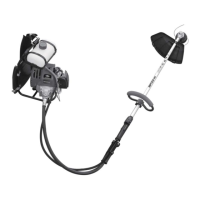
This document serves as the operator's manual for the NAX 600B Brushcutter, a device designed for household use in maintaining lawns and cutting thickets. It emphasizes safety, proper operation, and maintenance to ensure long-term and reliable performance.

Function Description

The NAX 600B Brushcutter is primarily used for mowing grass and cutting thickets in home lawn care. It can be equipped with either a cutting line head for general grass trimming or a three-armed knife for more demanding tasks like cutting thicker vegetation. The device is not intended for professional, semi-professional, or commercial purposes, and such use would void its warranty. It should not be used for leveling molehills, cutting bushes, or chopping branches.

Important Technical Specifications

The NAX 600B Brushcutter is powered by a TT-1E40F-5 BS series engine with a displacement of 42.7 cc. Key performance figures include:

  • Machine rated power: 1.2 kW at 7500 rpm
  • Maximum motor torque: 1.8 Nm at 5500 rpm
  • Maximum speed without load: 9,000 rpm
  • Engine idling speed range: 3000 ± 300 rpm

Fuel specifications:

  • Fuel mix: 40:1 (4 liters of gasoline for every 100 ml of two-stroke oil). The manual strongly recommends using Eurosuper 95 unleaded petrol and synthetic or semi-synthetic oil for high-speed two-stroke engines, noting that mineral oil (Mixol type) and oils for four-stroke engines are strictly prohibited.
  • Fuel tank capacity: 1 L
  • Spark plug: TORCH L8RTF

Cutting unit specifications:

  • Cutting diameter (line/disc): 42 cm / 25.5 cm
  • Cutting tool bore diameter: 26 mm
  • Maximum diameter of the line: 3.0 mm
  • Working shaft (pipe): 28 mm (diameter); 2 mm (thickness)
  • Shield rotation direction: leftward

Noise and vibration levels:

  • Guaranteed sound power level LWA: 113 dB (A)
  • Sound pressure level LpA at the workplace: 99.5 dB (A) with a measurement uncertainty K = 3 dB (A)
  • Vibrations transmitted to the operator's upper limbs: a front_hv, eg 6.566 m/s² and a rear_hv, eg 9.661 m/s², with a measurement uncertainty K = 1.5 m/s². The manual warns about prolonged exposure to vibrations potentially causing "white toe disease."

Physical characteristics:

  • Equipment mass: 7.6 kg
  • Year of manufacture: 2020

Usage Features

The brushcutter is delivered partially disassembled and requires assembly of the handle, cutting attachment cover, and cutting attachment (either line head or three-armed knife) before use.

Starting the engine:

  1. Ensure the switch on the right handlebar is in the "I" (on) position.
  2. Press the manual fuel pump several times until fuel appears in the pump.
  3. Pull the starter handle once without jerking if the engine is warm.
  4. If the engine does not start, move the choke lever to the suction position and pull the starter rope until the first cycle of work.
  5. Press the gas lever lock, then the gas lever to turn off the choke (which is automatic).
  6. Pull the starter rope to start the device.

Mowing:

  • Always wear solid footwear and long pants.
  • Check the work area for stones, branches, wires, and other foreign objects.
  • In high grass, mark hidden obstacles.
  • Always check cutting elements for wear and damage.
  • Check the centrifugal clutch before starting: the cutting tool should stop when the throttle lever is released.
  • Mow only in daylight or good artificial light.
  • Avoid mowing wet grass or on excessively sloping slopes.
  • Maintain a firm and balanced stance; do not run.
  • Do not use the device with damaged covers or without safety devices.
  • Keep hands and feet away from rotating parts.
  • Periodically remove grass fibers wrapped around the cutting tool axis to prevent overheating.

Replacing the cutting line:

  • Stop the engine and wait for all moving parts to stop.
  • Empty the fuel tank.
  • Prepare a 4-meter section of cutting line with a maximum diameter of 3 mm.
  • Align the arrow on the winding knob with the arrow on the head housing.
  • Insert the line through the aluminum grommet, ensuring equal lengths protrude from both sides.
  • Wind the line by turning the knob clockwise until about 15 cm protrudes from both sides.
  • The brushcutter is equipped with a bumper head for automatic line ejection by lightly tapping it on the ground. Manual ejection is also possible by pressing the button in the drum and pulling the line. A cutting knife in the cover trims excess line.

Maintenance Features

Regular maintenance is crucial for safe and efficient operation. Before any maintenance or repair, the engine must be off and cool, and the high-voltage cable disconnected from the spark plug.

Air filter cleaning:

  • Clean the air filter as needed, at least every 5 hours of operation.
  • Remove sawdust with a brush; use compressed air to clean from the inside.
  • Unscrew the mounting butterfly and remove the air filter cover.
  • Cleaning with a damp cloth is allowed, followed by immediate drying.
  • Protect metal parts with oil.
  • Regularly clean ventilation holes with compressed dry air.
  • Avoid aggressive or corrosive cleaning detergents.

Cylinder ribbing:

  • Inspect and clean cylinder fins periodically during air filter maintenance to prevent overheating.

Spark plug maintenance:

  • Check the spark plug condition, cleanliness, and gap (0.5-0.7 mm) with the engine off.
  • Carefully pull off the high-voltage cable from the spark plug.
  • Unscrew the spark plug using the provided wrench.
  • Inspect for damage and dirt; use a copper wire brush to remove carbon and soot.
  • Adjust the electrode distance to 0.5-0.7 mm using a feeler gauge.
  • Check the washer, screw the spark plug with the wrench (torque 12-15 Nm), and reinstall the power cord.

General maintenance and storage:

  • After use, clean the device of grass, dust, and dirt using a brush or scraper.
  • Avoid using high-pressure water, which can damage the housing and safety stickers.
  • Protect metal parts with anti-corrosive agents.
  • Oil levers and lines at least twice a season, and before and after.
  • Clean the entire brushcutter exterior with a damp cloth and protect with preservatives.
  • Store the brushcutter in a well-ventilated, dry, dust-free place.
  • Rectify any faults before storage.
  • Keep the tool out of reach of children.

Transportation:

  • Turn off the brushcutter, cool the engine, and drain fuel and oil before transport.
  • If transporting with a metal cutting attachment, secure it with a protective blade.
  • Secure the device with transport belts to prevent deformation of the propeller shaft tube.
  • Transport the scythe folded in its original packaging if possible.

Briggs & Stratton NAX 600B Specifications

General IconGeneral
BrandBriggs & Stratton
ModelNAX 600B
CategoryBrush Cutter
LanguageEnglish

Related product manuals