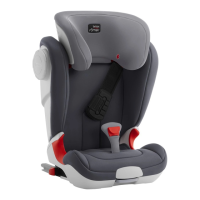
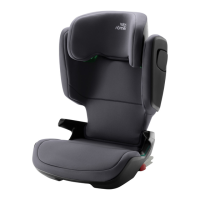
This document is a user guide for the Britax Römer KIDFIX M i-SIZE child car seat, designed for children with a height ranging from 100 cm to 150 cm. It provides comprehensive information on safety, installation, usage, cleaning, and care.
Function Description:
The Britax Römer KIDFIX M i-SIZE is a child safety seat designed to secure children in a vehicle, adhering to the European Standard for Child Safety Equipment UN ECE R129/03. Its primary function is to provide protection for children during travel, minimizing the risk of injury in the event of an accident or sudden stop. The seat can be installed using two primary methods: ISOFIX (installation method A) for vehicles with ISOFIX anchorage points, or the vehicle's 3-point seat belt (installation method B) for vehicles without ISOFIX or if the seat is not i-Size approved. The seat features a backrest, headrest, and belt guides to ensure proper positioning of the vehicle's seat belt across the child's body.
Important Technical Specifications:
- Child Height Range: 100 cm – 150 cm. For some vehicles where the child seat's headrest cannot be fully extended due to space limitations, it is recommended for child sizes between 100 cm and 135 cm.
- Approval Standard: UN ECE R129/03.
- Installation Methods:
- ISOFIX (Method A): Utilizes ISOFIX locking arms (09) that connect to the vehicle's ISOFIX installation brackets (05). Adjustment buttons (10, 11) facilitate proper positioning. A green area (06) indicates correct ISOFIX engagement.
- Belted (Method B): Uses the vehicle's 3-point seat belt, guided through specific points on the child seat.
- Components:
- Diagonal belt (01)
- Lap belt (02)
- Seat belt lock (03)
- Insertion aid (04)
- ISOFIX installation bracket (05)
- Green area (06)
- Red release button (07)
- Locking button (08)
- ISOFIX locking arms (09)
- Adjustment button (10)
- ISOFIX adjustment button (11)
- Dark-green belt guide (12)
- Light-green belt holder (13)
- Headrest (14)
- Safety Features: The seat cover is an integral safety component; using the seat without it or with non-original covers can compromise safety. The design incorporates belt guides (dark-green (12) and light-green (13)) to ensure the vehicle's seat belt is correctly routed across the child's hips and shoulder.
Usage Features:
- Installation:
- ISOFIX (Method A): Involves extending the ISOFIX locking arms, attaching them to the vehicle's ISOFIX brackets until the green area is visible, and then pushing the seat firmly against the vehicle's backrest. The headrest of the child seat should be adjusted to fit the child's height, and the vehicle's headrest may need to be removed if it obstructs the child seat's backrest from lying flat against the vehicle seat.
- Belted (Method B): Requires routing the vehicle's 3-point seat belt through the dark-green belt guides for the lap belt and the light-green belt holder for the diagonal belt. The belt must be pulled tight and not twisted, ensuring the child is correctly strapped in.
- Child Securing: The child is secured using the vehicle's 3-point seat belt. The lap belt should sit as low as possible over the child's hips, and the diagonal belt should lead diagonally to the back from the child seat, passing through the light-green belt holder. The seat belt lock should not be in or in front of the dark-green belt guide.
- Headrest Adjustment: The headrest (14) is adjustable to accommodate the child's height, ensuring the diagonal belt is positioned correctly over the child's shoulder.
- Pre-Journey Checks: Before each car journey, it is crucial to verify that the lap belt is correctly positioned in the dark-green guides, the diagonal belt is in the light-green guide, the seat belt is tight and untwisted, the child is correctly strapped in, and if using ISOFIX, the green area is visible on both locking arms.
- Empty Seat Securing: When the child seat is empty, it must still be secured in the vehicle to prevent it from becoming an unsecured object in case of an emergency stop or accident. This can be done by fastening the vehicle's 3-point seat belt through the guides or by ensuring the ISOFIX locking arms are engaged.
- Safety Warnings: The manual emphasizes critical safety points, including replacing the seat after an accident, protecting it from direct sunlight, keeping fingers clear when adjusting the backrest, avoiding damage from hard objects, and never leaving a child unsupervised. It also warns against using the seat with a 2-point seat belt or if the vehicle's front airbag poses a risk due to proximity.
Maintenance Features:
- Cleaning: Plastic parts of the child seat can be cleaned with soapy water. Abrasive cleaning agents (e.g., solvents) should not be used. The seat cover is removable and can be washed. The washing instructions typically indicate a 30°C wash cycle and prohibit bleaching, tumble drying, ironing, or dry cleaning.
- Care: Regular checks of all important parts for damage are recommended. Mechanical components should be ensured to work properly. Lubricating or oiling parts of the product is prohibited.
- Storage: The child seat should be stored in a safe place, away from dampness, moisture, liquids, dust, salt spray, heavy objects, and direct heat sources or sunlight.
- Disposal: Users are instructed to observe the disposal regulations in their country and not to dismantle the product.
- Replacement Parts: Only original Britax Römer replacement seat covers should be used. These are available from retailers.

 Need help?



 To Next Page
 General