30
D14
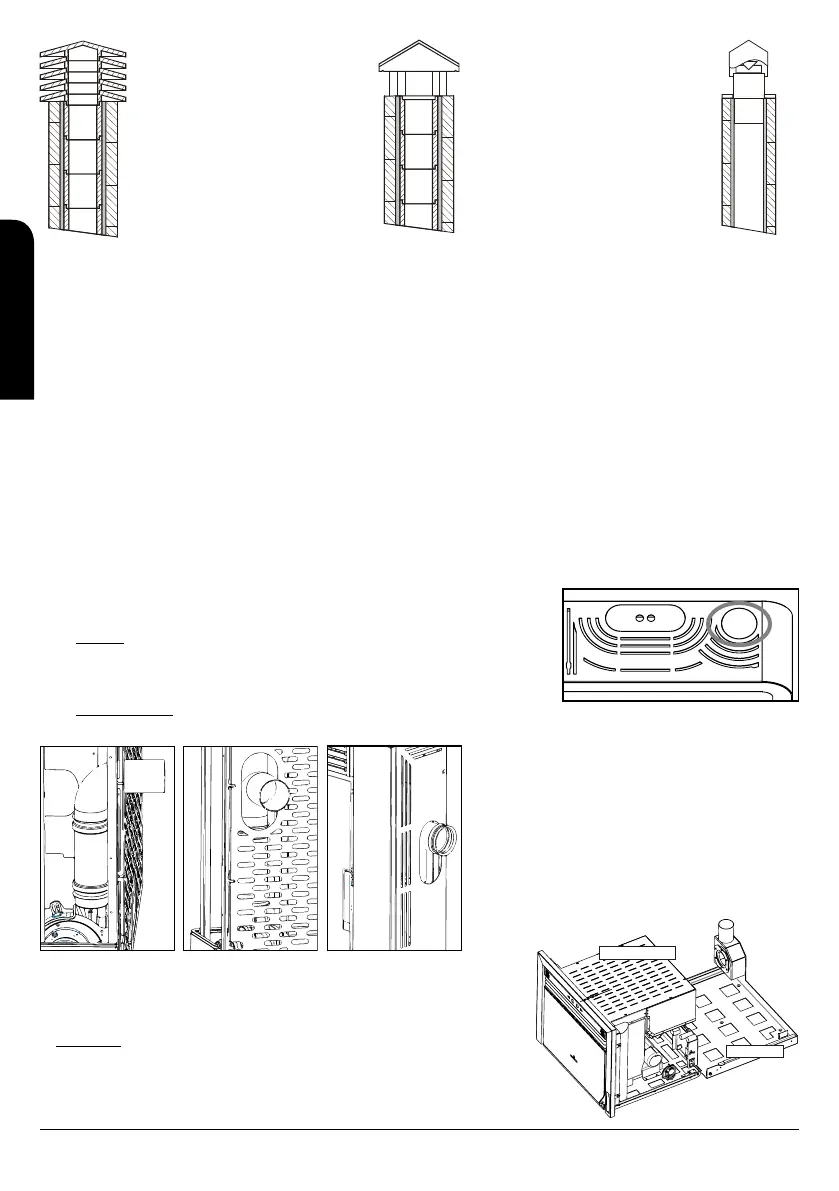
(1) Industrial chimney of
prefabricated elements
that allow a good smoke
extraction.
(2) Traditional chimney. The
proper exit section must be,
at least, two times the interior
section of the chimney. The best
is 2.5 times.
(3) Chimney with interior cone
smoke baffle-plate.
5.6 OUTSIDE AIR INTAKE
For the proper operation of the stove or insert, it is essential that there is enough air for the combustion and re/oxygenation of the environment
where it is installed. This means that the air must be able to move for the combustion through some openings connected to the exterior, even
when doors and windows are closed.
It must be placed in so that it cannot be obstructed. It must be connected to the environment where the equipment is installed and it must be
protected by a grate. The minimum area of the outlet should not be less than 100 cm2.
When the air flow comes through openings that are connected to the exterior of adjacent environments, it is important to avoid air intakes in
connection with garages, kitchens, toilets, etc.
The stove is provided with a necessary air intake for the combustion on the back side (40 mm diameter). It is important this intake is not
blocked and to respect the recommended distances to the wall or near items. However the insert Damasco has this intake on the rear; while
in the insert Neva this intake is placed on the front, exactly, on the right upper side of the front.
It is recommended the primary air intake connection of the stove or insert with the outside although it is not obligatory. The connection tube
material can be made in any material (PVC, aluminium, polyethylene, etc.), not necessarily metallic. Consider that inside this duct is going to
pass air at the outside temperature.
5.7 ASSEMBLY SPECIFICATIONS ACCORDING TO THE MODEL
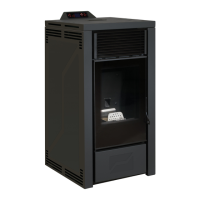
5.7.1 MODELS AGATHA, ALEXIA AND ALICIA
There are two different ways to connect the chimney duct to the stove:
- Top exit: it will be enough knocking softly the upper cover that is partially pierced and
connect the ducts to the smoke duct of the extractor on the stove (see drawing D15). Do
not forget to respect the safety distance of the stove with the walls (see chapter “safety
distance”).
- Rear or lateral exit: the pipe will be connected to the smoke duct of the extractor on the
stove (vertical) Place a 90º elbow of 80 mm diameter (to convert the outlet in lateral or rear) and then, place the rest of the installation
pipes, for example: converter, “T” with a register cover, elbow,
pipe, etc (see drawing D16). Take into account that, with
this option the stove will be separated of the wall, at least the
diameter duct plus the recommended security distance (see
chapter “safety distance”).
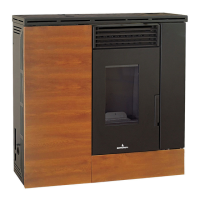
5.7.2 MODELS NEVA AND DAMASCO
The inserts model Neva and Damasco are composed of a
fixed metallic base which is inserted on the chimney hole and
a mobile base (body) which is inserted into the fixed base
through some extensible and removable guides (see drawing
D17).
It must
have an
electrical
power outlet on the rear and it must be accessible when the installation is finished. The
chimney must be provided with the smoke duct and an air intake. To place the fixed base
into the chimney hole it is necessary to place it with metallic bolts with 8 mm diameter. In
order to separate the fixed base from the mobile base we have to extract completely the
mobile base. To do this, first of all turn the safety lock placed on the frontal lower right part
(in model Neva, see drawing D18) and on the frontal lower left part (in model Damasco,
see drawing D19) with an Allen wrench.
Extract the mobile part, tilt it upwards by the frontal (see drawing D20) and pull back.
In this way, the components are separated. You must foresee a support to leave the
equipment at the moment of the extraction.
D15
D17
Mobile body
Fixed base
D16
INSTALLATION, OPERATING AND SERVICING INSTRUCTIONS RADIOFREQUENCY SERIES
EN



 To Next Page