EasyManua.ls Logo

BRUEL & KJAER 2226 - CALIBRATION

BRUEL & KJAER 2226
24 pages
Print Icon
To Next Page IconTo Next Page
To Previous Page IconTo Previous Page
Loading...
(Normalised
to
60s)
being
indicated
on
a
flashing
display
to
warn
that
the
measurement
is
still
in
prog-
ress.
On
completion
of
a
measure-
ment
the
display
stops
flashing
and
the
timer
allows
a
one-minute
read-
out
period
before
turning
the
instru-
ment
off
unless
a
reset
occurs
dur-
ing
this
time
.
Operating
any
switch
causes
a
reset.
The
important
advantage
of
dis-
playing
the
normalised
Leq
is
that
SEL(LAx )
can
be
obtained
easily
as
soon
as
the
event
is
over,
simply
by
adding
10
log
10
60,
(approx
.
18
dB)
to
the
reading
. SEL
(Sound
Expo-
sure
Level) is
the
sound
level
which
,
if
maintained
constant
for
a
period
of
1
second,
would
contain
the
same
A-weighted
energy
as
the
actual
event.
This
is a
useful
par
-
ameter
for
comparing
single
events
of
different
levels
and
duration,
or
in
building
up
a
long
term
Leq
from
a
knowledge
of
individual
events
and
their
frequency
of
occurrence.
Calibration
Calibration
is
easily
carried
out
us-
ing
Sound
Level
Calibrator
Type
4230,
which
fits
directly
over
the
microphone
producing
93,8
dB
0,25
dB).
A
windscreen
is
supplied
and
s
hould
always
be
used
when
mak-
mg
outdoor
measurements.
Description
A
composite
block
diagram
is
re-
pro
duced
in
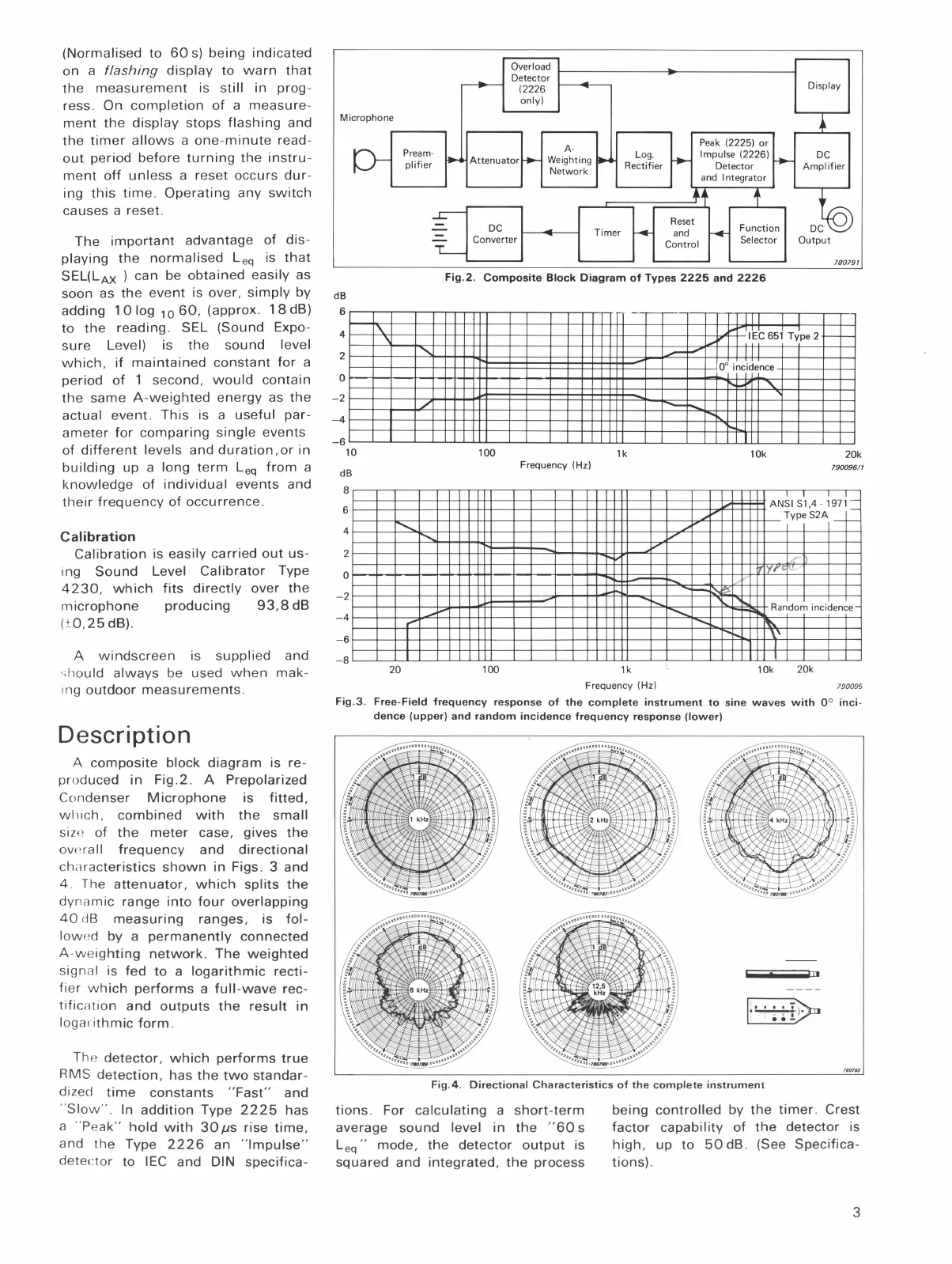
Fig.2. A Prepolarized
Co
ndenser
Microphone
is
fitted,
which,
combined
with
the
small
size
of
the
meter
case,
gives
the
overall
frequency
and
directional
chm
acteristics
shown
in
Figs. 3
and
4 . The
attenuator,
which
splits
the
dy
na
mic
range
into
four
overlapping
40
dB
measuring
ranges,
is
fol-
low
ed
by
a
permanently
connected
A -w e
ighting
network.
The
weighted
signal is
fed
to
a
logarithmic
recti-
fier
which
performs
a
full
-
wave
rec-
tific
il
tion
and
outputs
the
result
in
logar
ithmic
form.
Th e
detector,
which
performs
true
RMS
detection,
has
the
two
standar-
dized
time
constants
"Fast"
and
"
Slow
".
In
addition
Type
2225
has
a " Pe
ak"
hold
with
30
JJ.S
rise
time
,
and
the
Type
2226
an
"Impulse"
dete
ctor
to
IEC
and
DIN
specifica-
Overload
Detector
~
~
(2226
Display
only)
Microphone
p-
A·
Peak
(2225)
or
Pream-
...
Attenuator
~
Weighting
~
Log.
~
Impulse (2226)
~
DC
plifier
Rectifier Detector
Amplifier
Network
and
Integrator
Jt
t
D~
-=--
DC
Reset
Function
- Timer
f-4-
and
.......
-
""'[_____
Converter
Control
Selector
Output
780791
Fig
.
2.
Composite
Block
Diagram
of
Types
2225
and
2226
dB
6
4
2
0
-2
-4
-6
10
dB
8
6
4
2
0
-2
-4
-6
-8
~
'
'
./
100
Frequency (Hz)
.............
:""'.....
--
("'
I
I
l
20
100
l I
~
IEC
651
Type 2
1--
-
""""
---
v
ll
incidence
....
~
r-
1-o...
......
...
1k
.,..-
......
~
......
v
I-'
1-"'
......
~
.............
.........
...........
1k
?...
'-
10k
20k
790096
/ 1
AN~I
s\,4-
~97~-
Type S2A
--=
£
,
Random incidence
"-
\'
I
I
10k
20k
Frequency (Hz)
7
900
95
Fig.3.
Free-Field
frequency
response
of
the
complete
instrument
to
sine
waves
with
0°
inci-
dence
(upper)
and
random
incidence
frequency
response
(lower)
Fig
.
4.
Directional
Characteristics
of
the
complete
instrumen
t
tions.
For
calculating
a
short-term
average
sound
level
in
the
"60s
Leq"
mode,
the
detector
output
is
squared
and
integrated
,
the
process
being
controlled
by
the
timer
.
Crest
factor
capability
of
the
detector
is
high,
up
to
50dB
. (See Speci
fica-
tions).
3

Related product manuals