EasyManua.ls Logo

BRUEL & KJAER 4915 - Operation as a Free-Running Stroboscope; Determination of Motion Frequency or Speed

BRUEL & KJAER 4915
40 pages
Print Icon
To Next Page IconTo Next Page
To Previous Page IconTo Previous Page
Loading...
Mains Voltage Setting
The 4913
may
be
powered
from
100, 115, 127, 200, 220 and 240 V ± 10% (50
to
60 Hz)
single
phase
AC
mains
lines.
To
select
the
correct
mains
voltage
setting,
use a small
coin
or
wide-blade
screwdriver
to
turn
the MAINS
VOLT
AGE
selector
on the
rear
panel so
that
the
appropriate
voltage
setting
on the
selector
lines
up
with
the
black
arrow
printed
on
the
panel.
Fuse Rating
The
mains
fuse
is
contained
in the fuse
holder
immediately
above
the
MAINS INPUT on
the
rear
panel and
may
be released using a
screwdriver
to
turn
the
centre
of
the
holder.
For
operation
from
100
to
127 V
supplies
the fuse
should
be a 1 A
slow
blow
(B & K no.
VF 0013),
whilst
for
200
to
240 V
supplies
it
should
be
an 0,5 A
slow
blow
(B & K no.
VF 0023).
Make
sure
that
only
fuses
of
the
required
rated
current
and
of
specified
type
are
used
for
replacement.
The use
of
mended
fuses
or
short
circuiting
of
the
fuse
holder
is
prohibited.
Supply Connections
Once
the
mains
voltage
setting
and fuse have been
checked,
the
mains
supply
may
be
connected
to
the
MAINS
INPUT
of
the 4913 using
the
Power
Cable
AN 0020 supplied. The
4913 has a
high
standard
of
safety
insulation
in
accordance
with
safety
class
II
of
IEC 348
and
therefore
its
chassis
need
not
be
connected
to
mains
ground.
3.2. OPERATION AS A "FREE RUNNING" STROBOSCOPE
For
use
of
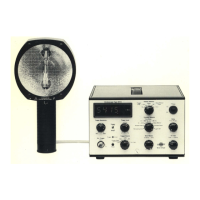
the 4913 as a
"free-running"
stroboscope,
its
internal
generator
is
employed.
This
type
of
operation
is well
suited
for
quick
investigation,
fault
detection
and
measure-
ments
on
rotating
and
reciprocating
machines
operating
at
a
relatively
constant
frequency.
3.2.1. Determination of Motion Frequency or Speed
For
obtaining
a
stationary
stroboscopic
image
of
a
rotating
or
reciprocating
machine,
plus
determination
of
its
motion
frequency,
the
basic
operating
procedure
is as follows:
1.
Carry
out
the
preliminary
checks
and
adjustments
necessary
(see
section
3.1) and
connect
the
drive
cable
plug
of
the
Lamp
Unit
to
the
LAMP
OUTPUT
socket
of
the
4913.
2.
Set
the
front
panel
controls
of
the 4913 as
follows:
DISPLAY SELECTOR:
TRIGGER SOURCE:
FUNCTION SELECTOR:
DELAY:
SLOW
MOTION:
Trigger
Freq.
"Hz"
or
"r/min"
"Int.
Gen."
"Phase
Delay"
extreme
anticlockwise
position
extreme
anticlockwise
position
11