Min
. Ext. Trigger
Hz
;;;.
5
;;;.
5
;;;.
5
;;;.
5
;;;.
8
;;;>
15
;;;.
30
;;;>
60
;;;.
100
Source Frequency
r/
min
;;;.
300
;;;>
300
;;;>
300
;;;.
300
;;;>
480
;;.
goo
;;;.
1,8k
;;;.
3,6k
;;;>
6k
Maximum
Phase
360
°
360°
360° 360°
360° 360°
360
° 360°
360°
Delay
Time
3,6 s
900
ms
450
ms
225
ms
110
ms
60
ms
30
ms
15
ms
9
ms
Camera
Shutter
Setting
"B"
1 s 1/2 s 1/4 s
1/8 s
1/15
s 1/
30
s
1/
60
s
1/ 100 s
Kodak
Tri
-X
B & W
27
DIN
(400 ASA) f 5,6 / 0,5 m ( 1,6 ft) - f 2,8 / 1 m (3,2
ft)
Polaroid
36
DIN
(3000
ASA)
f 22 /
0,5m
(1,6 ft)
-
f
11
/ 1 m (3,2
ft)
Film
E ktrachrome
Colour
24 DIN (200
ASA)
f 5,6/ 0,5 m ( 1,6 ft) - f 2,8 / 1 m (3,2
ft)
Polaroid
20
DIN
(75 ASA)
f 4 I 0,5 m ( 1,6
ft)
- f 2 / 1 m (3,2
ft)
Camera Aperature Setting f / Flash-Subject Distance
m(ft)
811338
Table 3.2.
Exposure
guide
for
synchronized
single
flash
activated
by
"X"
flash
contacts
of
a
camera
Stroboscope.
The
maximum
shutter
speed
setting
for
reliable
"X"
contact
triggering,
depends
on the
particular
camera
employed
and is
usually
limited
to
1
/30
s,
1
/60
s
or
1/100
s.
If in
doubt,
consult
the
camera's
instructions
concerning
use
with
electronic
flash.
To
obtain
sharp,
accurately
exposed
photographs
of
the
subject,
the
camera
should
be
mounted
on a
suitable
tripod
and the
Lamp
Unit
aimed
directly
at
the
subject
either
from
immediately
behind
or
slightly
to
one side
of
the
camera.
Also
all
background
illumination
should be
reduced
as
much
as
possible
so
that
the
light
of
the
Lamp
Unit
dominates.
When using a
shutter
speed
setting
longer
than 1
/30
s,
this
will
usually
necessitate
working
in
very
dim
or
dark
surroundings.
The
exposure
guide
given
in Table 3.2
may
also be used
to
provide
reliable
results
with
other
types
of
black
and
white
film
provided
that
these
have
the
same
film
speed
rating
as
the
Kodak
and
Polaroid
film
indicated.
However,
reliance
should
not
be
placed
in
their
application
to
colour
film
other
than the
particular
types
specified.
This is
because
different
types
colour
film
respond
differently
to
the
illumination
from
very
short
duration
flash
sources,
despite
of
the
the
fact
that
they
have
the
same
film
speed
rating.
It
is
therefore
recommended
that
the user
experiment
with
several
different
exposure
combi-
nations
to
determine
which
is
most
suitable.
3.7. USE WITH AUXILIARY LIGHT SOURCE
A
convenient
auxiliary
light
source
for
use
with
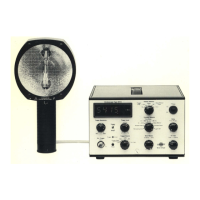
the 4913,
is
the
B & K
Portable
Strobo-
scope
Type
4912.
This
is
shown
in Fig. 3.6 and is a
completely
self-contained,
hand-held
unit
which
can
be
operated
either
from
its
own
built-in
rechargeable
batteries
or
from
an
external
DC
source.
For
operation
at
flash rates
of
25 Hz
or
more,
it
is
capable
of
producing
an
average
light
output
greater
than 1 and 2,5 k
lux
at
a
range
up
to
500 and
250mm
respectively.
For
combined
use
of
the
two
Stroboscopes,
the FUNCTION
SELECTOR
of
the
4912
should
be
set
to
"Ext.
Trig."
and the
centre
contact
and
outer
screen
of
its
EXT: TRIGGER
INPUT
connected
to
the
SIGNAL OUTPUT
of
the 4913
using
the
BNT
plug
(B & K
no
JP
0315) and
6-pin
plug
(B & K no. JP 0600) supplied.
With
the
4912
connected
to
the
"Flash
Ignition"
SIGNAL OUTPUT
line
(see Fig 3.7),
it
will
flash
in
direct
synchronism
with
the
Lamp
Unit
US 0008,
whilst
when
connected
to
the
"Flash
Trigger
Ref"
the
flash
ignition
of
US 0008
with
respect
to
that
of
the 4912 will be
delayed
in
accordance
with
the
particular
phase
or
time
delay
set
on
the
4913. If
required
more
than
one
4912
may
be
connected
without
having
an
adverse
influence on the 4913.
19


 To Next Page
 Loading...