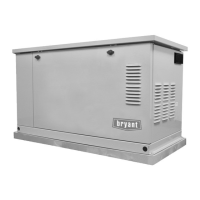
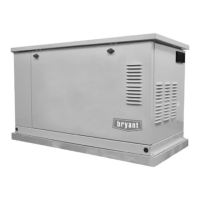
This document is the owner's manual for Bryant air-cooled, prepackaged automatic standby generators, specifically models ASPAS1BBA007 (6 kW NG, 7 kW LP), ASPAS1BBA012 (12 kW NG, 12 kW LP), and ASPAS1BBA015 (13 kW NG, 15 kW LP). These generators are designed to automatically supply electrical power to critical loads during a utility power failure. They are compact, high-performance, engine-driven units, factory-installed in an all-weather metal enclosure intended exclusively for outdoor installation. The generators can operate using either vapor-withdrawn liquid propane (LP) or natural gas (NG).
The manual emphasizes reading all safety rules carefully before installation, operation, or servicing. It highlights that the engine exhaust contains carbon monoxide, which can be deadly, and stresses that the generator MUST be installed outdoors. Potentially lethal voltages are generated, and all steps must be taken to render the machine safe before working on it. Parts of the generator are rotating and/or hot during operation, requiring caution. The document also warns against explosion hazards due to gaseous fuels and fire hazards, recommending a fire extinguisher be kept nearby. Electrical hazards are present, and contact with bare wires or terminals should be avoided. The generator's frame and external electrically conductive parts must be connected to an approved earth ground. Before any maintenance, the AUTO/OFF/MANUAL switch must be set to OFF, and the 7.5A and 15A fuses removed from the control panel to prevent accidental start-up.
Technical Specifications (Generator):
- Models: ASPAS1BBA007, ASPAS1BBA012, ASPAS1BBA015
- Rated Max. Continuous Power Capacity:
- ASPAS1BBA007: 6,000 NG / 7,000 LP Watts
- ASPAS1BBA012: 12,000 NG / 12,000 LP Watts
- ASPAS1BBA015: 13,000 NG / 15,000 LP Watts
- Rated Voltage: 120/240 Volts
- Rated Max. Continuous Load Current (Amps):
- ASPAS1BBA007: 50.0 NG / 58.3 LP (120V), 25.0 NG / 29.2 LP (240V)
- ASPAS1BBA012: 100.0 NG / 100.0 LP (120V), 50.0 NG / 50.0 LP (240V)
- ASPAS1BBA015: 108.3 NG / 125.0 LP (120V), 54.2 NG / 62.5 LP (240V)
- Main Line Circuit Breaker: 30 Amp (ASPAS1BBA007), 50 Amp (ASPAS1BBA012), 70 Amp (ASPAS1BBA015)
- Phase: 1
- Number of Rotor Poles: 2
- Rated AC Frequency: 60 Hz
- Power Factor: 1
- Recommended Air Filter: Bryant Part # 0C8127 (all models)
- Battery Requirement (at 0°F -17.8°C): Group 26, 12 Volts, 350 Cold-cranking Amperes Minimum (ASPAS1BBA007); 525 Cold-cranking Amperes Minimum (ASPAS1BBA012, ASPAS1BBA015)
- Weight: 375 Pounds (ASPAS1BBA007), 470 Pounds (ASPAS1BBA012), 487 Pounds (ASPAS1BBA015)
- Output Sound Level @ 23 ft (7m) at full load: 68 db (A) (ASPAS1BBA007), 70.5 db (A) (ASPAS1BBA012), 71.5 db (A) (ASPAS1BBA015)
- Normal Operating Range: -20°F (-28.8°C) to 104°F (40°C)
Technical Specifications (Engine):
- Type of Engine: GH-410 (ASPAS1BBA007), GT-990 (ASPAS1BBA012, ASPAS1BBA015)
- Number of Cylinders: 1 (ASPAS1BBA007), 2 (ASPAS1BBA012, ASPAS1BBA015)
- Rated Horsepower: 14.5 @ 3,600 rpm (ASPAS1BBA007), 30 @ 3,600 rpm (ASPAS1BBA012, ASPAS1BBA015)
- Displacement: 410cc (ASPAS1BBA007), 992cc (ASPAS1BBA012, ASPAS1BBA015)
- Cylinder Block: Aluminum w/Cast Iron Sleeve
- Valve Arrangement: Overhead Valves
- Ignition System: Solid-state w/Magneto
- Recommended Spark Plug: RC12YC
- Spark Plug Gap: 0.76 mm (0.030 inch) (ASPAS1BBA007), 0.508 mm (0.020 inch) (ASPAS1BBA012, ASPAS1BBA015)
- Compression Ratio: 8.6:1 (ASPAS1BBA007), 9.5:1 (ASPAS1BBA012, ASPAS1BBA015)
- Starter: 12 Vdc
- Oil Capacity Including Filter: Approx. 1.5 Qts (ASPAS1BBA007), Approx. 1.7 Qts (ASPAS1BBA012, ASPAS1BBA015)
- Recommended Oil Filter: Bryant Part # 70185
- Recommended Air Filter: Bryant Part # 0C8127
- Operating RPM: 3,600
Usage Features:
- Automatic Operation: The generator automatically starts and transfers loads to standby power when utility voltage drops below a preset level. Upon utility power restoration, it retransfers loads and shuts down after a cool-down period.
- Manual Operation: The generator can be manually started and stopped using the AUTO/OFF/MANUAL switch. Manual transfer of loads to standby power is also possible.
- Exercise Timer: Equipped with an exercise timer, the generator can be set to start and run for approximately 12 minutes once every seven days at a chosen day and time. During exercise, loads are not transferred to the generator output. The exerciser needs to be reset if the battery is disconnected.
- Control Panel: Features an AUTO/OFF/MANUAL switch, fuses (7.5A for accessory socket, 15A for DC control/battery charge), a 12 VDC accessory outlet, and LEDs for System Set, Low Oil, High Temp, Over Speed, and Over Crank.
- 12 VDC Accessory Outlet: Located on the control panel, it can temporarily power low-power automotive-style accessories (MAX 7.5 Amps) when the generator is running or in standby mode. It draws power from the starting battery and should not be used for battery charging.
- 120 VAC GFCI Outlet: An external 15-amp, 120-volt GFCI convenience outlet is located in the right rear of the enclosure. It can power items like lights or power tools when the generator is running (in absence of utility power or in manual mode).
- Fuel Requirements: Uses vapor withdrawal LP gas or natural gas. Factory set for natural gas but can be reconfigured for LP. Requires specific fuel pressures: 5-7 inches water column for natural gas and 11-14 inches water column for LP.
- Location: Must be installed outdoors on a level surface, allowing adequate cooling and ventilating air. Sufficient room (three feet) on all sides for maintenance is recommended. The transfer switch is enclosed in a NEMA 1 enclosure for indoor use only.
- Protection Systems:
- Low Oil Pressure Switch: Shuts down the engine if oil pressure drops below 8 psi. The Low Oil LED lights up.
- High Temperature Switch: Shuts down the engine if temperature exceeds approximately 140°C (284°F). The High Temp. LED lights up, and the generator automatically restarts and resets once temperature returns to a safe level.
- Over Crank: Prevents engine damage from continuous starting attempts if a problem (e.g., no fuel) prevents it from starting. The unit cranks and rests for preset time limits, then stops, and the Over Crank LED lights up.
- Over Speed: Shuts down the generator if it runs faster than a preset limit to prevent damage to the unit and connected appliances. The Over Speed LED lights up.
- NEC Requirement for Arc Fault Circuit Interruption Breaker for Bedrooms: If providing backup power to a bedroom branch circuit, the circuit breaker in the Bryant Transfer Switch should be replaced with an Arc Fault Circuit Interrupter (AFCI) of the same amperage.
Maintenance Features:
- Break-in Procedure: A recommended procedure after installation to ensure correct generator operation, involving running the unit at various load percentages, then draining and refilling oil, and replacing the oil filter.
- Oil Level Check: Involves running the engine briefly, then checking the dipstick. Oil should be at the "Full" mark.
- Oil Change: Recommended after the break-in period and annually thereafter. Involves warming up the engine, draining oil via a drain hose, and refilling with recommended SAE 5W-30 Synthetic oil (after initial organic break-in oil).
- Oil Filter Change: Recommended after the break-in period and annually thereafter. Involves removing the old filter, applying clean oil to the new filter's gasket, screwing it on, and tightening.
- Engine Air Cleaner Change: Involves loosening screws, removing the cover and filter, wiping debris, installing a new filter, and re-securing the cover.
- Spark Plug(s) Maintenance: Involves cleaning the area around the spark plug(s), removing and checking their condition, replacing if worn, and adjusting the gap to specified measurements (0.76 mm for 7 kW, 0.508 mm for 12/15 kW).
- Battery Maintenance: Regular inspection includes checking posts and cables for tightness and corrosion, checking fluid level (for unsealed batteries), and verifying charge state with a hydrometer.
- Cooling System: Air inlet and outlet openings must be kept open and unobstructed (clear of grass, weeds, brush, leaves, snow) to prevent overheating.
- Corrosion Protection: Periodically wash and wax the enclosure, especially in salt water/coastal areas. Spray engine linkage parts and brackets with corrosion-inhibiting spray.
- Out of Service Procedure: For storage longer than 90 days, involves warming up the engine, closing the fuel shutoff, setting the main circuit breaker and AUTO/OFF/MANUAL switch to OFF, removing fuses, disconnecting battery cables, draining and refilling oil, spraying fogging agent into spark plug openings, removing and storing the battery, and cleaning the generator.
- Return to Service Procedure: Reverses the out-of-service steps, including verifying oil, checking/recharging battery, reconnecting battery and fuses, opening fuel shutoff, and starting the unit. The exercise timer must be reset if the battery was dead or disconnected.
- Service Schedule: A table outlining recommended inspection, change, and cleaning procedures for various components (fuel lines, oil, oil filter, enclosure louvers, battery, air cleaner, spark plugs, general condition) and their frequencies (weekly, monthly, yearly, every 6 months, after break-in). Complete tune-ups are to be performed by a Bryant Dealer.

 Need help?
 General

 To Next Page