~
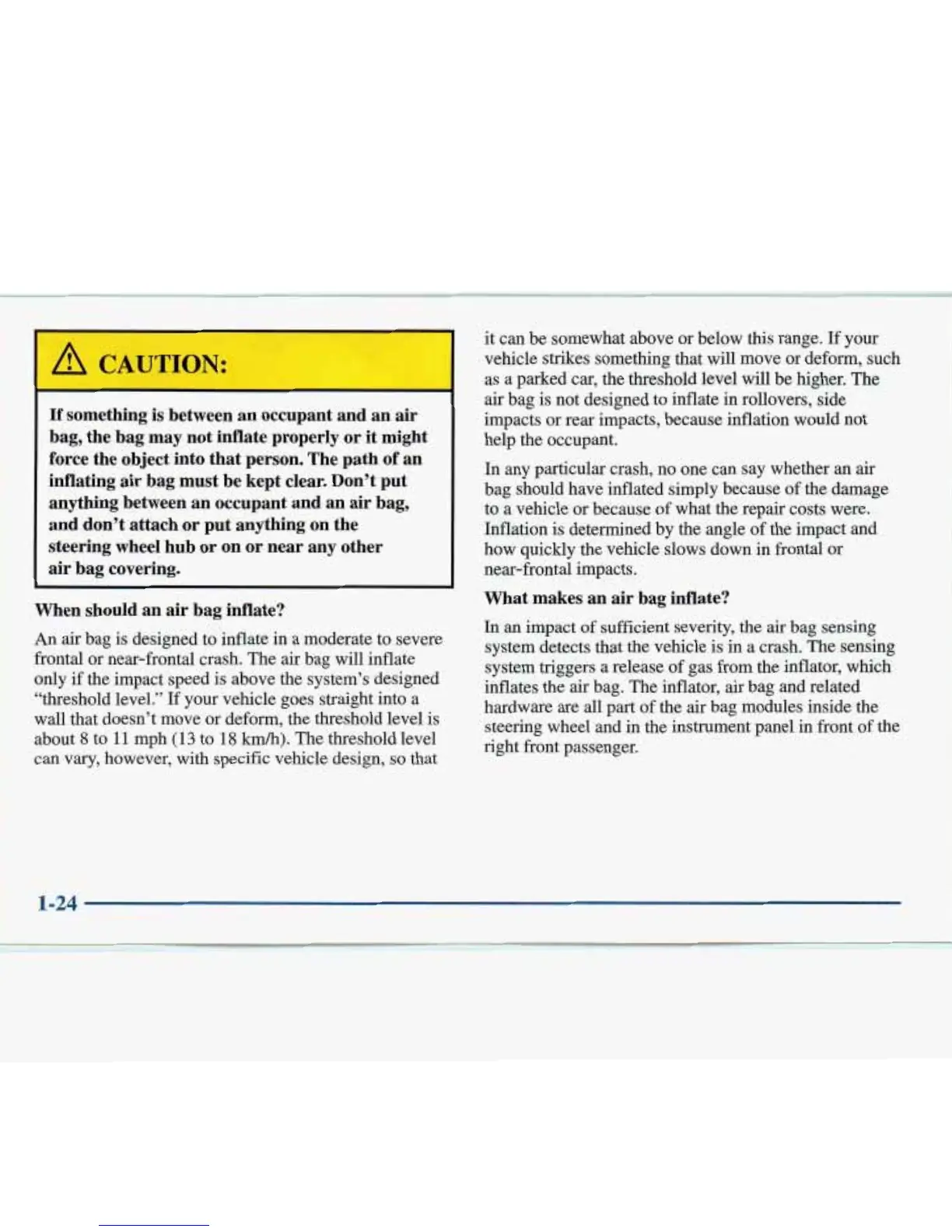
If
something
is
between an occupant and an air
bag, the bag may not inflate properly or it might
force the object into that person. The path of an
inflating air bag must be kept clear. Don’t put
anything between an occupant and an air bag,
and don’t attach or put anything on the
steering wheel hub
or
on or near any other
air
bag covering.
When should an air bag inflate?
An
air bag is designed to inflate
in
a moderate to severe
frontal or near-frontal crash. The air bag will inflate
only
if
the impact speed is above the system’s designed
“threshold level.”
If
your vehicle goes straight into a
wall that doesn’t move or deform, the threshold level is
about
8 to
11
mph
(13
to 18
km/h).
The threshold level
can vary, however, with specific vehicle design,
so
that
it can be somewhat above or below
this
range. If your
vehicle strikes something that will move or deform, such
as a parked car, the threshold level will be higher. The
air bag is not designed to inflate in rollovers, side
impacts or
rear
impacts, because inflation would not
help the occupant.
In any particular crash, no one can say whether an
air
bag should have inflated simply because of the damage
to a vehicle or because of what the repair costs were.
Inflation
is
determined by the angle of the impact and
how quickly the vehicle slows down in frontal or
near-frontal impacts.
What makes an air bag inflate?
h
an impact
of
sufficient severity, the
air
bag sensing
system detects that the vehicle is in a crash. The sensing
system triggers a release of gas from the inflator, which
inflates the air bag. The inflator,
air
bag and related
hardware are all part of the air bag modules inside the
steering wheel and in the instrument panel in front of the
right front passenger.
1-24





 To Next Page