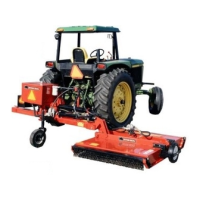
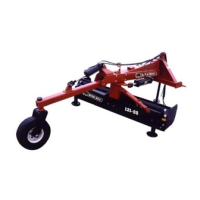
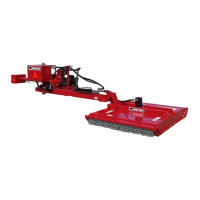
The provided manual describes the Bush Hog Model SM 60 Side Mount Rotary Cutter, an agricultural implement designed for cutting brush along ditches and banks.
Function Description
The Bush Hog SM 60 is a hydraulically powered side-mount rotary cutter. Its primary function is to cut brush up to 1 inch (2.5 cm) in diameter. The cutter is designed to be mounted on a tractor's 3-point hitch and is driven by the tractor's PTO (Power Take-Off). A hydraulic gear pump, powered by the PTO, delivers hydraulic oil to a hydraulic motor that drives the cutter deck. The cutter deck's slide and pivot cylinders are controlled by the tractor's auxiliary hydraulic system, allowing for precise positioning and adjustment during operation. Front and rear discharge shields are standard, aiming to manage debris discharge. The manual also notes the possibility of reversing blade rotation for certain cutting operations, though this requires specific safety precautions.
Important Technical Specifications
The manual provides detailed specifications for two models: SM60R and SM160R, differing primarily in their PTO speed requirements and motor speeds.
General Specifications:
- Brush Cutting Capacity: Up to 1 inch (2.5 cm) in diameter.
- Minimum Tractor Weight (not including ballast): 6000 lbs. (2722 kg).
- Minimum PTO Horsepower: 50 HP.
- Cutting Width: 60 inches.
- Max. Reach from Center of Tractor: 145 inches.
- Transport Width: 120-1/2 inches.
- Weight: 1580 lbs.
- Hydraulic Oil Capacity: 35 gallons.
- Maximum Hydraulic System Pressure: 3200 psi.
- Hitch Size: Cat. II Std., Cat. II & III Quick Hitch.
Model-Specific Specifications:
SM60R:
- Required PTO Speed: 540 rpm.
- Pump Output: 21.4 gpm.
- Motor Speed: 1101 rpm.
- Blade Tip Speed: 17,300 ft./min.
- Blade Type: 1/2" x 3" Double Edge.
SM160R:
- Required PTO Speed: 1000 rpm.
- Pump Output: 19.1 gpm.
- Motor Speed: 1182 rpm.
- Blade Tip Speed: 18,570 ft./min.
- Blade Type: 1/2" x 3" Double Edge.
The hydraulic circuit includes a 10-micron filter with a 15 PSI bypass and a 3200 PSI relief valve.
Usage Features
The manual emphasizes several key usage features and recommendations:
- Tractor Compatibility: Requires a tractor weighing at least 6000 lbs. (2722 kg) and with a minimum of 50 PTO horsepower. Front ballast is recommended for added steering stability. Tractor rear wheel base should not exceed 92 inches (233.7 cm).
- Mounting: The cutter connects to the tractor's 3-point hitch. Stabilizer bars, sway blocks, or chains are necessary to prevent mower swaying. Driveline length must be correctly matched to the tractor to prevent pump failure.
- Operation:
- Starting: Engage PTO at idle speed and allow 2-3 minutes for hydraulic fluid to warm up.
- Speed: Do not exceed 3 mph forward speed.
- Cutting Height Adjustment: The cutter deck's front should be 1-2 inches (25-51 mm) higher than the rear. The 3-point hitch position control should be set to prevent accidental dragging of the sliding beam.
- Ditch/Bank Work: Exercise caution when working along ditches. If the cutter contacts the ground or thick brush, it may cause the tractor's front wheels to slide into the ditch. For unseen obstacles, adjust the cutter deck 2-3 inches above normal cutting height. Avoid stalling the cutter repeatedly to prevent overheating.
- Pivot Cylinder: The pivot cylinder is single-acting, providing hydraulic pressure only for raising the deck. Operators should be aware that raising the deck too high on steep banks can cause the tractor to go over its center of gravity.
- Blade Rotation: The blade rotation can be reversed (counter-clockwise) by replumbing the hydraulic motor. However, this requires the cutter deck to be equipped with safety chains, and the operator must wear safety glasses and a hard hat.
- Parking: When parking, apply the tractor parking brake, disengage PTO, slide the cutter deck in, raise and pin the cutter deck in the travel position, pin the parking stand down, lower the implement to the ground, and shut down the tractor.
- Transport: The manual advises reducing speed when transporting to avoid bouncing and loss of steering. Using tractor flashing warning lights and an SMV (Slow Moving Vehicle) sign is recommended on roads.
- Safety: The manual includes extensive safety precautions, emphasizing reading the operator's manual, familiarizing oneself with controls and decals, performing pre-operation inspections, keeping the area clear of people and objects, wearing personal protective equipment (eye, ear, foot, hand, head protection), and never operating without all guards and shields in place. It also strongly recommends that the tractor be equipped with a Rollover Protective System (ROPS) and a seat belt, and that the cutter deck be enclosed by permanent bands, safety chains, or other factory-approved safety shields to reduce the risk of thrown objects.
Maintenance Features
The manual outlines a comprehensive maintenance schedule and procedures:
- Before Each Use:
- Check hydraulic oil level in the tank (fill to bottom of filler strainer).
- Inspect hydraulic lines and fittings for wear or leaks.
- Lubricate PTO driveline universal joints with multi-purpose grease.
- Apply 2-3 shots of multi-purpose grease to PTO driveline guard plastic fittings.
- Check tractor tire air pressure.
- Check blades and spindle for foreign objects.
- Check blade bolts for tightness (torque to 450 ft./lbs. (609.7 Nm)).
- Clean all debris from the machine, especially the underside of the deck.
- Check that cables are tight.
- Inspect blades for wear and replace if necessary (always replace both blades with a matched pair using genuine Bush Hog parts).
- Inspect chains and/or side bands for good repair.
- Listen for abnormal sounds during operation.
- Every 40 Hours:
- Disconnect and separate PTO driveline sections, clean the inner (male) section, and apply multi-purpose grease to the inside of the outer (female) section. Reassemble and ensure yokes lock into place.
- Clean sliding surfaces of slide assemblies and apply a thin coat of graphite-based or multi-purpose grease.
- Check oil level in the spindle assembly (with the cutter deck horizontal, remove the check plug at the top of the housing and fill with EP80W-90 gear oil as necessary).
- Every 150 Hours:
- Wipe cables with an oil-soaked rag.
- Yearly:
- Drain hydraulic tank while oil is warm.
- Clean suction strainer and filler strainer with compressed air.
- Replace return line filter.
- Refill tank with new hydraulic oil (filter to 10 microns before filling). Recommended hydraulic oils are listed (e.g., Chevron AW46, Mobil DTE-25, Texaco Rando HD46). Do not use motor oil or transmission oil.
- Drain spindle housing and refill with EP80W-90 gear oil (capacity 26 fl. oz.).
- Blade Holder Removal/Installation: Involves removing the cotter pin and castle nut. A gear puller may be needed for removal. Tighten the castle nut to 300 ft./lbs. (406 Nm) upon installation.
- Blade Replacement: Blades should be replaced in matched pairs using genuine Bush Hog parts. Nuts should be tightened to 450 ft./lbs. (610 Nm). Blades must swing freely.
- Cable Adjustment: Involves extending the slide cylinder, loosening eye bolts, positioning the counterweight box 1 inch (25.4 mm) from the hydraulic tank, and then tightening eye bolts until slack is removed.
- Hydraulic Pressure Adjustment: The system is factory preset at 3200 psi. Adjustments should only be made by an authorized Bush Hog dealer due to the risk of serious injury and equipment damage from incorrect settings.
- Troubleshooting: A table is provided for common issues like noisy hydraulic pump, overheated hydraulic fluid, continuously stalling cutter, and cutter deck not pivoting down, along with probable causes and remedies.
- Storage: Procedures include applying grease to sliding assemblies, relieving hydraulic pressure, disconnecting hydraulic lines and driveline, cleaning debris, and oiling pivot points and cables.
- Torque Specifications: Detailed tables are provided for both American and Metric fasteners, specifying recommended torque values in foot-pounds (Newton Meters) for different bolt grades and sizes. It notes to use 75% of the specified value for plated fasteners and 85% for lubricated fasteners.

 Need help?
 General



 To Next Page