The
four-speed record player
is
designed
to
operate
on
a.c.
mains only
of
200-250
volts,
50
cycles
per
second. Mains
frequen-
cies
of 40 or 60
cycles
per
second
may be
used
if the
appropriate
drive
pulley
is
substituted
in the
record
player.
LOUVRED
VENTILATION
PANEL
REMOVED
TO
SHOW
MAINS-VOLTAGE
ADJUSTMENT
PLUG
2H6/A
Fig.
2
Mains-voltage
adjustment
The
mains-voltage adjustment plug
(Fig.
2) is set to the
225/
250
tap,
when
the
record
player
leaves
the
factory.
Should
an
alteration
to the
setting
of the
voltage-adjustment plug
be
neces-
sary—disconnect
the
instrument
completely from
the
mains supply
and
remove
the
louvred ventilation plate
from
the
inside front edge
of
the
turntable compartment (Fig.
2).
Place
the
plug
in the
200/225
tap for
mains voltages between
200
and
225.
Place
the
plug
in the
225/250
tap for
mains voltages between
225
and
250.
Replace
the
louvred ventilation plate.
OPERATING
THE
INSTRUMENT
Place
the
record player
on a
level,
firm
surface. Ensure that
the
pick-up
plug (Fig.
1) is
inserted
in the
"Amp. Input" socket.
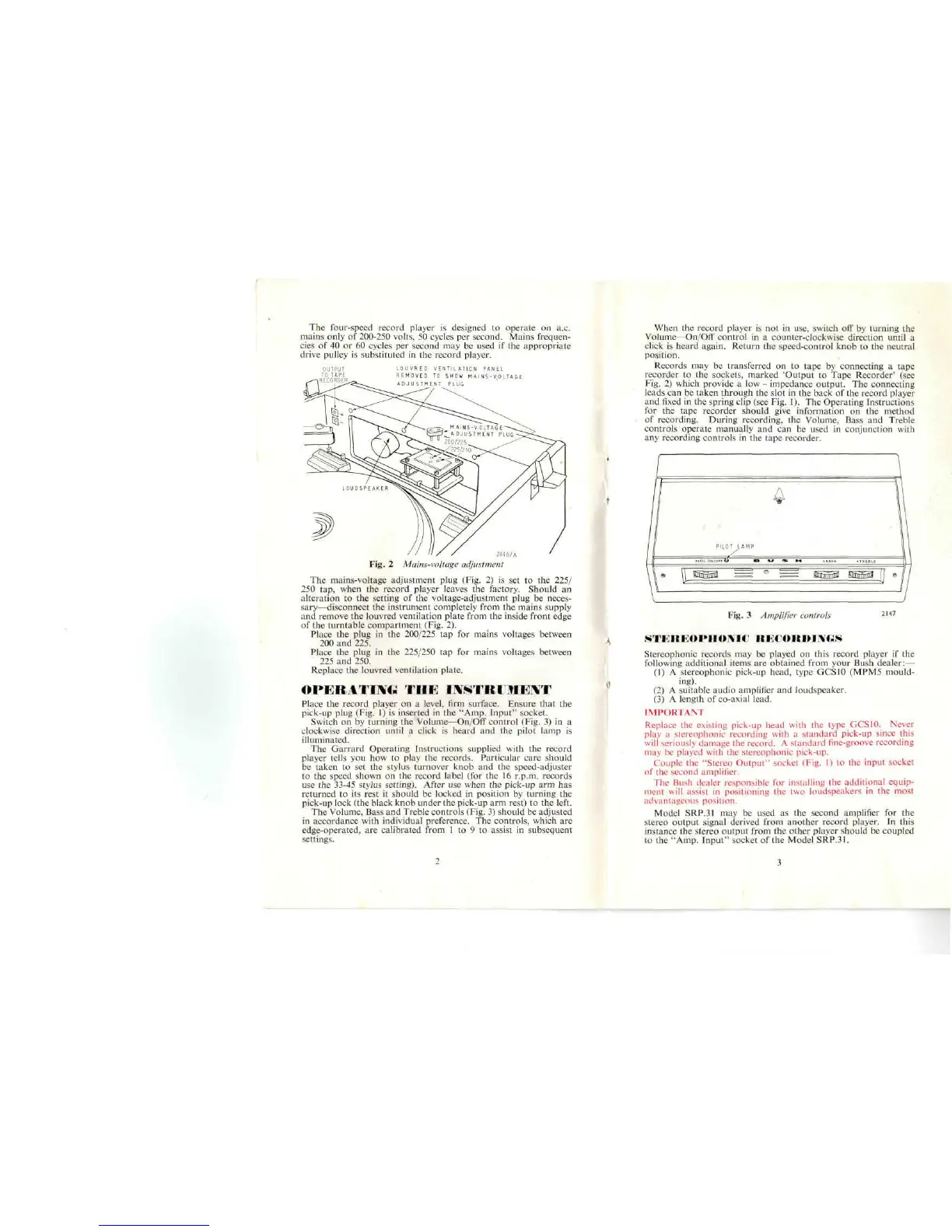
Switch
on by
turning
the
Volume—On/Off
control (Fig.
3) in a
clockwise direction
until
a
click
is
heard
and the
pilot lamp
is
illuminated.
The
Garrard
Operating Instructions supplied with
the
record
player tells
you how to
play
the
records. Particular
care
should
be
taken
to set the
stylus turnover knob
and the
speed-adjuster
to the
speed shown
on the
record label (for
the
16
r.p.m.
records
use
the
33-45 stylus setting). After
use
when
the
pick-up
arm has
returned
to its
rest
it
should
be
locked
in
position
by
turning
the
pick-up lock (the black knob under
the
pick-up
arm
rest)
to the
left.
The
Volume, Bass
and
Treble controls (Fig.
3)
should
be
adjusted
in
accordance
with individual preference.
The
controls, which
are
edge-operated,
are
calibrated from
1 to 9 to
assist
in
subsequent
settings.
When
the
record
player
is not in
use,
switch
off
by
turning
the
Volume—On/Off
control
in a
counter-clockwise direction until
a
click
is
heard again. Return
the
speed-control knob
to the
neutral
position.
Records
may be
transferred
on to
tape
by
connecting
a
tape
recorder
to the
sockets, marked
'Output
to
Tape
Recorder'
(see
Fig.
2)
which provide
a
low
-
impedance output.
The
connecting
leads
can be
taken through
the
slot
in the
back
of the
record player
and fixed in the
spring clip (see
Fig.
1). The
Operating Instructions
for
the
tape recorder should give information
on the
method
of
recording. During recording,
the
Volume, Bass
and
Treble
controls
operate manually
and can be
used
in
conjunction with
any
recording
controls
in the
tape
recorder.
,1
' *
1
PILOT
LAMP
Fig.
3
Amplifier
controls
2
'
47
"»
I I
181
OI'UOM<
RECORDINGS
Stereophonic
records
may be
played
on
this
record
player
if the
following
additional items
are
obtained from your Bush
dealer:—
(1)
A
stereophonic pick-up
head,
type
GCS10
(MPM5 mould-
ing).
(2) A
suitable audio amplifier
and
loudspeaker.
(3)
A
length
of
co-axial lead.
IMPORTANT
Replace
the
existing
pick-up
head
with
the
type
GCS10.
Never
play
a
stereophonic recording with
a
standard
pick-up since this
will
seriously
damage
the
record.
A
standard
fine-groove
recording
may be
played
with
the
stereophonic pick-up.
Couple
the
"Stereo Output" socket
(Fig.
1) to the
input socket
of the
second
amplifier.
The
Bush
dealer
responsible
for
installing
the
additional equip-
ment
will
assist
in
positioning
the two
loudspeakers
in the
most
advantageous
position.
Model
SRP.31
may be
used
as the
second
amplifier
for the
stereo
output signal derived from
another
record
player.
In
this
instance
the
stereo
output
from
the
other
player
should
be
coupled
to the
"Amp.
Input"
socket
of the
Model
SRP.31.



 To Next Page
 Loading...