EasyManua.ls Logo

CAEL 4PG8000 - User Manual

CAEL 4PG8000
16 pages
Print Icon
To Next Page IconTo Next Page
Loading...
Capital Automotive Equipment
Model:4PG8000
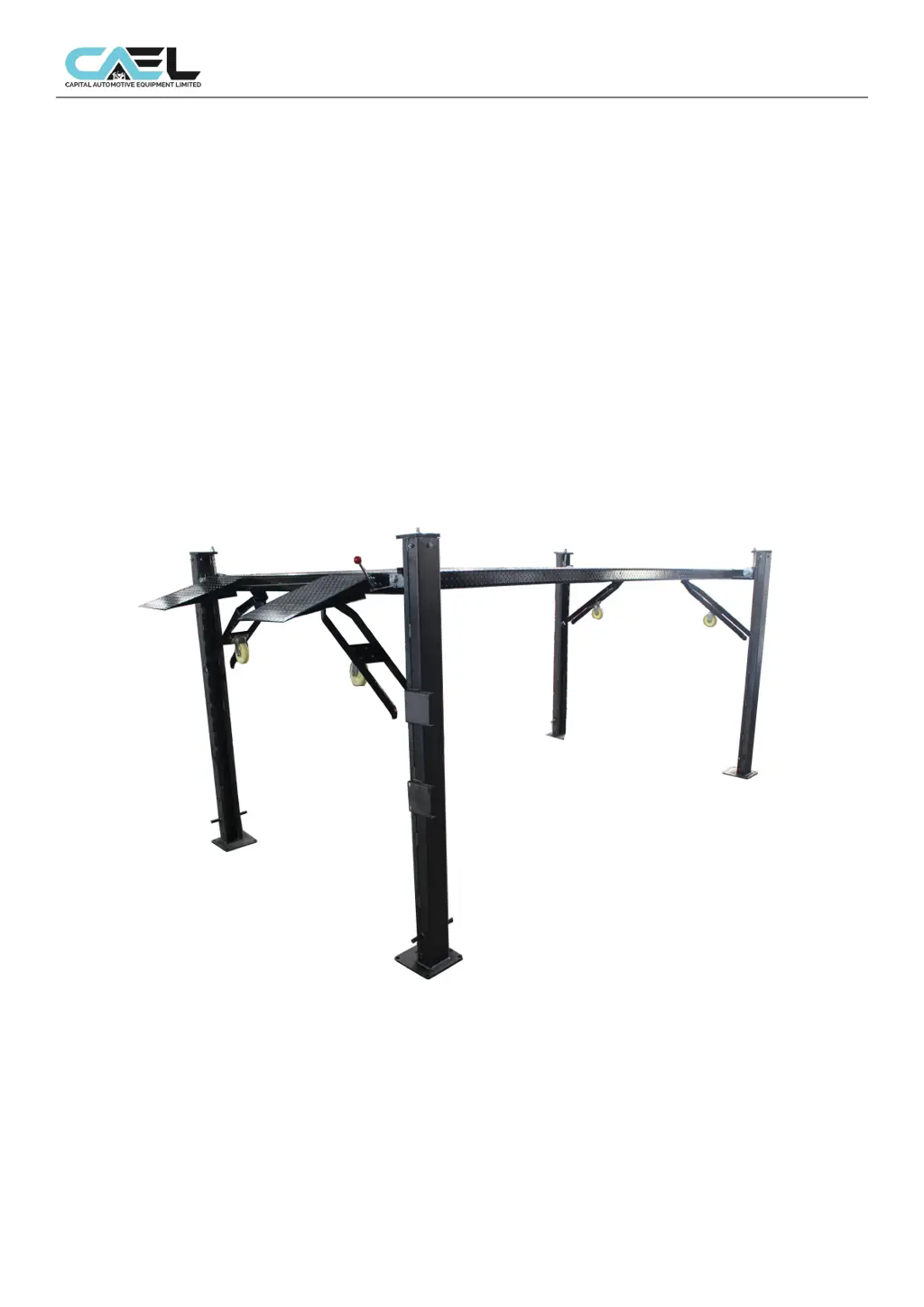
Four Post Car parking Lift
4PG8000 manual operation and manual lock release
Installation and Operation Manual
4PG8000 with optional casters

Questions and Answers

Overview

This document describes the CAEL 4PG8000 Four Post Car Parking Lift, an installation and operation manual for a vehicle lifting system.

Function Description

The 4PG8000 is a four-post car parking lift designed for lifting various vehicles. Its primary function is to elevate vehicles for parking, testing, repair, maintenance, and care. The lift is intended for indoor installation only and is equipped with safety features to ensure secure operation.

Important Technical Specifications

  • Model: 4PG8000
  • Lifting Capacity: 8000 lbs (3600 kg)
  • Package Weight: 910 kg
  • Package Dimensions: 4750 mm (length) x 534 mm (width) x 710 mm (height)
  • Layout Dimensions (approximate):
    • Overall Length: 209.4 inches (5318 mm)
    • Overall Width: 104.88 inches (2664 mm)
    • Overall Height: 90.98 inches (2311 mm)
    • Runway Length: 191 inches (4851 mm)
    • Runway Width (each): 18.5 inches (470 mm)
    • Distance between runways: 37 inches (940 mm)
    • Lift Height: 78.7 inches (2000 mm)
  • Concrete Requirements for Installation: 3000 PSI concrete with a minimum thickness of 150 mm and an extension of at least 1.5 m from anchoring points. New concrete must be cured for at least 20 days.
  • Storage Temperature: -25ºC to 55ºC
  • Anchor Bolt Tightening Torque: 80 Nm

Usage Features

  • Intended Use: Designed to lift vehicles weighing less than 8000 lbs (3600 kg) for vehicle testing, repair, maintenance, and care.
  • Safety Precautions:
    • Operators must read the entire manual before installation and operation.
    • A safety area of at least 1 meter free from the lift must be maintained during lifting and lowering.
    • Operation is only permitted from the operator's control site within the safety area.
    • Presence under the vehicle is only allowed when the vehicle is lifted and the safety lock is engaged.
    • Never use the lift if safety devices are offline.
    • Ensure the vehicle's motor is off, gear engaged, and parking brake is on before lifting.
    • Only authorized vehicles within the maximum lifting capacity should be lifted.
    • Mechanical safeties must be engaged before working on or near the vehicle.
    • Never leave the lift in an elevated position unless safeties are engaged.
    • Do not use for washing or spraying vehicles.
    • Do not install or use on asphalt, cracked, or defective concrete, or elevated floors without consulting a building architect.
    • Do not install or use outdoors.
  • Operation:
    • Raising the lift: Position vehicle tires in the center of each runway, set the parking brake or use wheel chocks. Ensure all personnel are clear. Press and hold the "UP" button on the power unit. Once at the desired height, the lift will automatically lower onto the nearest safety lock. Ensure all four safeties are engaged before entering the work area.
    • Lowering the lift: Raise the lift off the safety locks by pushing the "UP" button for at least two inches to clear the locks. Press the LOCK RELEASE HANDLE to disengage lock latches. Push the LOWERING HANDLE on the power unit until the lift is fully descended. Pay careful attention to ensure all personnel and objects are clear and all four locks are disengaged.
  • Synchronization Adjustment: The manual describes a process to repeat lifting and lowering the lift several times to ensure the tensile force and balance of the four steel cables, adjusting cable nuts if necessary.
  • Loading Test: A loading test is recommended to check if the hydraulic system works normally when loading heavy weight.

Maintenance Features

  • Important Safety Instructions: Always cut off the power supply before servicing the lift.
  • Maintenance Schedule:
    • Weekly:
      • Check rubber pads for wear on support arms/disk adapters.
      • Lubricate all rollers with general purpose oil or WD-40.
      • Check all cable connections, bolts, and pins for proper mounting.
      • Lubricate safety lock pivot points with general purpose oil or WD-40.
    • Monthly:
      • Check safety locks for good operating condition.
      • Check all cables for excessive signs of wear.
      • Visually inspect all moving parts for excessive signs of wear.
      • Replace all faulty parts before operating the lift.
      • Lubricate all bearings and hinges.
      • Lubricate the lock latch, steel cable, and some other moving parts.
    • Every 3 Months: Check the steel cable for abrasion or damage.
    • Every 6 Months:
      • Grease slide tracks inside the columns (more frequently if noise occurs).
      • Check nuts of anchor bolts for correct torque and retighten as required (80 Nm).
    • Annually (12 Months):
      • Check hydraulic fluid level (with lift fully lowered, fluid level must be above min level).
      • Visually check all hydraulic hoses for tightness.
      • Replace hydraulic oil once a year (fill by filter).
      • Annual inspection by qualified service personnel is recommended.
  • Hydraulic System Maintenance: The hydraulic fluid must be replaced periodically depending on aging, soiling, and water absorption. Pressure hoses should be replaced as required, but after six years at the latest.
  • Cleaning: Periodically wash off aggressive substances and treat the lift with oil or wax spray. Repair paintwork damage immediately to prevent corrosion. Do not use high-pressure/steam jet cleaners or caustic cleaning agents.
  • Troubleshooting Guide: The manual includes a comprehensive troubleshooting section with possible causes and solutions for common issues such as the lift not working, not raising, or not lowering smoothly, and the motor not stopping.
  • Disposal of Used Oil: Used oil must be treated as a polluting product and disposed of according to legal prescriptions.
  • Machine Demolition: Demolition must be carried out by authorized technicians, with metallic parts scrapped as iron and all materials disposed of according to current laws. Documentation for tax purposes is required.

CAEL 4PG8000 Specifications

General IconGeneral
BrandCAEL
Model4PG8000
CategoryLifting Systems
LanguageEnglish