24
............................................................................................................................................................................................................................................
S2
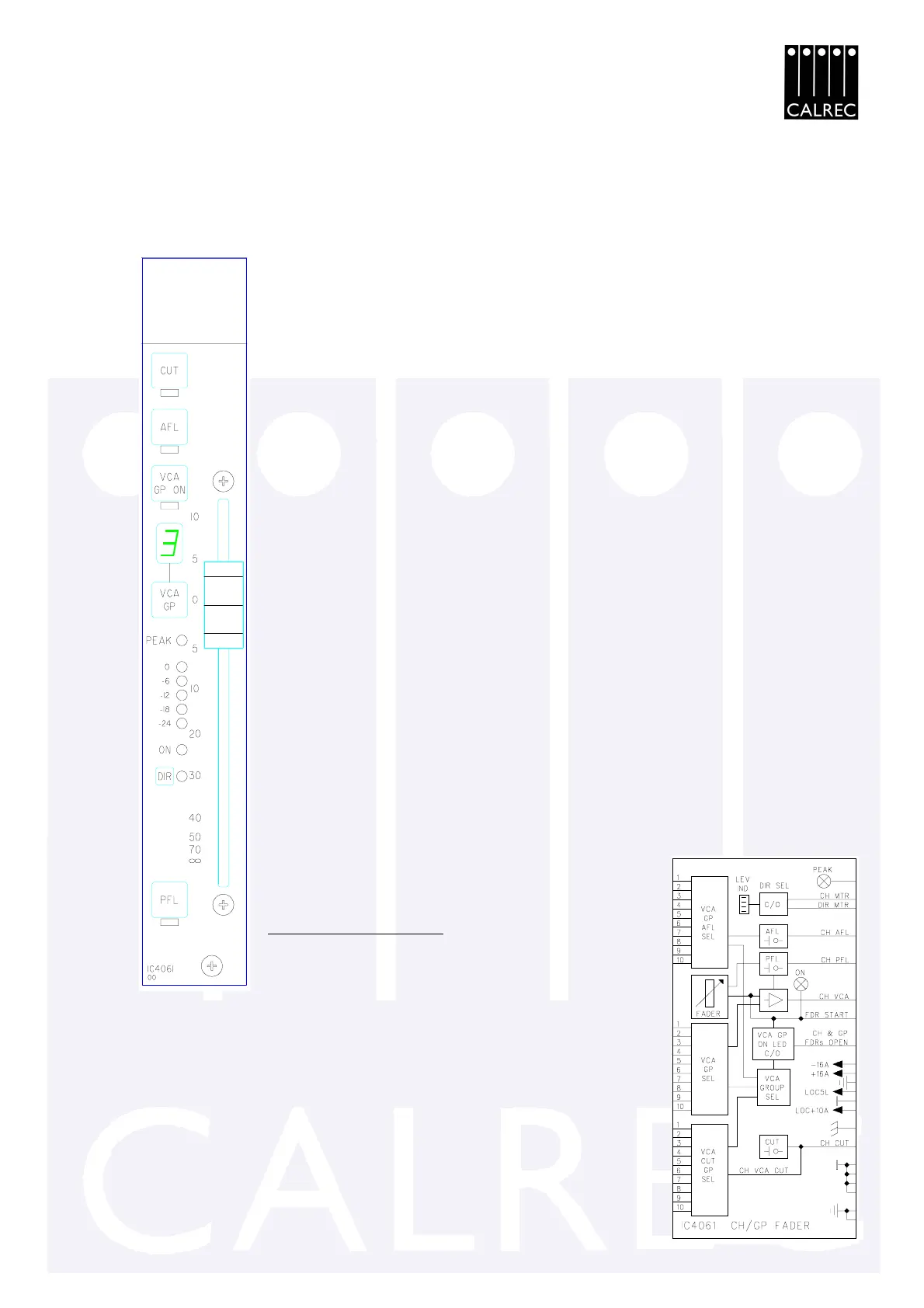
2.6 IC4061 CHANNEL/GROUP FADER
Scribble strip.
CUT button - cuts all channel/group outputs. Yellow LED.
- mechanically latching function (retained through power down).
AFL button routes channel or group signal exclusively to monitor loudspeaker, (in
place stereo) via AFL bus over-ride. Momentary button can be internally set for push-
push electronic latching.
VCA GROUP ON
Latching switch: switches VCA channel or group assignment on/off.
Normally, red LED when depressed. When VCA assigned to channel or group and
active, LED illuminates green.
VCA GROUP
Push to select channel or group to VCA assignment number 1-10.
FADER - with +10dB in hand - can be reverse scale to order.
PEAK - Red LED (top) illuminates when signal anywhere in circuit approaches within
3dB of clipping. Yellow LED illuminates when auto gain ranging circuit is operative in
a channel selected to mic (see below).
SIGNAL LEVEL LEDS
Post channel eq/pre fader, signal level detection.
ON - Green LED illuminates when fader is open.
DIR
Latching switch: changes signal level LEDS to read channel/group direct output signal
feed.
PFL button routes channel or group signal to PFL loudspeaker{s} (in-place stereo).
Momentary button can be internally set for push-push
electronic latching.
Calrec Auto Gain Ranging
This unique principle allows the channel to operate with
a normal headroom of 28dB above chosen setting.
On severe overloads the headroom is automatically
extended to 36dB up to the fader. The pre-fader signals
to Echo, Foldback etc. and limited in this condition to
avoid severe overload but the channel signal is
exclusively under the control of the operator and he/she
will naturally pull back the channel fader.
This principle ensures a very good noise figure in the
channel especially in the equaliser whilst coping with
extreme levels experienced often in outside broadcast
work.



 To Next Page