3
Some Points to Remember
• LearntorecognizetheodorofLPGas.YourlocalLPGas
dealercangiveyoua“ScratchandSniff”pamphlet.Useitto
find out what propane odor smells like. If you suspect that your
LP Gas has a weak or abnormal odor, call your LP Gas dealer.
• Ifyouarenotqualied,donotlightpilotlights,perform
service, or make adjustments to appliances on the LP Gas
system. If you are qualified, consciously think about the odor
of LP Gas prior to and while lighting pilot lights, performing
service, or making adjustments.
• Sometimesabasementoraclosed-uphousehasamusty
smellthatcancover-upLPGasodor.Donottrytolightpilot
lights, perform service, or make adjustments in an area where
the conditions are such that you may not detect the odor if
there has been a leak of LP Gas.
• Odorfade,duetooxidationbyrustorabsorptiononwallsof
the new cylinders and tanks, is possible. Therefore, people
should be particularly alert and careful when new tanks or
cylinders are placed in service. Odor fade can occur in new
tanks, or reinstalled old tanks, if they are filled and allowed
to sit too long before refilling. Cylinders and tanks that have
been out of service for a time may develop internal rust, which
will cause odor fade. If such conditions are suspected to
exist, a periodic sniff test of the gas is advisable. If you have
any question about the gas odor, call your LP Gas dealer. A
periodic sniff test of the LP Gas is a good safety measure
under any circumstance.
• If,atanytime,youdonotsmelltheLPGasodorantandyou
think you should, assume you have a leak. Then take the same
immediate action recommended above for the occasion when
you do detect the odorized LP Gas.
• Ifyouexperienceacomplete“gasout”(thecontainerisunder
no vapor pressure), turn the tank valve off immediately. If the
container valve is left on, the container may draw in some air
through openings such as pilot-light orifices. If this occurs,
some new internal rusting could occur. If the valve is left
open, then treat the container as a new tank. Always be sure
your container is under vapor pressure by turning it off at
the container before it goes completely empty or by having it
refilled before it is completely empty.
SAFETY INFORMATION FOR USE OF LP GAS (cont.)
SAFETY INFORMATION FOR USE OF LP GAS (cont.)
Gas Supply
The installation must conform to local codes. In the absence
of local codes, the installation must conform with American
National Standard (National Fuel Gas Code) known as NFPA
54 and ANSI Z223.1 2002 or the latest edition (Available
from the American National Standard Institute, Inc.,
(HQ)1819LStreetNW,6thFloor,Washington,DC20036
Phone - 202-293-8020 / Fax - 202-293-9287 or
(OPS) 25 W 43rd Street, 4th floor, New York, NY 10036
Phone - 212-642-4900 / Fax - 212-398-0023).
The heater is designed to operate with a manifold pressure
(the gas pressure downstream from the appliance controls)
of 10.5" w.c. (0.38 psig). A gas supply pressure of 11" w.c.
(0.40 psig) minimum is required at the heater controls.
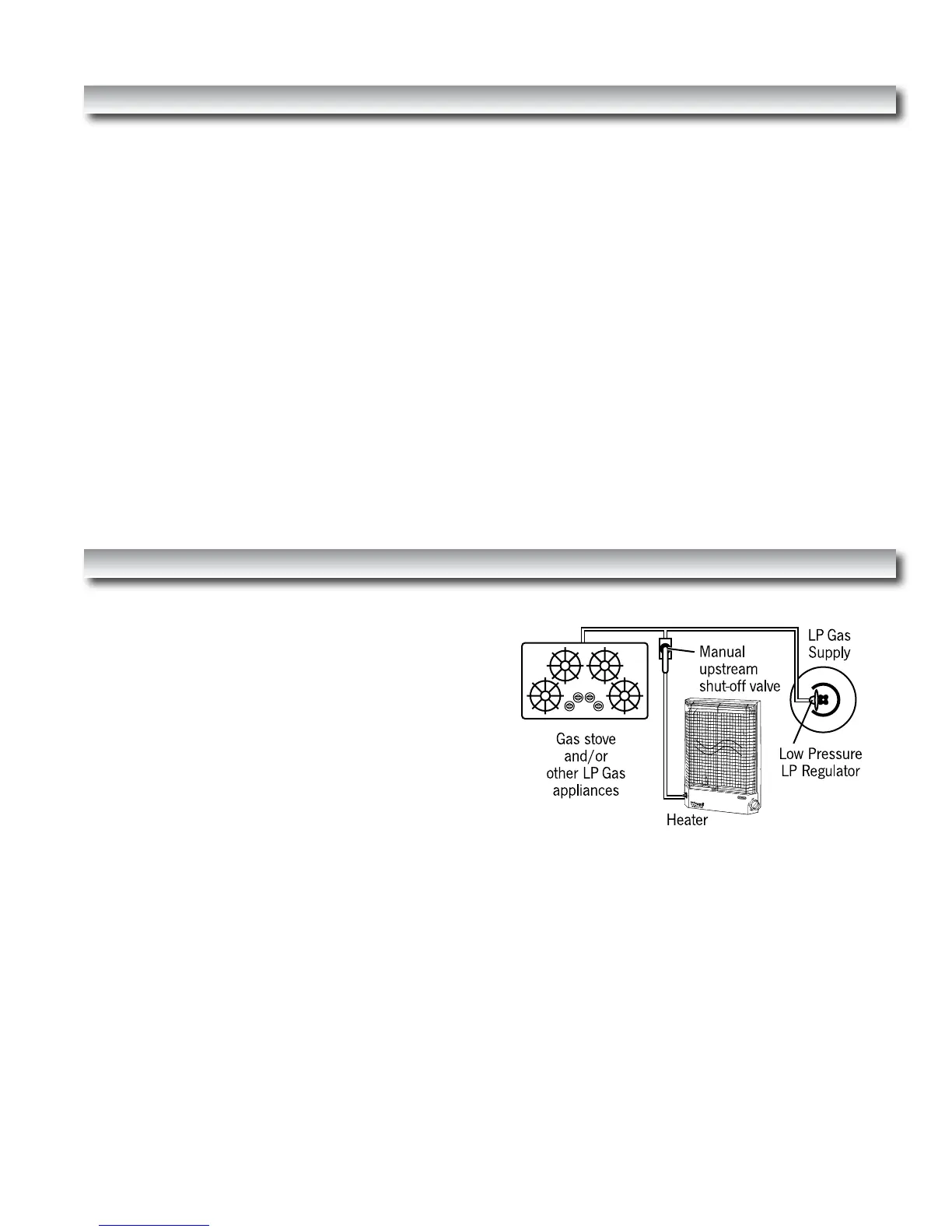
The supply line must be equipped at the cylinder with
a listed low pressure LP regulator set to deliver the
specified pressure. The high-pressure propane line
between the propane supply source and the regulator
must be equipped with an excess flow valve to limit the
escape of fuel in case of a break in the line.
Include a drip leg (trap) in the supply line. The purpose
of the drip leg is to prevent moisture and contaminates
in the gas supply from entering the heater controls. The
drip leg should be readily accessible to permit cleaning
or emptying. A drip leg should not be located where
condensation is likely to freeze. Failure to use a drip
leg can result in operational difficulties in the heater.
Operation of the heater at lower pressures can
cause improper combustion and lower operating
efficiency. Operation at higher pressure can cause
improper combustion or release of unburned gas.
The heater is furnished with a 3/8" male flare SAE fitting
for connection to the gas supply.
A union must be provided directly at the gas inlet to the
heater. A manual gas valve must be provided upstream of
the union. The heater must be isolated from the gas supply
by closing this valve during any pressure testing of the gas
supply piping system at pressure equal to or less than
0.50 psig (13.85" w.c.). The heater and its individual
manual shut-off valve must be disconnected from the gas
supply piping system during any pressure testing of the
system at test pressures in excess of 0.50 psig. (3.45 kPa)


 To Next Page
 Loading...