EasyManua.ls Logo

Campbell Hausfeld HVLP - User Manual

Campbell Hausfeld HVLP
10 pages
Print Icon
To Next Page IconTo Next Page
Loading...
Please read and save these instructions. Read carefully before attempting to assemble, install, operate or maintain the product described. Protect yourself and
others by observing all safety information. Failure to comply with instructions could result in personal injury and/or property damage! Retain instructions for
future reference.
For parts, product & service information
visit www
.chpower.com
IN206701AV 9/07
Operating Instructions & Parts Manual HVLP Spray Gun
HVLP Spray Gun
Description
High volume, low pressure (HVLP)
paint spray ers are de signed to de liv er
a fine finish with low overspray. The
sprayer can be used to apply various
acrylics, stains, sealers, lacquers, latexes,
and primers. This unit can be used for
painting cabinets, fur ni ture, ma chin ery,
equip ment, walls and trim work. Spray-
ers of this type are not recommended
for au to mo tive final coat. This por ta ble
unit is an ideal alternative to con ven tion-
al spray guns. The HVLP’s high transfer
efficiency pro vides pro fes sion al re sults
with much less material waste and en vi-
ron men tal con tam i na tion than other
con ven tion al spray paint ing sys tems.
Unpacking
When unpacking the sprayer, inspect
carefully for any damage that may
have occurred during transit. Make
sure any loose fittings, bolts, etc., are
tightened before putting sprayer into
service. Each sprayer has been tested
before shipment.
NOTE: The packing nut may need
additional adjustment due to the
packing material relaxing during
shipment.
The fluid used for testing the sprayer
has been drained, but some of this fluid
will remain in the spray gun. This fluid
should be flushed from the spray gun to
prevent contamination of the coating
material. Use a solvent compatible with
the coating to be sprayed.
Locking Lever For
Quick-Release Paint Cup
Air Flow Control
Material Flow
Control Knob
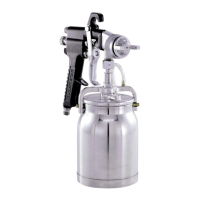
1 Quart Cup
Oval To Round
Pattern Ad just ment
Quick Connect Fitting
Figure 1 - Features
General Safety
Danger means a
!
DANGER
hazard that will cause
death or serious injury if the warning is ignored.
!
WARNING
Warning means a
hazard that could cause death or serious
injury if the warning is ignored.
Caution means a
!
CAUTION
hazard that may cause
minor or moderate injury if the warning is
ignored. It also may mean a hazard that will
only cause damage to property.
Notice means any
NOTICE
additional
information pertaining to the product or its
proper usage.
Read all instructions and safety
precautions before operating the unit.
Risk
!
WARNING
of fire
or explosion! Solvent and
paint fumes can explode or
ignite, causing severe injury
and property damage.
Paints and solvents containing
HALOGENATED HYDROCARBONS can react
explosively with aluminum. Always check
the product’s label before using these
materials in the unit.
Make sure the room is well-ventilated.
Avoid all ignition sources, such as static
electricity sparks, open flames, hot objects,
sparks from connecting and disconnecting
power cords, and working light switches.
Follow the material and solvent
manufacturers’ safety precautions and
warnings. Do not use liquids with flash
points less than 100 degrees Fahrenheit (38
degrees Celsius).
Do not carry TURBINE while spraying.
Keep the turbine at the maximum distance
from the spraying area.
Static electricity can be produced by
HVLP spraying. Make sure any electrically
conductive object being sprayed is
grounded to prevent static sparking. The
sprayer is grounded through the electric
cord. If an extension cord is necessary, the
cord must be a grounded, 115 volt, three
wire type cord.
Attention: Campbell Hausfeld recommends that servicing other than that shown in the instruction manual should be performed by an
authorized service facility.
Table Of Contents
Description . . . . . . . . . . . . . . . . . . . . 1
Unpacking. . . . . . . . . . . . . . . . . . . . . 1
General Safety Information. . . . . . . 1
Setup. . . . . . . . . . . . . . . . . . . . . . . .2-3
Operation . . . . . . . . . . . . . . . . . . . . . 4
Maintenance. . . . . . . . . . . . . . . . . .4-5
Troubleshooting. . . . . . . . . . . . . . . . 6
Warranty. . . . . . . . . . . . . . . . . . . . . 10
©2007 Campbell Hausfeld/ Scott Fetzer

Question and Answer IconNeed help?

Do you have a question about the Campbell Hausfeld HVLP and is the answer not in the manual?

Summary

General Safety Precautions

Hazardous Fumes and Material Reactions

Warns about flammable fumes, explosive reactions with certain materials, and liquid flash points.

Ventilation and Ignition Source Control

Emphasizes proper room ventilation and avoiding all ignition sources.

Safe Handling and Turbine Operation

Covers safe material handling, turbine carrying, placement, and static electricity precautions.

Preparation for Spraying

Operation and Maintenance

Painting Techniques

Details on spray gun distance, stroke motion, overlap, and pattern adjustment.

Adjusting Material and Air Flow

Instructions for adjusting material flow and air flow for pattern control.

Cleaning the Spray Gun

Step-by-step guide for disassembling and cleaning the spray gun components.

Maintenance and Drying Procedures

Troubleshooting Common Issues

No Material Flow and Slow Material Flow

Diagnoses and corrective actions for issues with material flow.

Material Leaks and Spray Shut-off Problems

Troubleshooting steps for material leaks and the gun not shutting off.

Advanced Troubleshooting and Finish Quality

Limited Warranty Information

Overview

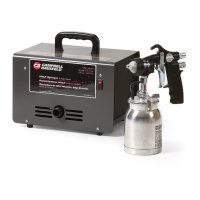
The Campbell Hausfeld HVLP Spray Gun is a high-volume, low-pressure paint sprayer designed to deliver a fine finish with minimal overspray. This portable unit serves as an ideal alternative to conventional spray guns, offering high transfer efficiency for professional results with less material waste and reduced environmental contamination.

Function Description:

The HVLP spray gun is capable of applying various coatings, including acrylics, stains, sealers, lacquers, latexes, and primers. It is suitable for painting cabinets, furniture, machinery, equipment, walls, and trim work. However, it is not recommended for automotive final coats. The gun operates by using a turbine to generate warm air, which atomizes the paint and propels it onto the surface. The design allows for precise control over material flow, air flow, and spray pattern, ensuring a smooth and even application.

Important Technical Specifications:

While specific numerical specifications like pressure or flow rates are not provided, the manual highlights several key operational aspects:

  • Paint Cup Capacity: The spray gun is equipped with a 1-quart cup for holding paint.
  • Needle/Nozzle Kits: The unit comes with an all-purpose material needle kit (three groove rings) installed. Optional thin material (single groove ring) and thick material (two groove rings) needle kits are available for purchase, allowing versatility across different material viscosities.
  • Viscosity Measurement: A viscosity stick, located in the storage compartment, is used to ensure the material is adequately thinned for optimal spraying. The ideal thinning results in drips about one second apart.
  • Power Requirement: The sprayer is grounded through an electric cord. If an extension cord is used, it must be a grounded, 115-volt, three-wire type cord.

Usage Features:

  • Adjustable Spray Patterns: The air cap can be rotated to achieve three distinct spray patterns:
    • Horizontal Pattern: For up and down strokes.
    • Vertical Pattern: For right-to-left or left-to-right strokes.
    • Round Pattern: For strokes in any direction.
  • Material Flow Control: A material flow control knob allows users to increase or decrease the amount of material being sprayed.
  • Air Flow Control: An air flow control knob (clockwise to decrease, counterclockwise to increase) helps fine-tune the pattern and reduce overspray.
  • Quick-Release Paint Cup: The 1-quart paint cup features a locking lever for quick and secure attachment and removal.
  • Packing Nut Adjustment: The packing nut, located forward of the trigger assembly, can be adjusted to ensure the needle returns freely to the closed position, preventing clogs and maintaining proper function.
  • Preparation Guidelines: The manual emphasizes the importance of straining paint, filling the cup 1/2 to 3/4 full, and checking material viscosity before spraying. It also provides a material thinning chart for various coatings like acrylics, stains, lacquers, and latex paints.
  • Spraying Technique: Users are advised to keep the gun 4-9 inches from the surface, move it in smooth, even strokes, and overlap each stroke by 25-50% for best results. For narrow patterns, the gun can be moved as close as 2 inches from the work surface.
  • Safety Features: The manual highlights critical safety warnings, including the risk of fire or explosion from solvent and paint fumes, the danger of using halogenated hydrocarbons with aluminum, the need for good ventilation, and the importance of grounding electrically conductive objects to prevent static sparking. A respirator or mask is recommended to prevent inhalation of hazardous vapors.

Maintenance Features:

  • Cleaning Procedure: Thorough cleaning is essential after each use. This involves:
    • Removing the material control knob, spring, and needle (pulling the trigger helps remove the needle).
    • Unscrewing and removing the retainer ring, nozzle, and airflow ring using the supplied wrench.
    • Soaking parts in a suitable solvent (or soap and water for latex).
    • Flushing cleaning solvent through the material tube and nozzle until clear.
    • Using the cleaning brush to clean the material tube and nozzle.
    • Reinstalling components in reverse order, ensuring the nozzle is installed before the needle to prevent damage.
    • Using the turbine hose to blow-dry all parts and passages to prevent contamination and oxidation.
  • Packing Nut Maintenance: The packing nut may require adjustment or replacement when the needle/nozzle assembly is changed or if the needle does not return freely.
  • Troubleshooting Charts: Comprehensive troubleshooting charts are provided for common issues such as "No material flow," "Slow material flow," "Material leak," "Spray will not shut off," "Pulsating spray," "Excessive overspray," "Spray not uniform (spitting)," "Poor pattern," "Overheating," "Poor air flow," and "Spray tip clogs." Additionally, a "Troubleshooting Chart - Finish Quality" addresses issues like "Orange Peel," "Runs and sags," "Pin-holing and solvent pops," "Fish eye," "Blistering," "Lumpy, coarse surface," and "Mottled surface finish," offering possible causes and corrective actions for each.

Campbell Hausfeld HVLP Specifications

General IconGeneral
BrandCampbell Hausfeld
ModelHVLP
CategoryPaint Sprayer
LanguageEnglish

Related product manuals