EasyManua.ls Logo

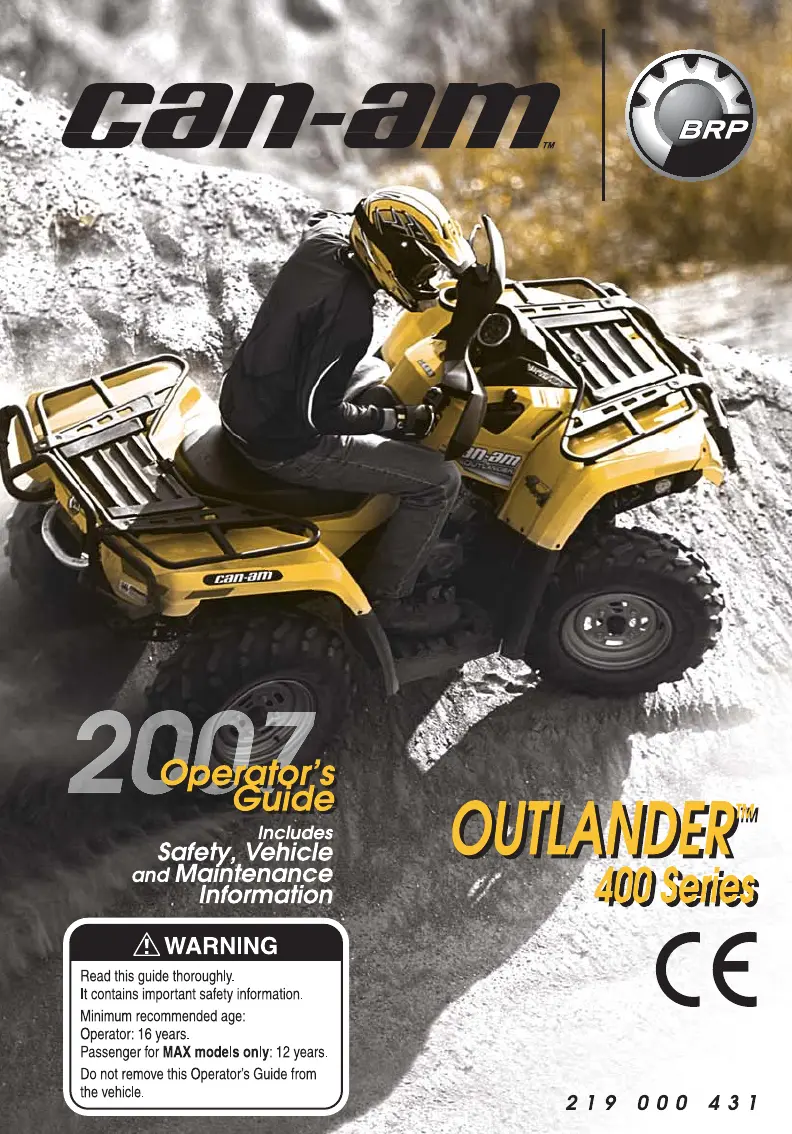
Can-Am outlander 400 series - User Manual

Can-Am outlander 400 series
156 pages
Print Icon
To Next Page IconTo Next Page
Loading...
vmo2007 OUTLANDER 400 series CE ang.FH10 Thu Apr 20 13:26:10 2006 Page 1
Composite
C M Y CM MY CY CMY K

Table of Contents

Questions and Answers

  • C
    christopher77Jul 26, 2025
    What to do if my Can-Am outlander 400 Offroad Vehicle engine turns over but fails to start?
    • E
      Elizabeth TaylorJul 27, 2025
      If the engine of your Can-Am Offroad Vehicle turns over but doesn't start, ensure the engine stop switch is in the ON position. Check the fuel tank level and starting procedure, paying special attention to the choke. If the engine is flooded, turn the ignition switch to ON without applying the choke, make sure the transmission lever is in PARK, fully press and hold the throttle lever while starting, and release the throttle as soon as the engine starts, avoiding racing the engine. Clean the spark plug cap area, remove the spark plug, crank the engine several times, add a small amount of engine oil to the cylinder, and install a new or cleaned and dried spark plug. Also, verify the fuel supply by checking the fuel tank level and turning the fuel valve to ON or RES.
  • M
    Michele AllenJul 31, 2025
    Why is my Can-Am outlander 400 Offroad Vehicle engine misfiring?
    • C
      christophersnyderJul 31, 2025
      If your Can-Am Offroad Vehicle engine misfires, the cause might be a fouled, damaged, or worn spark plug. Try cleaning or verifying the spark plug and its heat range, replacing it if necessary. Another potential cause is water in the fuel. If this is the case, drain the fuel system and refill with fresh fuel.
  • K
    Kenneth AndersonAug 4, 2025
    How to fix a Can-Am outlander 400 Offroad Vehicle when the engine does not turn?
    • J
      Jon FreemanAug 4, 2025
      If your Can-Am Offroad Vehicle engine doesn't turn over, first ensure the ignition switch is in the ON position. Next, confirm the transmission is set to PARK or NEUTRAL, or press the brake lever. Check the main fuse and charging system fuse for any burns. Inspect the battery connections and terminals for looseness or corrosion. If the battery is weak, have it checked or contact an authorized Can-Am ATV distributor/dealer.
  • S
    simonalexisAug 13, 2025
    Why my Can-Am outlander 400 cannot reach full speed?
    • C
      catherine78Aug 13, 2025
      If your Can-Am Offroad Vehicle cannot reach full speed, the issue may be related to the engine (refer to the 'ENGINE LACKS ACCELERATION OR POWER' section for troubleshooting), the parking brake (ensure the brake lever lock is completely removed), or a dirty air filter/housing (check the air filter and clean if necessary, check for deposits in the air filter housing drain, and check the position of the air intake tube).
  • B
    Bethany LeAug 17, 2025
    What to do if the transmission lever is hard to move on my Can-Am outlander 400 Offroad Vehicle?
    • W
      William Guzman MDAug 17, 2025
      If the transmission lever on your Can-Am Offroad Vehicle is hard to move, it could be due to the transmission gears being in a bind. Try rocking the vehicle back and forth to realign the gears. Another cause might be that the engine idle speed is set too high; in this case, adjust the idle speed according to the SPECIFICATIONS.
  • L
    Lucas CastilloAug 21, 2025
    What to do if the RPM increases but my Can-Am Offroad Vehicle doesn't move?
    • J
      Jeffrey WhitakerAug 21, 2025
      If the RPM increases on your Can-Am Offroad Vehicle but the vehicle does not move, make sure that the transmission is not in PARK or NEUTRAL. Select the Reverse, HI, or LO position.
  • A
    Alison GloverNov 7, 2025
    Why does my Can-Am Offroad Vehicle lack acceleration or power?
    • M
      Michael PetersNov 7, 2025
      If your Can-Am Offroad Vehicle lacks acceleration or power, the issue might stem from several causes. A fouled or damaged spark plug could be the culprit, so refer to the 'ENGINE TURNS OVER BUT FAILS TO START' section for guidance. Similarly, a lack of fuel to the engine can cause this problem, so consult the same section. Also, check and clean the radiator fins if the engine is overheating. Reduce vehicle speed to allow air to the radiator; if overheating persists, stop the vehicle, set the transmission to PARK, and turn off the engine, then place the ignition switch to ON to let the radiator fan cool it. Allow the engine to cool down, check the coolant level, and refill if needed. Check the air filter and clean if necessary, inspect for deposits in the air filter housing drain, and ensur...

Summary

IMPORTANT INFORMATION

2-UP vs 1-UP Models

Explains the difference between 1-UP and 2-UP models in the operator's guide.

SAFETY INFORMATION

SPECIAL SAFETY MESSAGES

Covers essential safety warnings and guidelines for operating the vehicle.

General Safety Warnings

General warnings about the vehicle's hazards and the need for precautions.

Rider Age and Passenger Safety

Specifies age limits for operators/passengers and passenger safety guidelines.

Safe Riding Practices

Covers essential tips for safe operation, including speed, terrain, and conditions.

Protective Gear and Clothing

Details the mandatory and recommended safety apparel for operators and passengers.

OPERATION WARNINGS

Hazardous Operation Scenarios

Highlights potential hazards from improper operation, including instruction, age, and modifications.

Riding Conditions and Terrain Hazards

Warns about hazards related to road use, protective gear, alcohol, speed, and stunts.

Vehicle Control and Terrain Hazards

Addresses risks associated with terrain, obstacles, skidding, water, reverse, tires, and modifications.

RIDING THE VEHICLE

Pre-Operation Check

Lists essential checks to ensure the vehicle is safe to operate before each ride.

Riding Techniques and Terrain Navigation

Provides guidance on various riding techniques for different terrains and situations.

Slope and Obstacle Navigation

Details safe procedures for ascending, descending, side-hilling, and avoiding obstacles.

CONTROLS;INSTRUMENTS;EQUIPMENT

Vehicle Controls Overview

Explains the function and operation of key controls like throttle, brake, and transmission.

Speedometer and Indicator Lamps

Describes the vehicle's speedometer, display codes, and various indicator lamps.

Fuel, Ignition, and Electrical Systems

Covers fuel gauge, ignition switch, battery, fuses, and lighting systems.

LIQUIDS

Fuel and Lubricant Specifications

Specifies the correct types of fuel, engine/transmission oil, and their specifications.

Coolant and Brake Fluid Management

Details procedures for checking and maintaining coolant and brake fluid levels.

OPERATING INSTRUCTIONS

Pre-Operation Checks and Engine Starting

Lists essential pre-operation checks and guides on starting the engine.

Transmission, Reverse, and Winch Operation

Explains gear shifting, reverse use, winch operation, and stopping the vehicle.

TROUBLESHOOTING

Engine Starting and Performance Issues

Provides solutions for common engine starting and performance problems.

SPECIFICATIONS

Engine, Transmission, and Electrical Specs

Lists detailed technical specifications for the engine, transmission, and electrical systems.

Tires, Brakes, and Loading Capacity Specs

Details specifications for tires, wheels, brakes, and vehicle loading limits.

MAINTENANCE INFORMATION

MAINTENANCE CHART

Presents a periodic maintenance schedule for various vehicle parts and tasks.

Engine;Transmission and Fuel System Maintenance

Covers oil changes, filter replacement, and maintenance for fuel and electrical systems.

WARRANTY

Warranty Coverage and Conditions

Outlines the scope, coverage period, and conditions for the vehicle's limited warranty.

Warranty Exclusions and Limitations

Lists items not covered by the warranty and limitations of liability.

Can-Am outlander 400 series Specifications

General IconGeneral
BrandCan-Am
Modeloutlander 400 series
CategoryOffroad Vehicle
LanguageEnglish

Related product manuals