EasyManua.ls Logo

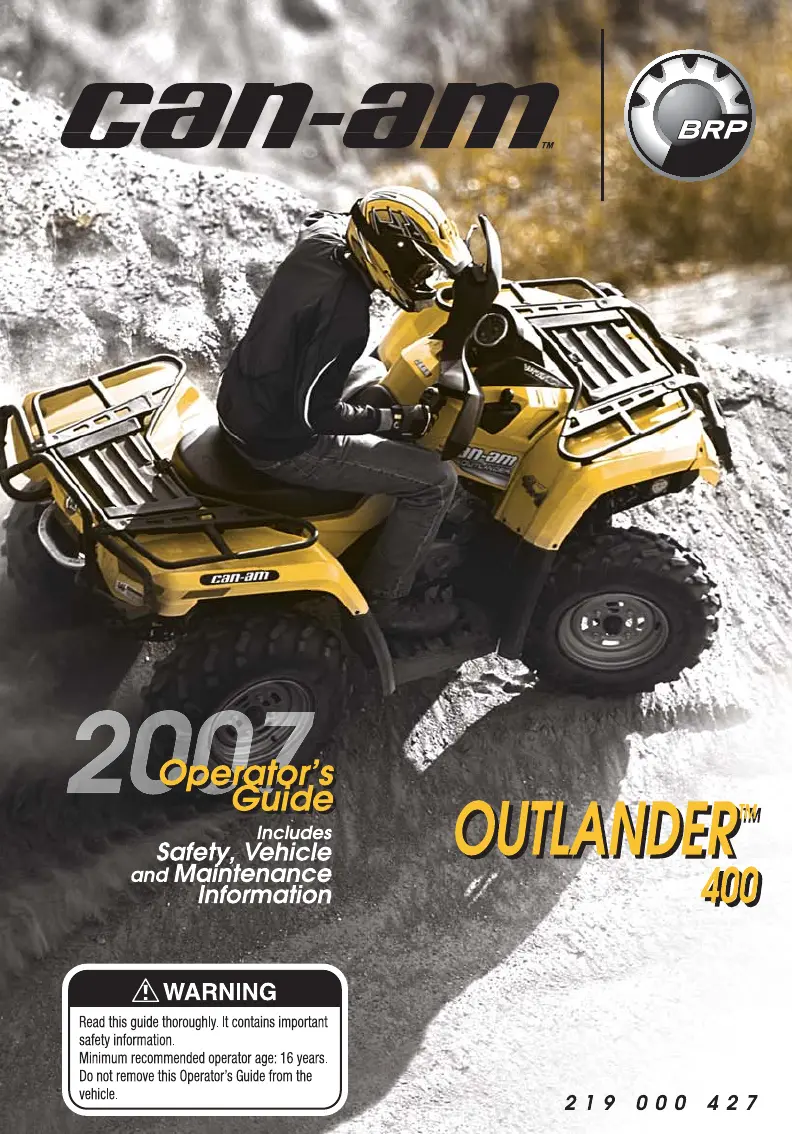
Can-Am outlander 400 - User Manual

Can-Am outlander 400
148 pages
Print Icon
To Next Page IconTo Next Page
Loading...
vmo2007 OUTLANDER 400 ang.FH10 Thu Apr 13 14:21:28 2006 Page 1
Composite
C M Y CM MY CY CMY K

Table of Contents

Questions and Answers

  • K
    Krista MartinezAug 20, 2025
    What to do if my Can-Am Offroad Vehicle engine lacks acceleration or power?
    • F
      fjacksonAug 21, 2025
      If your Can-Am Offroad Vehicle's engine lacks acceleration or power, there could be several reasons. A fouled or damaged spark plug or a lack of fuel to the engine could be the cause. Also, if the engine is overheating, check and clean the radiator fins, reduce vehicle speed while keeping it moving to supply air to the radiator. If overheating continues, stop the vehicle, set the transmission to PARK, stop the engine, and turn the ignition switch to ON (without restarting) to let the radiator fan cool the engine. Check and refill the coolant level if possible. Another potential cause is a plugged or dirty air filter/housing; inspect the air filter and clean it if necessary, check for deposits in the air filter housing drain, and verify the air intake tube's position.
  • A
    Angela JamesAug 23, 2025
    What to do if my Can-Am Offroad Vehicle cannot reach full speed?
    • P
      pbrownAug 23, 2025
      If your Can-Am Offroad Vehicle isn't reaching full speed, several factors could be responsible. The parking brake may be engaged; ensure the brake lever lock is completely disengaged. A plugged or dirty air filter/housing could also be the cause; check the air filter, clean it if needed, inspect the air filter housing drain for deposits, and check the position of the air intake tube.
  • A
    Andrew SkinnerAug 26, 2025
    What to do if my Can-Am Offroad Vehicle engine does not turn?
    • S
      Shawn SchultzAug 26, 2025
      If your Can-Am Offroad Vehicle's engine won't turn over, start by checking if the ignition switch is in the ON position. Ensure the transmission is set to PARK or NEUTRAL, or press the brake lever. Inspect the main fuse for any signs of burning. Also, check the charging system fuse, connections, and terminals for any looseness or corrosion. Have the battery checked.
  • K
    Kimberly HowardAug 28, 2025
    What to do if my Can-Am Offroad Vehicle RPM increases but the vehicle does not move?
    • L
      Leah BauerAug 28, 2025
      If the RPM increases on your Can-Am Offroad Vehicle but it doesn't move, make sure the transmission is not in PARK or NEUTRAL. Select the R, HI, or LO position.
  • D
    Dennis HollowayAug 30, 2025
    Why won't my Can-Am outlander 400 Offroad Vehicle engine turn over?
    • C
      cindy54Aug 30, 2025
      Your Can-Am Offroad Vehicle engine may not turn over due to several reasons. First, ensure the ignition switch is in the ON position. Also, the transmission must be set to PARK or NEUTRAL, or the brake lever must be pressed. A burnt fuse could also be the cause, so check the main fuse condition. Finally, a weak battery or loose connections can prevent the engine from turning over; inspect the charging system fuse, check connections and terminals, and have the battery checked by an authorized Can-Am dealer.
  • S
    samuel89Sep 1, 2025
    What to do if my Can-Am outlander 400 engine turns over but won't start?
    • C
      Carl CoxSep 1, 2025
      If your Can-Am Offroad Vehicle engine turns over but doesn't start, first check that the engine stop switch is in the ON position. Make sure you have enough fuel and follow the correct starting procedure, using the choke if needed. If the engine is flooded (spark plug wet), turn the ignition switch to ON, ensure the choke is not applied, set the transmission lever to PARK, fully press and hold the throttle lever while starting the engine, and release the throttle as soon as the engine starts. If the spark plug is dry, check the fuel tank level and ensure the fuel valve is ON. If problems persist, contact an authorized Can-Am dealer.
  • A
    Angela StevensonSep 4, 2025
    Why does my Can-Am outlander 400 Offroad Vehicle engine lack acceleration or power?
    • L
      Linda WrightSep 4, 2025
      A lack of acceleration or power in your Can-Am Offroad Vehicle engine can stem from several issues. This could be due to a fouled or damaged spark plug or a lack of fuel to the engine. Also, the engine may be overheating; if the indicator light turns on, check and clean the radiator fins, reduce vehicle speed while keeping it moving, and if overheating continues, stop the vehicle, set the transmission to PARK, turn the ignition switch to ON (without restarting), let the engine cool down, and check/refill the coolant level if possible. Lastly, a plugged or dirty air filter/housing can cause this issue; check and clean the air filter, check for deposits in the air filter housing drain, and check the position of the air intake tube.
  • N
    Nicole DixonSep 6, 2025
    Why is the transmission lever hard to move on my Can-Am Offroad Vehicle?
    • S
      Sarah McdonaldSep 6, 2025
      If the transmission lever on your Can-Am Offroad Vehicle is hard to move, it could be because the transmission gears are in a position that prevents movement. Try rocking the vehicle back and forth to move the gears and allow the lever to be set. Another reason might be that the engine idle speed is set too high; adjust the idle speed.
  • C
    campbellbrentSep 8, 2025
    What causes engine misfire in my Can-Am Offroad Vehicle?
    • D
      Dylan WuSep 8, 2025
      Engine misfire in your Can-Am Offroad Vehicle can be caused by a fouled, damaged, or worn spark plug. Clean, verify the spark plug, check its heat range, and replace it if necessary. Another cause could be water in the fuel. Drain the fuel system and refill with fresh fuel.
  • M
    Maria HernandezSep 12, 2025
    How to fix an engine misfire in my Can-Am outlander 400?
    • A
      Alicia GrantSep 12, 2025
      To address an engine misfire in your Can-Am Offroad Vehicle, start by inspecting the spark plug for fouling, damage, or wear. Clean, verify the spark plug, check its heat range, and replace if needed. Another potential cause is water in the fuel. If this is the case, drain the fuel system and refill with fresh fuel.

Summary

Foreword

Notice and Symbols

Safety Symbols Explained

Explains symbols used to emphasize hazards and instructions.

Introduction to the Operators Guide

Riding Conditions and Responsibilities

Guidance on varying riding conditions, operator responsibility, and safe practices.

Safety Information

Special Safety Messages

Critical safety warnings and guidelines for operating the ATV.

Operation Warnings

Key warnings related to vehicle operation and potential hazards.

Riding the Vehicle

Riding Tips and Vehicle Handling

Guidance on familiarization, terrain awareness, vehicle stability, and riding responsibilities.

Pre-Operation Checks and Apparel

Essential checks before operating the vehicle and recommended protective clothing.

Specific Terrain and Hazard Riding

Guidelines for cargo, trailers, recreational riding, environmental, and hazard navigation.

Routine Maintenance

Routine Maintenance Procedures

Procedures for cleaning and maintaining the vehicle after use.

Hang Tag Information

Hang Tag Safety Details

Details on safety information provided on the vehicle's hang tag.

On-Product Labels

On-Product Label Identification

Location and identification of important labels affixed to the vehicle.

Vehicle Information

How to Identify Your Vehicle

Locating engine and vehicle identification numbers (VIN).

Compliance Label Details

Information regarding vehicle compliance with country-specific regulations.

Noise Emission Control Regulations

Noise Emission Control Prohibitions

Prohibitions and definitions related to tampering with noise control systems.

Emission Requirements

Emission Standards Compliance

Details on California Air Resources Board (CARB) emission standards compliance.

Break-In Period

Engine and Belt Break-In

Recommended break-in procedures for the engine and drive belt.

10-Hour Inspection

Importance and timing of the initial 10-hour inspection by a dealer.

Controls, Instruments, and Equipment

Vehicle Controls and Indicators

Operation of throttle, brakes, transmission, 2WD/4WD, parking brake, and multi-function switch.

Instrumentation and Fuel System

Understanding speedometer, ignition, power outlet, fuel cap, gauge, and valve.

Accessory Components and Storage

Use of footpegs, access panel, storage, cargo racks, trailer hitch, radiator cap, and fuses.

Tools and Specialized Equipment

Contents of tool kit, rewind starter, dipstick, and winch components.

Liquids and Fuel

Engine Oil Specifications and Level Check

Recommended oil viscosity, types, and procedure for checking oil level.

Engine Coolant Specifications and Level

Recommended coolant type and procedure for checking coolant level.

Brake Fluid and Battery

Brake fluid type, level check, and battery information.

Operating Instructions

General Operation and Pre-Operation Check

General starting procedures and essential pre-operation checks.

Starting the Engine

Procedures for initial cold and warm engine starting, and emergency manual start.

Transmission and Drive System Operation

Shifting gears, using reverse, and operating the 2WD/4WD selector.

Winch Operation and Post-Operation Care

Winch use and procedures for stopping the engine and vehicle care.

Special Procedures

Vehicle Rollover and Immersion Handling

Procedures for handling vehicle rollovers and submersion.

Cargo and Transportation

Maximum Load Capacities

Specifications for maximum allowed loads for racks and towing.

Vehicle Transportation Guidelines

Securely transporting the vehicle on trailers or in pickup boxes.

Troubleshooting Common Issues

Specifications

Maintenance Information

Maintenance Schedule and General Procedures

Schedule for routine inspections and general guidelines for performing maintenance.

Engine, Drivetrain, and Fuel Systems

Maintenance for engine, transmission, drivetrain, air filter, fuel system, and carburetor.

Electrical, Suspension, and Brake Systems

Maintenance for electrical, suspension, and brake systems.

Body, Frame, Storage, and Transportation Prep

Body/frame care, storage, and preseason preparation.

Warranty Information

North America Limited Warranty

Details of the limited warranty for North American models.

International Limited Warranty

Details of the limited warranty for international models.

Privacy Obligation and Disclaimer

Privacy and Data Usage Policy

Information on coordinate usage and privacy policy.

Change of Address or Ownership

Address;Ownership Notification Procedures

Procedures for notifying BRP of address changes or ownership transfers.

Can-Am outlander 400 Specifications

General IconGeneral
BrandCan-Am
Modeloutlander 400
CategoryOffroad Vehicle
LanguageEnglish

Related product manuals