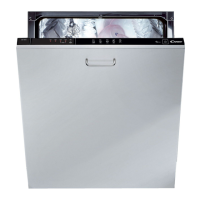
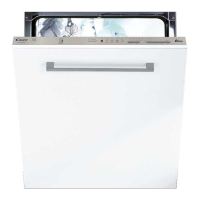
Need help?
Do you have a question about the Candy CDI 2L1047 and is the answer not in the manual?
This document serves as an instruction manual for the Candy CDI 2L1047 dishwasher, providing comprehensive guidance on its operation, maintenance, and installation. It is designed to help users achieve optimal performance and ensure the longevity of their appliance.
The Candy CDI 2L1047 is a household dishwasher designed to clean dishes, cutlery, and other kitchenware. It features various wash programs tailored for different levels of soiling and types of items. The appliance incorporates a water softener system to manage water hardness, preventing limescale deposits and improving cleaning results. It also includes a rinse aid dispenser to enhance drying performance and prevent spots and stains. The dishwasher is equipped with baskets for organized loading of items, including an upper basket for delicate items and a lower basket for larger, heavily soiled items, along with a dedicated cutlery basket.
Control Panel and Programs: The dishwasher features a user-friendly control panel with buttons for On/Off, Delay, and Program selection. Indicators show power status, delay time, and warnings for salt and rinse aid levels. It offers several wash programs:
The "Half load" function allows for washing smaller loads (up to 6 place settings) with reduced water and energy consumption, available for Intensive, Normal, ECO, Glass, and 90-minute programs.
Loading the Dishwasher: Proper loading is crucial for effective cleaning. Items should be placed facing downwards, and curved items or those with recesses should be loaded aslant to allow water to drain. Utensils must be stacked securely to prevent tipping, and spray arms should be free to rotate. Sharp items like knives should be loaded with points down or horizontally in the upper basket. Very small items should not be washed in the dishwasher to prevent them from falling out of the basket. The upper basket's height can be adjusted to accommodate larger items. The lower basket features folding spikes for better stacking of pots and pans.
Detergent and Additives: The dishwasher requires specific dishwasher detergent (powder, liquid, or tablet form). The detergent dispenser is located inside the door. The amount of detergent varies based on the dirtiness of dishes. Rinse aid is automatically released during the last rinse cycle to aid drying and prevent spots. The rinse aid dispenser has an indicator eye to check levels, and its dosage can be adjusted from 1 to 6 based on water hardness and drying results. Dishwasher salt is essential for the water softener system, especially in hard water areas, to prevent mineral deposits. The salt container is located beneath the lower basket and should be refilled when the salt warning light illuminates. It is recommended to run a short wash program immediately after filling salt to prevent corrosion.
Starting and Modifying a Program: To start, load baskets, add detergent, plug in the appliance, turn on the water supply, close the door, press the On/Off button, select a program, and then press the Start/Pause button. A running cycle can be modified if it has been running for a short time; otherwise, the detergent dispenser may need refilling. Dishes can be added during a cycle by opening the door slightly, waiting for spray arms to stop, adding items, and then closing the door.
End of Wash Cycle: At the end of a cycle, the dishwasher will sound a buzzer. Turn off the appliance and water supply. It is advisable to wait a few minutes (about 15 minutes) before unloading to allow dishes to cool and dry better, starting with the lower basket to prevent water from dripping onto them.
Filtering System: The dishwasher's filtering system, consisting of a coarse filter, a main filter, and a fine filter, prevents food remnants from entering the pump. These filters should be cleaned regularly to ensure optimal performance. To clean, turn the filter in an anti-clockwise direction and lift it out. Use a cleaning brush to remove food particles and rinse under running water. Reassemble the filters correctly, ensuring they are positioned in their seat and pressed downwards. The dishwasher should never be operated without the filters.
Caring for the Dishwasher:
Troubleshooting: The manual includes a comprehensive troubleshooting guide to help users identify and resolve common issues such as the dishwasher not starting, water not pumping out, suds in the tub, stained interiors, white film on surfaces, rust stains on cutlery, and various noises. It also lists error codes (Rapid light flicker for longer inlet time, Glass light flicker for overflow) and their possible causes and solutions. In case of overflow, the main water supply should be turned off before calling for service.
 General
| Number of Place Settings | 10 |
|---|---|
| Energy Efficiency Class | E |
| Noise Level | 47 dB |
| Dimensions (H x W x D) | 820 x 598 x 550 mm |
| Drying system | Condensation |
| Delayed start timer | Yes |
| AquaStop function | Yes |
| Energy consumption per 100 cycles | 76 kWh |
| Depth | 550 mm |
| Height | 820 mm |
| Energy Rating | E |
| Delay Start | Yes |
| Appliance placement | Built-in |
| Product size | 60 cm |
| Washing programs | Eco, Intensive |
| Delay start (max) | 9 hours |

 To Next Page