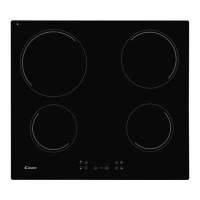
Need help?
Do you have a question about the Candy CHG6BR4WX and is the answer not in the manual?
This document provides user instructions for Candy Hobs, covering installation, usage, and maintenance. It emphasizes safety precautions and proper handling of the appliance.
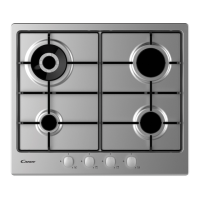
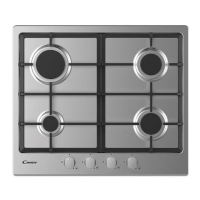
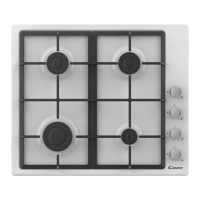
The Candy Hob is a domestic cooking appliance designed for various cooking processes using gas burners. It is intended for household use and should not be operated by external timers or separate remote control systems. The hob features multiple gas burners with different power outputs, allowing for versatile cooking. Some models may include electronic ignition for convenient startup and safety taps that cut off gas flow if the flame is accidentally extinguished. The appliance is designed to be built into a worktop, ensuring a seamless integration with kitchen cabinetry.
Ignition and Flame Control: To ignite the gas burners, users should place a lighted taper near the burner, press in, and turn the control knob anti-clockwise. For appliances with electronic ignition, the process involves pushing in and turning the knob to the ignition symbol, then pressing the sparker button. Hobs with automatic ignition simplify this by requiring only a push and turn of the knob to the ignition symbol. The ignition system will continue to generate sparks as long as the control knob is pressed. If a burner does not ignite within 5 seconds, the knob should be turned to the '0' position, and the operation repeated. For models with safety taps, it is crucial to hold the control knob for 5-6 seconds after ignition to ensure the flame is established and the gas flow is maintained. If there is no electricity, a lighter can be used to ignite the burner by pushing and turning the knob anti-clockwise and holding it for 5 seconds after ignition.
Minimum Flame Regulation: After lighting a burner, the control knob can be turned to the minimum setting. The knob can then be gently removed to access a regulating screw. Using a small screwdriver, this screw can be adjusted to control the gas flow: turning it clockwise reduces the flow, while turning it anti-clockwise increases it. The aim is to achieve a flame of approximately 3-4 mm in length. If the available gas supply is LPG, the screw for the idle flame must be turned clockwise to its end stop. After regulating the gas, the control knob should be replaced.
Cookware Usage: For optimal results, it is recommended to use cooking vessels with a flat surface that matches the size of the gas burner. For smaller containers, the gas burner should be regulated so that the flame does not overlap the base of the pan. Vessels with concave or convex bases should not be used. It is important to always place the pan in the center of the unit being cooked on.
Safety Features: The hob is equipped with safety features such as safety taps on some models that cut off gas flow if the flame is accidentally extinguished. If a flame goes out accidentally, the knob should be turned to the 'off' position, and no attempt should be made to re-ignite it for at least 1 minute. The appliance and its accessible parts become hot during use, so care must be taken to avoid touching heating elements. Children under 8 years of age must be kept away from the appliance unless continuously supervised. Unattended cooking with fat or oil can be dangerous and may result in fire; users should never try to extinguish a fire with water but switch off the appliance and cover the flame with a lid or fire blanket. Storing items on cooking surfaces is discouraged due to fire risk. If the hob surface is cracked, the glass should not be touched, and the appliance should be switched off to avoid electric shock.
General Cleaning: Before cleaning the hob, ensure the appliance has cooled down. The plug should be removed from the socket or, if connected directly, the electricity supply should be switched off. Cleaning and user maintenance should not be performed by children without supervision. Abrasives, corrosive detergents, bleaching agents, or acids should never be used on the hob. Acidic or alkaline substances (e.g., lemon juice, vinegar) should be avoided on enamelled, varnished, or stainless steel sections. For enamelled, varnished, or chrome sections, warm soapy water or a non-caustic detergent should be used. For stainless steel, an appropriate cleaning solution is recommended.
Burner Cleaning: The burners can be cleaned with soapy water. To restore their original shine, a household stainless steel cleaner can be used. After cleaning, the burners should be thoroughly dried and correctly replaced.
Grids and Burners: Chromed grids and burners may discolour with use, which is a normal occurrence and does not affect the functionality of the hob.
Gas Tap Maintenance: If the gas taps become stiff over time, they may require lubrication. This operation should only be carried out by qualified Service Engineers.
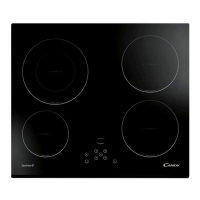
Post-Use Cleaning: After every use, some cleaning of the hob is necessary to prevent the build-up of dirt and grease. If left, this can become re-cooked when the hob is used again, leading to smoke, unpleasant smells, and potential fire risks. Steam or high-pressure sprays should never be used to clean the appliance. The heat zones should not be touched during operation or for a while after use. Food should never be cooked directly on the glass ceramic hob.
Storage and Handling: Heavy items should not be stored above the hob, as they may cause damage if dropped. The hob should not be used as a working surface, a cutting board, or for storing any items. Cookware should not be slid across the hob. Nothing should be placed on the control panel.
 General
| Type | Gas Hob |
|---|---|
| Number of Burners | 4 |
| Control Type | Knobs |
| Ignition Type | Automatic |
| Material | Stainless Steel |
| Surface Material | Glass |
| Dimensions (WxD) | 580 x 510 mm |
| Gas Type | Natural Gas |


 To Next Page