
 Need help?
Do you have a question about the Canon 330 and is the answer not in the manual?
The internal Image Server enables efficient document processing with features like Scan-Once-Print-Many.
Models offer speeds of 33/40 ppm, 1200x600 dpi resolution, and standard duplexing for efficient output.
Models seamlessly integrate into Ethernet or Token Ring networks for enhanced connectivity and performance.
Device driver software offers ease-of-use and full document control across various network platforms.
Simplifies installation, configuration, and management through an easy-to-understand user-interface.
Offers Network Multi-PDL Printer Board-H1 for PCL5e and PostScript 3 printing.
Utilizes multiple CPUs on expansion boards for optimized function and system redundancy.
Canon's DIPS system digitizes images for high clarity, contrast, and sharpness.
Handles scanning needs from low-resolution text to high-grayscale images, supporting 150-2400 dpi.
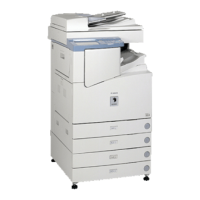
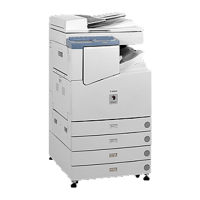
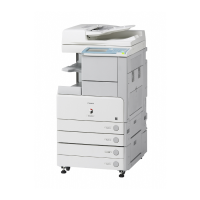
The Canon imageRUNNER 330/400 Series represents a new generation of digital imaging systems designed to revolutionize document management in networked departmental environments. These multifunction devices integrate printing, copying, faxing, and scanning capabilities, offering a comprehensive solution for organizations seeking to enhance productivity and streamline workflows.
At the core of every imageRUNNER 330/400 is an internal Image Server, which optimizes the performance and efficiency of various jobs. This server comes with standard memory, supporting features like Scan-Once-Print-Many, Automatic Image Orientation, Automatic Page Layout for booklet-making, and Confidential User Mailboxes for secure printing. The memory can be expanded, allowing for increased capacity and enhanced functionality.
The imageRUNNER 330/400 Series is built with an open, fully modular architecture, enabling easy configuration and expansion to meet evolving organizational needs. This design ensures that the devices can adapt to new imaging technologies as they emerge, providing long-term investment protection.
For user control, powerful and intuitive Canon device drivers and remote device-management software are standard. This software allows workgroups to manage document creation from their desktops, and network administrators can remotely monitor device status, configure settings, and manage print or fax queues using Canon's NetSpot™ Network Device Management Software.
The imageRUNNER 330 operates at 33 pages per minute, while the imageRUNNER 400 achieves 40 pages per minute. Both systems deliver an output resolution of 1200 x 600 dpi at 256 grayscale, which is the highest in their class. Standard built-in duplexing supports various paper sizes, helping to reduce paper consumption. A standard 1,050-sheet paper supply is provided through two 500-sheet paper cassettes and a 50-sheet stack bypass, with options for expansion to accommodate paper-intensive operations.
The imageRUNNER 330S is the base model, offering high image quality and editing capabilities. It includes a 32MB internal Image Server, upgradable to 96MB, and supports Scan-Once-Print-Many and Automatic Image Orientation. As a stand-alone digital copier, it offers a modular upgrade path for future document-management needs.
The imageRUNNER 330N is the flagship model, featuring standard high-performance 10/100 Ethernet network printing at 200MHz. It includes digital copying with built-in duplexing, an Automatic Document Feeder, and a 64MB internal Image Server. With a standard 32MB of RAM and a 2.1GB Hard Drive on the network print controller, it maximizes document throughput using RIP-While-Print® and Continuous Print™ technologies, which conserve network resources and eliminate engine cycle downtime.
Similarly, the imageRUNNER 400S offers the same capabilities as the 330S but at a faster speed, making it an ideal mid-range solution for users requiring exceptional image quality and editing. The imageRUNNER 400N mirrors the capabilities of the 330N, providing a complete networked system for maximum multitasking and digital engine throughput, also utilizing RIP-While-Print and Continuous Print technologies for energy conservation and efficiency.
The imageRUNNER 330/400 models can seamlessly integrate into Ethernet or Token Ring environments through available network printer options. They support multiple protocols, including IPX/SPX™™, TCP/IP, AppleTalk®, and SNMP, ensuring cross-platform compatibility across UNIX®, Windows®, and Macintosh® environments.
For printing, Canon offers various network printer options. The Network Multi-PDL Printer Board-H1 provides 10/100 Ethernet connectivity, 200MHz processing, 32MB standard memory, and a 2.1GB Hard Disk, supporting PCL5e and Adobe PostScript 3 printing. The Network Printer Board-K1 offers similar performance but is tailored for PCL print environments only.
For faxing, the Super G3 Fax Board-F1 and Super G3 Dual Line Fax Board-A1 provide a more productive solution than stand-alone devices. With 33.6 Kbps transmission speed, JBIG compression, and 32MB of standard RAM (upgradable to 96MB), these boards support up to 1,000 pages of faxed documents. The Dual Line board adds an extra phone line for simultaneous sending and receiving.
Scanning capabilities are enhanced with the Interface Board-D1, which enables scanning of hard-copy originals from 150 dpi to 2400 dpi. This board includes 10MB standard memory and supports industry-standard ISIS® scanner interface technology, making it compatible with over 120 popular imaging applications.
The imageRUNNER 330/400 Series features a built-in fault tolerance system. Instead of relying on a single Central Processing Unit (CPU), each expansion board has its own processor, optimizing specific functions and processing multiple jobs simultaneously. This redundancy minimizes the risk of total system failure.
Canon's patented Digital Image Processing System (DIPS) digitizes original images into a digital form and prints them using a high-quality invisible ray laser at up to 1200 x 600 dpi resolution, ensuring exceptional clarity. DIPS also incorporates advanced Artificial Intelligence to improve contrast and text sharpness.
Ease of use is a key design principle, with an integrated LCD touch-panel that simplifies operations. Users can copy, fax, or edit documents with minimal steps.
Paper supply options include the Cassette Feeding Unit-R1, which adds four 500-sheet paper trays for a total capacity of 3,000 sheets, and the Cassette Feeding Unit-S1, which adds two 500-sheet paper trays and a device pedestal for a total of 2,000 sheets. The Paper Deck-B1 holds 3,500 sheets of letter-sized paper, bringing the total capacity to 5,500 sheets when used with the Cassette Feeding Unit-S1. A 50-sheet stack bypass handles transparencies, labels, and other media.
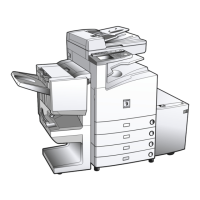
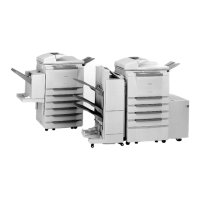
High-level finishing options include the DADF-A1 Automatic Document Feeder (standard on N models) for stacking up to 50 originals, and the DADF-B1 for stacking up to 30 originals. The Finisher-E1 (Stapler Stacker) holds up to 1,000 prints and can staple sets of up to 30 sheets. The Finisher-C1 (Multiposition Auto Stapler) has three output trays and an interrupt tray, offering multiposition stapling. The Finisher-C2 (Saddle-stitch Finisher) has five output trays, including an interrupt tray, and offers multiposition stapling up to 50 sheets and saddle-stitch finishing up to 15 sheets.
 General
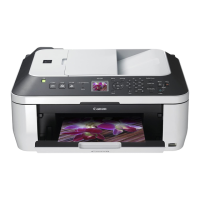
| Print Technology | Inkjet |
|---|---|
| Output Capacity | 50 sheets |
| Scanner Type | Flatbed |
| Functions | Print, Copy, Scan |
| Print Speed (Color) | 4.0 ipm |
| Paper Sizes | A4, A5, B5, Letter, Legal, Envelopes (DL, COM10), Photo (4x6") |
| Connectivity | USB 2.0 |
| Operating Systems | Windows |
| Print Resolution | Up to 4800 x 1200 dpi |


 To Next Page