
 Need help?
Do you have a question about the Canon EOS 3000N and is the answer not in the manual?
Guidelines for maintaining and storing the camera to prevent damage and ensure proper operation.
Information on how camera LCD displays may fade or slow down at different temperatures.
Details on the type of batteries used, installation, and handling precautions for the camera.
Explains how low battery levels affect camera operation and provides guidance on battery replacement.
Instructions on how to handle the lens to protect its electrical contacts and surface.
Detailed diagram and explanation of the camera's LCD panel icons and indicators.
Diagram and explanation of the information displayed within the camera's viewfinder.
Explanation of the Command Dial's zones and their functions for controlling camera settings.
Guide on how to properly attach the camera strap for secure handling and carrying.
Instructions for inserting batteries and checking the battery level for optimal camera performance.
Step-by-step guide on how to securely attach and remove lenses from the camera body.
Explanation of how the shutter button functions when pressed halfway and completely.
Detailed instructions on how to load film into the camera and unload it after shooting.
Guidance on proper camera holding techniques to prevent blurred shots and ensure stability.
Explains how to use the camera in Full Auto mode for simple point-and-shoot photography.
Information on using the camera's built-in flash in various shooting modes.
How the AF-assist beam helps the camera focus in low-light or low-contrast conditions.
Details on the film advance modes for single shots and continuous shooting.
Instructions on how to use the red-eye reduction feature to minimize red eyes in flash photos.
Using Portrait mode to blur the background and make the subject stand out.
Utilizing Landscape mode for capturing sweeping scenery and night scenes.
How to use Close-up mode for detailed shots of flowers, insects, and small subjects.
Employing Sports mode to freeze fast-moving action for dynamic photography.
Taking pictures of people in twilight or at night with balanced flash and ambient exposure.
How to use the self-timer to include yourself in the picture or for steady shots.
Attaching the eyepiece cover to prevent stray light from affecting exposure when not looking through the viewfinder.
Instructions for imprinting the date or time on photographs using the QD model's feature.
Procedure for setting the camera's date and time for date imprinting.
Guide on replacing the battery for the date back feature when the display fades.
How to select AF frames for focusing, both automatically and manually.
Techniques for focusing on subjects not within the standard AF frames using focus lock.
Methods to overcome autofocus difficulties with challenging subjects or low light.
Description of Evaluative, Partial, and Centerweighted averaging metering modes.
Using Program AE mode for easy, general-purpose photography with automatic settings.
Setting shutter speed while the camera automatically adjusts aperture for correct exposure.
Setting aperture while the camera automatically adjusts shutter speed for correct exposure.
Complete control over shutter speed and aperture for total exposure management.
Achieving wide depth of field automatically for group photos and landscapes.
Locking exposure settings on a specific part of the scene for backlit subjects or recomposing.
Adjusting exposure level to make pictures darker or brighter by +/- 2 stops.
Taking multiple shots with varying exposures to ensure a correctly exposed image.
Using bulb exposure for long exposures required for night scenes or fireworks.
Technique to shoot multiple images on a single frame without advancing the film.
How to silence or enable the camera's beeper sounds in all shooting modes.
Manually setting the camera's ISO film speed for non-DX-coded film or specific needs.
Connecting and using an optional remote switch for triggering the camera.
Guide to using the built-in flash effectively in different shooting modes and conditions.
Using external Speedlite EX-series for advanced flash photography features.
Enabling high-speed sync for flash synchronization with all shutter speeds.
Locking flash exposure for specific parts of the scene, similar to AE Lock.
Definitions of key photography terms like exposure, shutter speed, aperture, and ISO film speed.
Understanding how aperture, distance, and focal length affect the depth of field.
Interpreting blinking warnings on the LCD for underexposure, overexposure, or depth of field issues.
A table showing feature availability across different Command Dial modes and AF modes.
Solutions for when the camera's LCD panel displays nothing.
Troubleshooting steps to resolve issues causing blurred photographs.
Diagnosing and fixing problems when the camera's shutter button does not operate.
Addressing issues related to blinking icons on the camera's LCD panel.
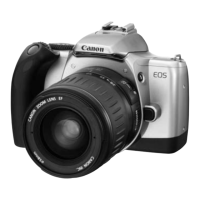
Details on the camera type, recording media, image size, compatible lenses, and lens mount.
Specifications related to the camera's viewfinder, including type, coverage, and magnification.
Technical details about the camera's autofocus system, modes, and AF-assist beam.
Information on exposure metering modes and how exposure control is managed by the camera.
Details on metering ranges, exposure control modes, film speeds, and exposure compensation.
Specifications for the shutter mechanism, release, self-timer, and built-in flash.
Details on film loading, advance modes, frame counting, and film rewind.
Information on automatic dating features and the power source for date imprinting.
Details on power source, battery life, dimensions, weight, and FCC compliance.
 General
| Lens Mount | Canon EF |
|---|---|
| Flash Sync Speed | 1/90 sec |
| Battery | 2 x CR123A |
| Shutter Speed | 30 - 1/2000 sec |
| Focus Modes | Manual |
| Exposure Control | Program AE, Shutter priority AE, Aperture priority AE, Full manual |
| Metering Modes | Evaluative, Partial |
| Flash Modes | Auto, Red-eye reduction |
| Viewfinder | Eye-level pentamirror |
| Dimensions | 145 x 92 x 62 mm |




 To Next Page