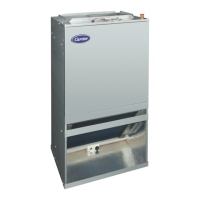
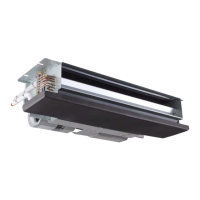
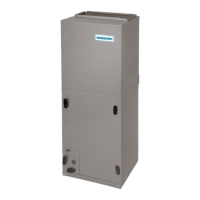
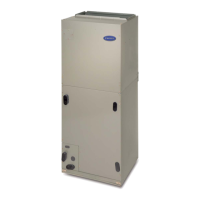
FMA5L, FMA5X: Installation Instructions
Manufacturer reserves the right to change, at any time, specifications and designs without notice and without obligations.
4
When breaking into the refrigerant circuit to make repairs or for any
other purpose conventional procedures shall be used. However, for
flammable refrigerants it is important that best practice be followed,
since flammability is a consideration. The following procedure shall be
adhered to:
– safely remove refrigerant following local and national regulations.
– evacuate.
– purge the circuit with inert gas.
– evacuate.
– continuously flush or purge with inert gas when using flame.
– open the circuit.
The refrigerant charge shall be recovered into the correct recovery
cylinders if venting is not allowed by local and national codes. For
appliances containing flammable refrigerants, the system shall be purged
with oxygen-free nitrogen to render the appliance safe for flammable
refrigerants. This process might need to be repeated several times.
Compressed air or oxygen shall not be used for purging refrigerant
systems. For appliances containing flammable refrigerants, refrigerants
purging shall be achieved by breaking the vacuum in the system with
oxygen-free nitrogen and continuing to fill until the working pressure is
achieved, then venting to atmosphere, and finally pulling down to a
vacuum. This process shall be repeated until no refrigerant is within the
system. When the final oxygen-free nitrogen charge is used, the system
shall be vented down to atmospheric pressure to enable work to take
place. The outlet for the vacuum pump shall not be close to any
potential ignition sources, and ventilation shall be available. Ensure that
contamination of different refrigerants does not occur when using
charging equipment. Hoses or lines shall be as short as possible to
minimize the amount of refrigerant they contain. Cylinders shall be kept
upright. Ensure that the refrigeration system is grounded prior to
charging the system with refrigerant. Label the system when charging is
completed (if it is not already labeled). Take extreme care not to overfill
the refrigeration system.
Prior to recharging the system, it shall be pressure-tested with the
appropriate purging gas. The system shall be leak-tested on completion
of charging but prior to commissioning. A follow up leak test shall be
carried out prior to leaving the site. Before carrying out this procedure, it
is essential that the technician is completely familiar with the equipment
and all its detail. It is recommended that all refrigerants are recovered
safely. Prior to the task being carried out, an oil and refrigerant sample
shall be taken in case analysis is required prior to reuse of reclaimed
refrigerant. It is essential that electrical power is available before the task
is commenced.
a. Become familiar with the equipment and its operation.
b. Isolate system electrically.
c. Before attempting the procedure ensure that:
(1.) mechanical handling equipment is available, if required, for
handling refrigerant cylinders.
(2.) all personal protective equipment is available and being
used correctly.
(3.) the recovery process is supervised at all times by a
competent person.
(4.) recovery equipment and cylinders conform to the
appropriate standards.
d. Pump down refrigerant system, if possible.
e. If a vacuum is not possible, make a manifold so that refrigerant
can be removed from various parts of the system.
f. Make sure that the cylinder is situated on the scales before
recovery takes place.
g. Start the recovery machine and operate it in accordance with the
manufacturer's instructions.
h. Do not overfill cylinders. (No more than 80% volume liquid
charge).
i. Do not exceed the maximum working pressure of the cylinder,
even temporarily.
j. When the cylinders have been filled correctly and the process has
been completed, make sure that the cylinders and the equipment
are removed from site promptly and all isolation valves on the
equipment are closed off.
k. Recovered refrigerant shall not be charged into another
refrigeration system unless it has been cleaned and checked.
Equipment shall be labeled stating that it has been
de-commissioned and emptied of refrigerant. The label shall be
dated and signed. Ensure that there are labels on the equipment
stating the equipment contains flammable refrigerant. When
removing refrigerant from a system, either for servicing or
decommissioning, it is recommended that all refrigerants are
removed safely.
When transferring refrigerant into cylinders, ensure that only appropriate
refrigerant recovery cylinders are employed. Ensure that the correct
number of cylinders for holding the total system charge is available. All
cylinders to be used are designated for the recovered refrigerant and
labeled for that refrigerant (i.e. special cylinders for the recovery of
refrigerant). Cylinders shall be complete with pressure-relief valve and
associated shut-off valves in good working order. Empty recovery
cylinders are evacuated and, if possible, cooled before recovery occurs.
The recovery equipment shall be in good working order with a set of
instructions concerning the equipment that is at hand and shall be
suitable for the recovery of the flammable refrigerant. If in doubt, the
manufacturer should be consulted. In addition, a set of calibrated
weighing scales shall be available and in good working order. Hoses
shall be complete with leak-free disconnect couplings and in good
condition.
The recovered refrigerant shall be processed according to local
legislation in the correct recovery cylinder, and the relevant waste
transfer note arranged. Do not mix refrigerants in recovery units and
especially not in cylinders.
If compressors or compressor oils are to be removed, ensure that they
have been evacuated to an acceptable level to make certain that
flammable refrigerant does not remain within the lubricant. The
compressor body shall not be heated by an open flame or other ignition
sources to accelerate this process. When oil is drained from a system, it
shall be carried out safely.
Do not use the air conditioner for other purposes. In order to avoid any
quality deterioration, do not use the unit for the cooling of precision
instruments, food, plants, animals or works of art. Before cleaning, be
sure to stop the operation, turn the breaker off or unplug the supply cord.
Otherwise, electric shock and injury may occur.
In order to avoid electric shock or fire, make sure that an earth leak
detector is installed. Never touch the air outlet or the horizontal blades
while the swing flap is in operation.
Your fingers may become caught or the unit may break down.
Never put any objects into the air inlet or outlet.
Objects touching the fan at high speed can be dangerous.
Never inspect or service the unit by yourself.
Ask a qualified service person to perform this task.
Do not dispose of this product as unsorted municipal waste. This waste
should be collected separately for special treatment. Do not dispose of
electrical appliances as unsorted municipal waste. Use separate
collection facilities. Contact your local government for information
regarding the connection systems available.
If electrical appliances are disposed of in landfills or dumps, hazardous
substances can leak into the groundwater and get into the food chain,
harming your health and well-being.
To prevent refrigerant leak, contact your dealer.


 To Next Page
 Loading...