EasyManua.ls Logo

Carrier Graviner Mk7 - User Manual

Carrier Graviner Mk7
14 pages
Print Icon
To Next Page IconTo Next Page
Loading...
OMD Technical Note TN18001
Carrier Fire & Security
8 Newmarket Court, Page 1 of 14
Chippenham Drive,
Kingston, Milton Keynes, MK10 0AQ
Graviner Mk7 Oil Mist System Detector Head Inspection &
Cleaning Process
Introduction
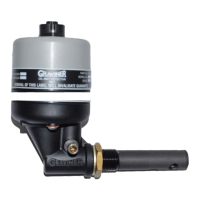
The Graviner OMD Detector is made of 2 assemblies, the Detector Head and the Detector
Base. The Detector Head is attached to the Detector Base with 2 Allen bolts.
The oil mist detection chamber in each Detector Head must be inspected at regular intervals
and cleaned to remove any buildup of oil splash or carbon deposits created by the operation
of the engine.
Our experience indicates that the cleaning interval will be unique to each engine and
dependant upon many factors such as the way the vessel engine is operated, the engine
temperature, the condition of the engine oil and the engine service intervals.
This Technical Note describes the tools required and the cleaning procedure to be used to
inspect and clean the Mk7 Detector.
As required by IACS M67 Graviner Mk7 OMD systems will automatically warn the Users
when the detection window becomes partially obscured and must be cleaned. Graviner
recommend establishing a cleaning and maintenance regime to minimise any Fault message
warnings of this type and maximise the service life of each Detector Head.
As a guide, the Detector Head should be cleaned and inspected every 6 months and the
sample pipe in the Detector Base cleaned and inspected every 12 months.
Detector Head
Detector Base
Detector Sample Pipe
Question and Answer IconNeed help?

Do you have a question about the Carrier Graviner Mk7 and is the answer not in the manual?

Summary

Cleaning the Detector

Inspect the contents of the Mk7 Event log

Checks the event log for fault messages indicating detector contamination.

Carry out Parameter readings of each Mk7 Detector

Records parameter readings for each detector before cleaning.

Remove Detector Head and Inspect Base Unit Seal

Detaches the detector head, exposes the fan, and checks the base unit seal.

Clean Oil Mist Detection Opening

Uses recommended fluid and buds to clean the detector head's internal aperture.

Check Contamination Level Post-Cleaning

Measures and records the contamination level after cleaning to assess effectiveness.

Detector Head Replacement Criteria

Defines conditions for replacing the detector head based on contamination level readings.

6 months

Final Assessment and Support

Final Contamination Level Assessment

Compares post-cleaning contamination levels to original values to determine detector service life.

Overview

The Graviner Mk7 Oil Mist Detector is a critical component in engine monitoring systems, designed to detect the presence of oil mist within an engine's crankcase. This detection is crucial for preventing potential engine damage or catastrophic failure, as oil mist can be an early indicator of overheating bearings or other internal issues. The system operates by continuously sampling the atmosphere within the crankcase. If oil mist is detected above a predefined threshold, the system triggers alarms, alerting operators to a potential problem.

The device itself is composed of two main assemblies: the Detector Head and the Detector Base. The Detector Head, which houses the optical detection chamber, is securely attached to the Detector Base using two Allen bolts. The Detector Base, in turn, connects to the engine's crankcase via a sample pipe, allowing for the continuous draw of crankcase atmosphere into the detection chamber.

Function Description:

The primary function of the Graviner Mk7 OMD system is to provide early warning of potential engine problems by detecting oil mist. This is achieved through an optical detection method where the presence of oil mist obscures a light path within the Detector Head. The system is designed to be highly sensitive, capable of detecting even small concentrations of oil mist. When the detection window within the Detector Head becomes partially obscured by oil splash or carbon deposits, the system automatically issues a warning to the users, indicating that cleaning is required. This proactive warning system helps maintain the accuracy and reliability of the oil mist detection.

The system also features an Event Log, which records various events, including system resets, alarms, pre-alarms, and fault messages such as "Contamination Low Fault" or "Photodiode Fault." These fault messages are particularly important as they directly indicate that the detector is contaminated and requires cleaning. The Remote Display Unit allows users to access and review these logs, providing valuable insights into the detector's operational history and current status. Additionally, the system provides detailed parameter readings for each detector, including Peak Level, Current Level, Offset Digipot, Gain Digipot, Contamination Low Limit, Original Contamination Value, Current Contamination Value, Serial Number, and Software Version. These parameters are essential for monitoring the detector's performance and assessing its remaining service life.

Important Technical Specifications:

While specific numerical technical specifications like power consumption or dimensions are not explicitly detailed in the provided document, several key operational and maintenance-related specifications are highlighted:

  • Cleaning Fluid: Only Electrolube ASC fluid is recommended for cleaning the detector. The use of third-party electronic contact cleaners, isopropyl alcohols, flux removers, or harsh chemical cleaners is strictly prohibited as they can negatively affect detector performance.
  • Cleaning Buds: Graviner-recommended foam buds are specified for cleaning the detection chamber.
  • Air Pressure for Sample Pipe: Clean air at a working pressure of up to 90 PSI should be used to clear potential blockages in the Detector Base and sample pipe.
  • Contamination Threshold for Replacement: A Detector Head should be replaced if its "Current Contamination Value" does not return to within 20% of its "Original Contamination Value" after cleaning, indicating it is nearing the end of its operational service life.
  • Self-Retaining Screws: The two fixing screws that attach the Detector Head to the Detector Base are self-retaining, simplifying assembly and disassembly.
  • Service Kit (D9221-027): This kit includes essential spares and consumables for maintenance, such as fan retainers, compression springs, base moulding seals, fan connector seals, M3 screws, glass cleaner (250ml), foam buds (packet of 25pcs), 4mm hexagon keys, and a pulling tool.

Usage Features:

  • Remote Display Unit: The system includes a Remote Display Unit that allows users to view the Event Log, check the status of each detector, and access detailed parameter readings. This unit is crucial for monitoring the system's health and diagnosing issues.
  • Mk7 Oil Mist Engine Manager Tool (Optional): For more advanced data management, an optional Mk7 Oil Mist Engine Manager Tool with a USB cable can be used to download the Event Log and System Test Log to a PC for future records.
  • Isolation Feature: Detectors can be isolated as described in the Mk7 OMD system Installation, Operation & Maintenance (IOM) Manual, which is useful during maintenance or troubleshooting.
  • Automatic Warnings: The system automatically warns users when the detection window becomes partially obscured, prompting timely cleaning.

Maintenance Features:

The Graviner Mk7 OMD system incorporates several features and recommendations to facilitate regular maintenance and ensure optimal performance:

  • Regular Inspection and Cleaning: The oil mist detection chamber in each Detector Head requires inspection and cleaning at regular intervals to remove oil splash or carbon deposits. Graviner recommends cleaning and inspecting the Detector Head every 6 months and the sample pipe in the Detector Base every 12 months.
  • Cleaning Procedure: A detailed cleaning procedure is outlined, involving the use of specific tools and cleaning agents. This includes disconnecting the cable connector, loosening fixing screws, removing the Detector Head, wiping off excess oil, examining seals, carefully removing the fan using a pulling tool, and thoroughly cleaning the glass ring and small aperture with recommended cleaning fluid and foam buds.
  • Fan Inspection and Replacement: The fan should be inspected for free running and oil clogging. If fan damage is suspected, replacement procedures detailed in the Mk7 IOM Manual should be followed. Care must be taken not to press the fan label, handling only the outer housing.
  • Compression Springs and Fan Retaining Plug: These components should be examined for damage and replaced if necessary, with spares available in the service kit.
  • Sample Pipe Cleaning: At 12-month intervals, the detector sample pipe should be removed for cleaning and inspection. It is crucial that the engine is stopped during this process to prevent hot oil spray. The Detector Base and sample pipe should be blown through with clean air (up to 90 PSI) to clear blockages.
  • Visual Inspection (6-month interval): This includes externally inspecting all Mk7 Control Unit(s) for the condition of glands, external wiring, and LED indications. It also involves checking for correctly blanked-off holes to maintain IP65 and EMC ratings, internally inspecting control units, documenting the status of LEDs on all detectors and spares, verifying the Remote Display Unit shows the correct number of engines and detectors, inspecting other enclosures and wiring, and documenting software versions.
  • Documentation of Concerns: During maintenance, any concerns such as corrosion, burnt components, poor quality wiring, incorrect cabling, missing/incorrect EMC glands, missing/incorrect screening & earthing, or missing blanking plugs/caps should be documented.
  • Event Log Analysis: Regular inspection of the Mk7 Event log is critical for diagnosing and resolving fault messages, which is an integral part of service visits.
  • Contamination Level Monitoring: After cleaning, the "Current Contamination Value" is compared to the "Original Contamination Value." A significant deviation (not within 20%) indicates the detector head is at the end of its service life and requires replacement.
  • Safety Precautions: Warnings are provided against removing the Detector Base from the engine crankcase while the engine is in operation due to the risk of hot oil. Also, extreme care is advised to avoid losing compression springs or the fan retaining plug during disassembly.

Carrier Graviner Mk7 Specifications

General IconGeneral
BrandCarrier
ModelGraviner Mk7
CategorySecurity Sensors
LanguageEnglish

Related product manuals