INTRODUCTION
BATTERIES ...
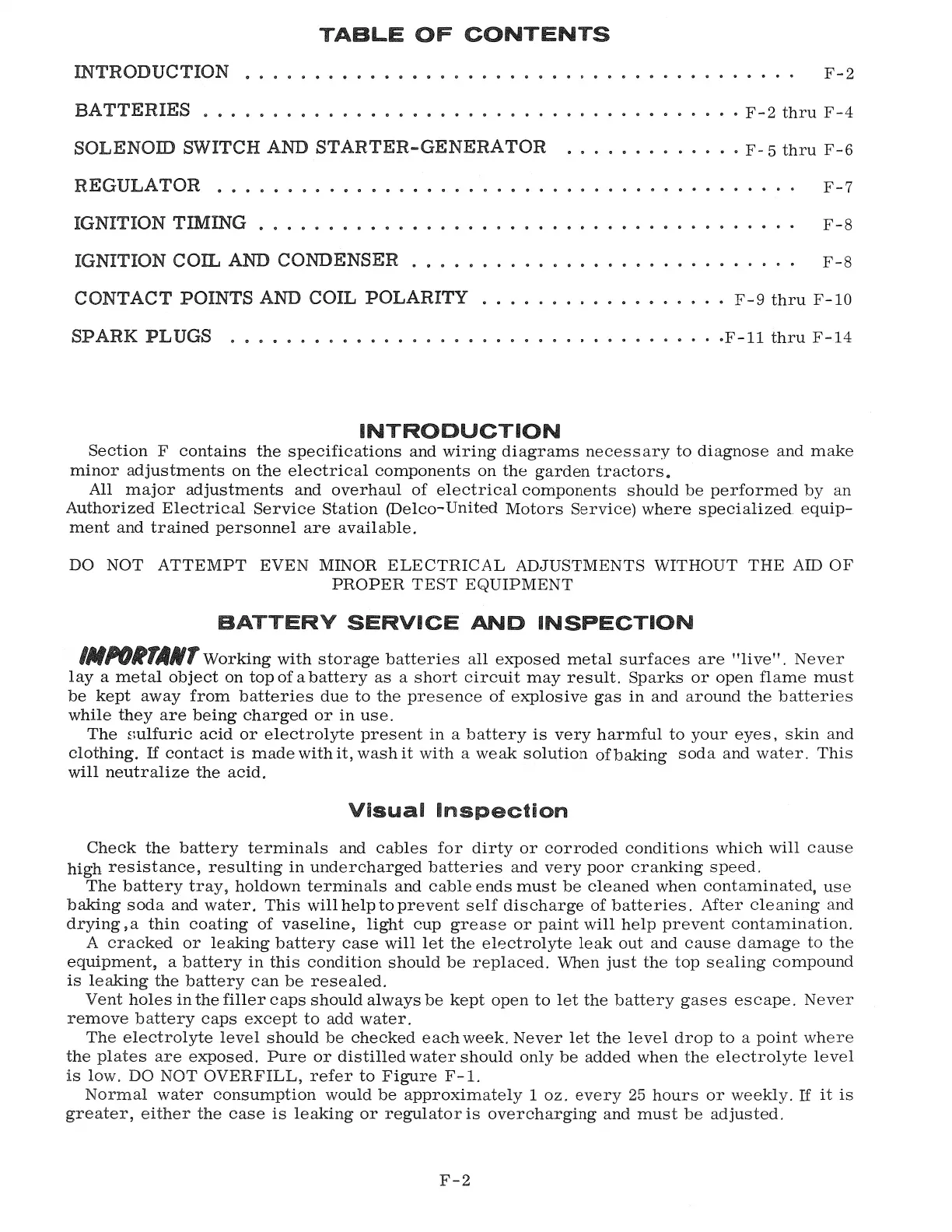
TABLE OF CONTENTS
SOLENOID SWITCH AND STARTER-GENERATOR
REGULATOR ....
IGNITION TIMING
IGNITION COIL AND CONDENSER
CONTACT POINTS AND COIL POLARITY
SPARK PLUGS
INTRODUCTION
F-2
, · · • F-2 thru F-4
· · F- 5 thru F-6
F-7
F-8
F-8
F-9 thru F-10
-F-11 thru F-14
Section F contains the specifications and wiring diagrams necessary to diagnose and make
minor adjustments on the electrical components on the garden tractors.
All major adjustments and overhaul of electrical components should be performed by an
Authorized Electric.al Service Station (Delco- United Motors Service) where specialized. equip-
ment and trained personnel are available.
DO NOT ATTEMPT EVEN MINOR ELECTRICAL ADJUSTMENTS WITHOUT THE AID OF
PROPER TEST EQUIPMENT
BATTERY SERVICE AND INSPECTION
/#/IORTA/ITworking with storage batteries all exposed metal surfaces are "live". Never
lay a metal object on top of a battery as a short circuit may result. Sparks or open flame must
be kept away from batteries due to the presence of explosive gas in and around the batteries
while they are being charged or in use.
The ~mlfuric acid or electrolyte present in a battery is very harmful to your eyes, skin and
clothing.
If contact is made with it, wash it with a weak solution of baking soda and water. This
will neutralize the acid.
Visual Inspection
Check the battery terminals and cables for dirty or corroded conditions which will cause
high resistance, resulting in undercharged batteries and very poor cranking speed.
The battery tray, hold own terminals and cable ends must be cleaned when contaminated, use
baking soda and water. This will help to prevent self discharge of batteries. After cleaning and
drying ,a thin coating of vaseline, light cup grease or paint will help prevent contamination.
A cracked or leaking battery case will let the electrolyte leak out and cause damage to the
equipment, a battery in this condition should be replaced. When just the top sealing compound
is leaking the battery can be resealed.
Vent holes in the filler caps should always be kept open to let the battery gases es cape. Never
remove battery caps except to add water.
The electrolyte level should be checked each week. Never let the level drop to a point where
the plates are exposed. Pure or distilled water should only be added when the electrolyte level
is low. DO NOT OVERFILL, refer to Figure F-1.
Normal water consumption would be approximately 1 oz. every 25 hours or weekly.
If it is
greater, either the case is leaking or regulator is overcharging and must be adjusted.
F-2


 To Next Page
 Loading...