
 Need help?
Do you have a question about the Casio Edifice EQW-A1200B-1A and is the answer not in the manual?
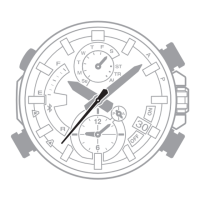
Describes the watch's hands and indicators used in manual operation.
Explains how to move watch hands rapidly for setting.
Details the initial check of the Home City setting before watch use.
Outlines the process for setting the watch's current time.
Details how to check the watch's power level using the second hand.
Describes indicators and consequences of low power levels on watch function.
Explains the watch's automatic mode to conserve power during low battery.
Provides estimated times required to charge the watch under various light conditions.
Describes the watch's sleep modes that conserve power when not in use.
Explains how to wake the watch from its power-saving sleep state.
Provides steps to manually set the watch's time.
Provides steps to manually set the watch's date.
Lists the specific hands used for direction readings.
Details the procedure for performing a digital compass reading.
Introduces methods to improve digital compass accuracy.
Explains the process for calibrating the compass in two directions.
Describes calibrating the compass to detect true north.
Step-by-step guide for bidirectional compass calibration.
Lists the watch hands and indicators for World Time mode.
Explains how to check the time in different global cities.
Describes how to interchange Home and World Time cities.
Lists the watch hands and indicators for Stopwatch mode.
Details how to measure total elapsed time.
Explains how to measure individual lap times.
Lists the watch hands and indicators for Countdown Timer mode.
Guides setting the duration for the countdown timer.
Explains how to start and manage the countdown timer.
Lists the watch hands and indicators for Alarm mode.
Details how to set a specific alarm time.
Explains how to activate or deactivate the daily alarm.
Describes the automatic correction of hand positions.
Outlines the manual procedure for correcting hand positions.
Addresses issues related to incorrect hand movement and alignment.
Discusses errors indicated during operation of the watch's sensors.
Explains troubleshooting steps related to watch charging.
Covers troubleshooting for radio-controlled time synchronization.
Addresses issues and troubleshooting for the watch's alarm function.
This document describes the operation and features of a CASIO watch, model MA1302-EA, with an Operation Guide number 5325. The watch is a solar-powered, radio-controlled atomic timepiece with a variety of functions including timekeeping, direction readings, stopwatch, countdown timer, and alarm.
The CASIO watch is designed to provide accurate timekeeping through its radio-controlled atomic timekeeping feature, which receives time calibration signals. It also offers a digital compass for direction readings, a stopwatch for measuring elapsed and lap times, a countdown timer, and a daily alarm. The watch is powered by a solar panel and a rechargeable battery, making it a low-maintenance device.
The watch displays time using hour, minute, and second hands, along with an upper dial hand for 24-hour format and a lower dial hand indicating the current mode. A day indicator also shows the current day of the week. The timekeeping mode is the default and central mode from which all other functions are accessed.
Radio-Controlled Atomic Timekeeping: The watch automatically updates its time settings by receiving time calibration signals up to six times a day (five times for the Chinese signal) between midnight and 5 a.m. This ensures high accuracy. Manual reception is also possible. The watch supports reception from transmitters in Japan, North America, Europe, and China, corresponding to specific Home City codes like TYO (Tokyo), HNL (Honolulu), LON (London), PAR (Paris), ATH (Athens), HKG (Hong Kong), and others. Signal reception can be affected by location (e.g., inside buildings, near appliances, mountains), power level, and ongoing operations.
Home City Settings: Users can configure their Home City from 29 global city codes. This setting is crucial for accurate time calibration signal reception and proper display of local time and Daylight Saving Time (DST).
Daylight Saving Time (DST) / Standard Time (STD) Switching: The watch offers an AUTO setting for DST, which automatically switches between standard time and daylight saving time according to its calendar. Users can also manually set it to STD or DST.
Manual Time and Day Settings: If signal reception is not possible, the current time and day settings can be adjusted manually using the crown. The watch's full automatic calendar accounts for different month lengths and leap years, so manual day adjustment is rarely needed once set.
The watch features a magnetic sensor for taking digital compass readings. It can indicate magnetic north, and with calibration, true north. The 2 Second Hand points to magnetic north during a direction reading.
Calibration: To ensure accurate direction readings, bidirectional calibration is recommended, especially when using the watch in areas with magnetic interference or if readings differ from another compass. Northerly calibration is also available to detect true north.
The stopwatch mode allows for measuring elapsed time and lap times. It can store up to 10 lap times and keeps track of the fastest lap time.
The countdown timer can be set for durations from one minute to 60 minutes. An alarm sounds for 10 seconds when the timer reaches zero.
A daily alarm can be set to sound for 10 seconds at a preset time, even if the watch is not in the Alarm Mode.
The watch's operations are primarily controlled by its screw-in lock crown and three buttons (A, B, C).
Crown Operation: The crown must be rotated outwards to loosen it before use and screwed back in to maintain water resistance and prevent damage. It supports high-speed movement (HS1 and HS2) for quickly adjusting hands, either forward or backward, by rapidly rotating it.
Mode Selection: The watch has five modes: Timekeeping, World Time, Stopwatch, Countdown Timer, and Alarm. The 5 Lower Dial Hand indicates the current mode. Pressing button C cycles through these modes. Holding button C for at least two seconds returns the watch to Timekeeping Mode.
Checking Power Level: Pressing button B in Timekeeping Mode moves the 2 Second Hand to H (High), M (Mid), or L (Low) to indicate the current power level.
World Time: The World Time Mode allows viewing the current time in 29 different time zones. The 2 Second Hand indicates the selected World Time City.
Swapping Home City and World Time City: This feature allows users to quickly swap their Home City and World Time City, useful for frequent travelers.
Abnormal Magnetism Detection: If the 1 Hour Hand stops at 6 o'clock during a direction reading, it indicates abnormal magnetism. The watch also indicates sensor errors during operation if subjected to strong impact or internal circuitry issues.
The watch is designed with several features to ensure its longevity and reliable performance.
Solar Charging: The watch's face acts as a solar panel, charging a built-in rechargeable battery when exposed to light. This eliminates the need for regular battery replacements.
Power Saving: To conserve power, the watch enters a sleep state (second hand sleep or function sleep) when left in the dark for a certain period. Moving the watch to a well-lit area or pressing any button recovers it from sleep.
Power Recovery Mode: If power suddenly drops below a certain level (e.g., due to continuous signal reception or other operations), the watch enters a power recovery mode, temporarily stopping hand operation. Normal operation resumes after power recovers, which can be expedited by exposing the watch to light.
Low Battery Alert: If the power level is low (Level 2), the 2 Second Hand moves at two-second intervals. If power drops further (Level 3), the 2 Second Hand stops, and all functions are disabled. Recharging is necessary in these cases.
Auto Home Position Adjustment: The watch automatically corrects the home positions of its hands in Timekeeping Mode, ensuring accurate alignment even after exposure to strong magnetism or impact. Manual home position adjustment is also available for the day indicator or if auto-correction is insufficient.
Troubleshooting: The manual provides extensive troubleshooting guidance for common issues such as incorrect time settings, sensor malfunctions, charging problems, and alarm failures, directing users to relevant sections for solutions.
 General
| Brand | Casio |
|---|---|
| Series | Edifice |
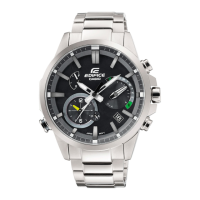
| Model | EQW-A1200B-1A |
| Case Material | Stainless Steel |
| Band Material | Stainless Steel |
| Water Resistance | 100 meters |
| Features | World Time |



 To Next Page