
 Need help?
Do you have a question about the Cast LAVA and is the answer not in the manual?
Explains the stove's purpose for indoor heating and how heat is diffused.
Installation must be carried out by qualified people to prevent serious accidents.
Initial lighting may produce smoke/odor; proper room ventilation is essential.
Good room ventilation is essential for proper operation and safety, as the stove uses air.
Chimney must rise 1m above roof ridge; surrounding objects must not cover it.
Internal flue surface must be smooth, resistant to heat and gases.
Metal tube diameter must not be smaller than appliance outlet hole.
Clean stove, tubes, flue when draught is difficult; use appropriate means when cold.
Damp wood burns poorly, damages flue; recommended humidity up to 20%.
Lists wood types by quality; advises against certain materials.
Check chimney entrance, dimensions, isolation, door seal.
Open primary air, use dry wood, ensure room oxygen.
Check primary air, chimney leaks, obstructions, draught, gaskets.
Use dry wood, correct fuel, avoid overloading, check draught, regulation.
Normal initially; check wood and chimney condition if persistent.
Stove for heating spaces, made of cast iron/steel, panoramic door.
Adjusts air via ash drawer/grate for combustion process.
Regulates secondary air for better combustion and clean glass.
Ensure proper lighting, fuel, draught for efficient cleaning.
Secondary air slows deposit build-up; avoid wet wood.
Empty ash drawer periodically; store ashes in fire-resistant container.
Clean hearth, flue; check gaskets; protect interior from dampness.
This document provides a comprehensive user guide for the LAVA Wood Stove, model S440L, manufactured by CAST. The stove is designed for indoor heating and operates by burning solid fuel, specifically dry wood logs.
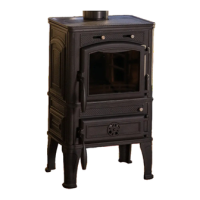
The LAVA Wood Stove serves as a primary heating appliance for living spaces or as a supplementary heat source for an existing central heating system. Its core function is to generate heat through the combustion of wood, which is then diffused into the environment primarily through radiation from its panoramic glass door and cast iron external surfaces. The stove is constructed from cast iron and steel plates, with the hearth internally sheathed in a single sheet of cast iron. A rotatable and extractable grate is located inside the hearth. The panoramic door features heat-resistant glass, allowing for a clear view of the burning flames and contributing to maximum heat distribution.
The stove incorporates both primary and secondary air controls, which are crucial for regulating the combustion process. The primary air control, located on the stove door, adjusts the airflow through the ash drawer and the grate towards the fuel. This air is essential for initiating and sustaining combustion. The secondary air control, positioned above the hearth door, regulates secondary air horizontally. This control is vital for achieving better wood combustion and helps keep the glass clean during operation by providing additional combustion air.
Fuel: The stove is designed to burn only dry wood logs with a maximum moisture content of 20%. Recommended wood types for optimal efficiency include hornbeam, oak, ash, maple, birch, elm, and beech. Fir, willow, alder-scotch pine, larch, ime, and poplar are less suitable or very bad. It is strictly forbidden to burn green or damp wood, treated wood (e.g., railway sleepers, plywood off-cuts, painted wood), low-grade anthracite, coke, coal remainders, bark scraps, panels, plastic materials, or materials of organic origin, as this can damage the stove, chimney, and void the warranty. Paper and carton can be used for ignition only. Continuous and prolonged use of aromatic wood (eucalyptus, myrtle, etc.) can quickly damage the cast iron parts.
Lighting: When lighting the stove for the first time, a reduced quantity of fuel (about half the recommended amount) should be loaded, and the fire should be kept continuously on for at least 6-10 hours with the regulators less open than indicated in the manual. This process should be repeated 4-5 times to allow the protective paint to stabilize, which may produce smoke and odors, requiring proper ventilation. Small wood pieces and paper or other lighting aids are suggested for ignition. Liquid substances like alcohol, gasoline, or oil are strictly forbidden.
Operation: During the initial lighting phase (15-20 minutes), the primary air control must be fully open. Once a stable operation regime is established, the primary air control should be closed, and the desired combustion intensity adjusted using the secondary air control. The stove should always be operated with the doors closed, opening them slowly only to add fuel when embers are present, to avoid smoke suppression. Overloading the stove with too much fuel or excessive air for combustion can lead to overheating and damage. The best combustion is achieved when most of the air passes through the secondary air regulator. If smoke from the chimney is gray or black, it indicates incomplete combustion, and more secondary air is needed.
Transition Periods: During periods of higher external temperatures, a sudden increase in temperature can cause the flue gases to be insufficiently drawn out. In such cases, the grate should be shaken to improve air circulation, and the fuel quantity should be reduced to prevent rapid burning and stabilize the draft. All openings for cleaning and connections to the stack must be air-tight.
Cleaning: Regular cleaning is essential for optimal performance and safety. Ash should be removed daily, ensuring it does not accumulate to the point of touching the grate, which would obstruct primary air circulation. The stove should be cold when cleaning. External surfaces should be cleaned with non-abrasive products to avoid damaging the heat-resistant paint; chemical diluents should not be used. The panoramic glass should be cleaned with normal detergent and pure water only when cold, then dried with a soft cloth. Tiled parts can be cleaned with non-abrasive detergents, water, and a soft cloth.
Flue and Chimney Maintenance: The flue must be regularly maintained and cleaned at least once a year. The junction pipe connecting the stove to the flue should be as short as possible, straight, or slightly uphill, and all connections must be hermetic. The smoke pipe should not be inserted too deeply into the flue to avoid reducing its cross-section. The chimney must be well-insulated to prevent condensation and have a smooth internal surface made of refractory, acid-resistant, and gas-impermeable materials. An inadequate draft (less than 12 Pa) can lead to poor combustion, carbon deposits, and smoke escaping into the room. A draft greater than 15 Pa requires a flue adjuster to reduce heat dispersion.
Ash Drawer: The ash drawer should be emptied periodically to prevent overheating of the grate. Ashes must be stored in a fire-resistant, hermetic container placed on a fire-resistant floor. Accessory tools should be used for ash drawer discharge and for dispersing embers and ash.
Summer Pause: After cleaning the hearth, chimney, and flue, and removing all ash and residuals, the hearth door and its regulators should be closed. If the stove is disconnected from the flue, its openings must be closed to allow other devices connected to the same flue to operate. Gaskets should be checked annually and replaced if necessary. If dampness is present in the room, absorbent salts can be placed in the hearth. To preserve the aesthetic appearance of the stove, its internal cast iron walls can be protected with neutral Vaseline.
Fire Safety: The stove must be installed by qualified professionals, adhering to all safety standards. Minimum safety distances from flammable objects and materials must be maintained (100 cm from the front, 70 cm from the sides, 40 cm from the back). If installed on a flammable floor, it must be protected by an insulating plate (steel, brass, marble, stone) extending at least 50 cm from the front and 15 cm from the sides. The floor's bearing capacity must be sufficient. Continuous combustion air flow must be ensured, with adjustable air openings in the room. Children should be kept away from the stove during operation. In case of a chimney fire, close the feeding door, ash drawer, and combustion air controls, then use CO2 fire-fighting means and call the fire brigade. Do not use water. After a fire, the flue must be inspected by an expert for cracks.
Warranty: The product is made from recoverable materials. The warranty is two years from the device purchase date and covers all cast iron and steel parts. Gaskets, ceramic hardened glass, hearth facing, paints, ceramics, and chemically coated parts are considered wear parts and are not covered. Damages due to improper installation, incorrect connection, tampering by unauthorized personnel, or using forbidden fuels are not covered. The manufacturer reserves the right to make modifications to the product without prior notice.
 General
| Type | Wood Stove |
|---|---|
| Burn Time | Up to 8 hours |
| EPA Certified | Yes |
| Log Size | 18 inches |
| Heating Capacity | 800 - 1, 600 sq. ft. |

 To Next Page
