Avoid direct spraying of water on electrical
connectors, connections, and components. When
using air for cleaning, allow the machine to cool to
reduce the possibility of fine debris igniting when
redeposited on hot surfaces.
Fluid Penetration
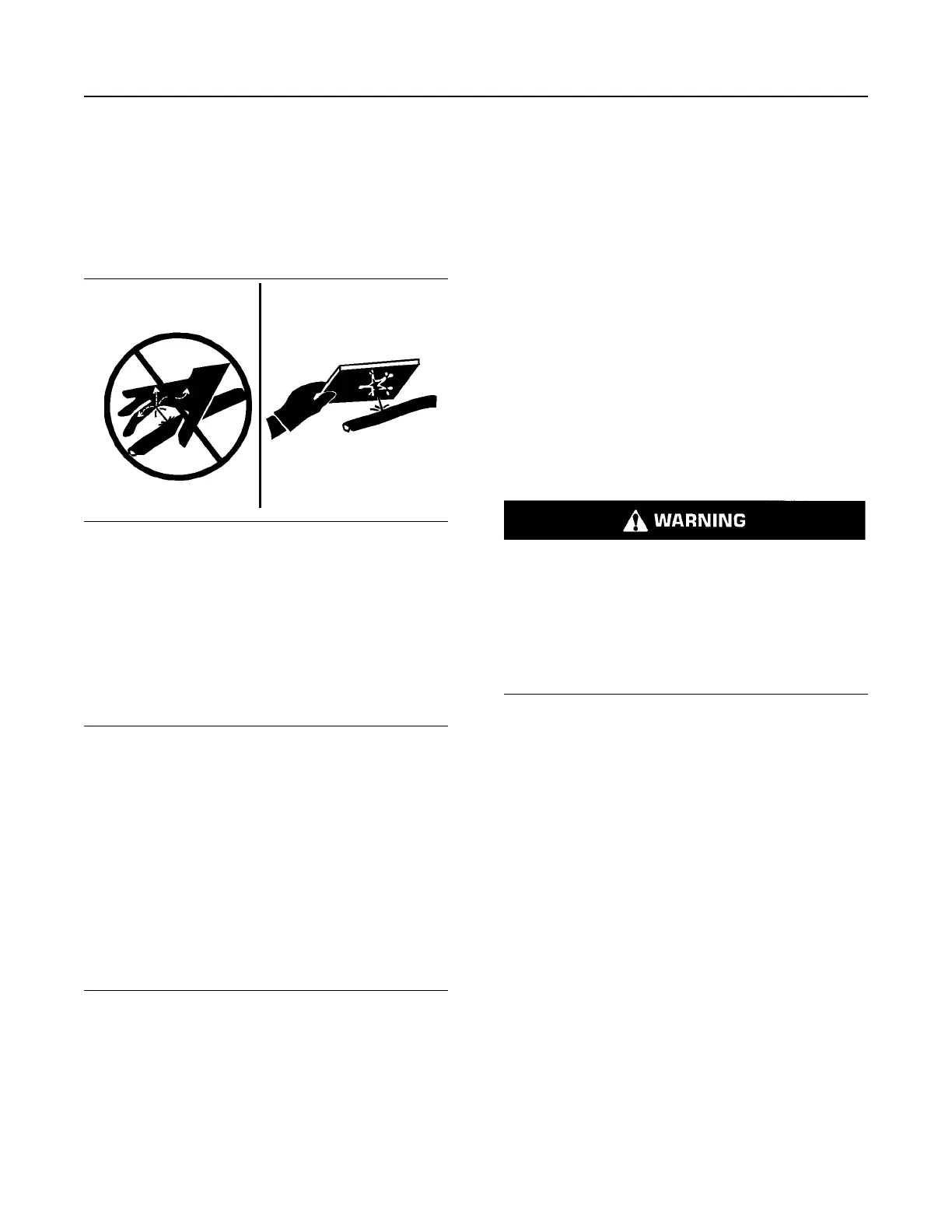
Illustration 17 g00687600
Always use a board or cardboard when you check for
a leak. Leaking fluid that is under pressure can
penetrate body tissue. Fluid penetration can cause
serious injury and possible death. A pin hole leak can
cause severe injury. If fluid is injected into your skin,
you must get treatment immediately. Seek treatment
from a doctor that is familiar with this type of injury.
Containing Fluid Spillage
NOTICE
Care must be taken to ensure that fluids are con-
tained during performance of inspection, mainte-
nance, testing, adjusting, and repair of the product.
Be prepared to collect the fluid with suitable contain-
ers before opening any compartment or disassem-
bling any component containing fluids.
Refer to Special Publication, NENG2500, “Cat Dealer
Service Tool Catalog” or refer to Special Publication,
PECJ0003, “Cat Shop Supplies and Tools Catalog”
for tools and supplies suitable to collect and contain
fluids on Cat products.
Dispose of all fluids according to local regulations
and mandates.
Static Electricity Hazard when
Fueling with Ultra-low Sulfur Diesel
Fuel
The removal of sulfur and other compounds in ultra-
low sulfur diesel fuel (ULSD fuel) decreases the
conductivity of ULSD and increases the ability of
ULSD to store static charge. Refineries may have
treated the fuel with a static dissipating additive.
Many factors can reduce the effectiveness of the
additive over time. Static charges can build up in
ULSD fuel while the fuel is flowing through fuel
delivery systems. Static electricity discharge when
combustible vapors are present could result in a fire
or explosion. Ensure that the entire system used to
refuel your machine (fuel supply tank, transfer pump,
transfer hose, nozzle, and others) is properly
grounded and bonded. Consult with your fuel or fuel
system supplier to ensure that the delivery system
complies with fueling standards for proper grounding
and bonding.
Avoid static electricity risk when fueling. Ultra-
low sulfur diesel fuel (ULSD fuel) poses a greater
static ignition hazard than earlier diesel formula-
tions with a higher sulfur contents. Avoid death
or serious injury from fire or explosion. Consult
with your fuel or fuel system supplier to ensure
the delivery system is in compliance with fueling
standards for proper grounding and bonding
practices.
Lines, Tubes, and Hoses
Do not bend or strike high-pressure lines. Do not
install lines, tubes, or hoses that are damaged.
Repair any fuel lines, oil lines, tubes, or hoses that
are loose or damaged. Leaks can cause fires.
Inspect all lines, tubes, and hoses carefully. Do not
use bare hands to check for leaks. Always use a
board or cardboard for checking engine components
for leaks. Tighten all connections to the
recommended torque.
Check for the following conditions:
• End fittings that are damaged or leaking
• Outer covering that is chafed or cut
• Wire that is exposed in reinforced hose
• Outer covering that is ballooning locally
• Flexible part of the hose that is kinked or crushed
• Armoring that is embedded in the outer covering
10
SEBU7125-13
Safety Section
General Hazard Information


 To Next Page
 Loading...