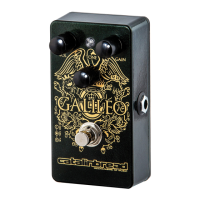
booster to work its magic. On mid-heavy (British) amps, it’s business as usual with the Galileo,
just plug and go.
If you’re stacking the Galileo with another pedal: The same rules apply as far as EQing your
gear, but less so depending on how much the Galileo and the pedal after it are on together.
Adjust the pedal after the Galileo to account for some extra treble and get to work.
Upon plugging the Galileo in for the first time, set the Tone control a hair above zero, turn Gain
all the way down. Inch the Gain up until you find a spot you like, then adjust Tone to infuse a
little treble back in. Some people like the Tone knob down all the way no matter what, and that’s
totally OK! It’s there if you want it.
Power Supply: The Galileo requires at least 9VDC and up to 18VDC, with a negative center. It
draws a miserly 5mA, meaning you can run it with pretty much any supply fitting the above
requirements. You can also use a 9V battery, just remember to unplug the input cable when
you’re finished, or it will continue to use battery power. However, the modest current draw will let
the battery last a good long time.


 To Previous Page