76
2.Important Information on Blood Pressure
and its Measurement
2.1. How does high or low blood pressure arise?
Your level of blood pressure is determined in the circulatory center of the brain
and adjusts to a variety of situations through feedback from the nervous
system. To adjust blood pressure, the strength and speed of the heart (Pulse),
as well as the width of circulatory blood vessels is altered. Blood vessel width
is controlled by fine muscles in the blood vessel walls.
Your level of arterial blood pressure changes periodically during heart activity:
During the “blood ejection” (Systole) the value is highest (systolic blood
pressure value). At the end of the heart’s “rest period” (Diastole) pressure is
lowest (diastolic blood pressure value).
Blood pressure values must lie within certain normal ranges in order to prevent
particular diseases.
Blood pressure is very high if your diastolic pressure is above 90 mmHg
and/or your systolic blood pressure is over 160 mmHg, while at rest. In this
case, please consult your physician immediately. Long-term values at this
level endanger your health due to continual damage to the blood vessels in
your body.
If your systolic blood pressure values are between 140 mmHg and 159mmHg
and/or the diastolic blood pressure values between 90 mmHg and 99mmHg,
consult your physician. Regular self-checks are necessary.
If you have blood pressure values that are too low, (i.e., systolic values under
105mmHg and/or diastolic values under 60 mmHg), consult your physician.
Even with normal blood pressure values, a regular self-check with your blood
pressure is recommended. You can detect possible changes in your values
early and react appropriately.
If you are undergoing medical treatment to control your blood pressure, keep
a record of values along with time of day and date. Show these values to
your physician. Never use the results of your measurements to independently
alter the drug doses prescribed by your physician.
• If your values are mostly normal under resting conditions but exceptionally
high under conditions of physical or psychological stress, it is possible that
you are suffering from so-called “labile hypertension.” Consult your doctor.
• Correctly measured diastolic blood pressure values above 120mmHg
require immediate medical treatment.
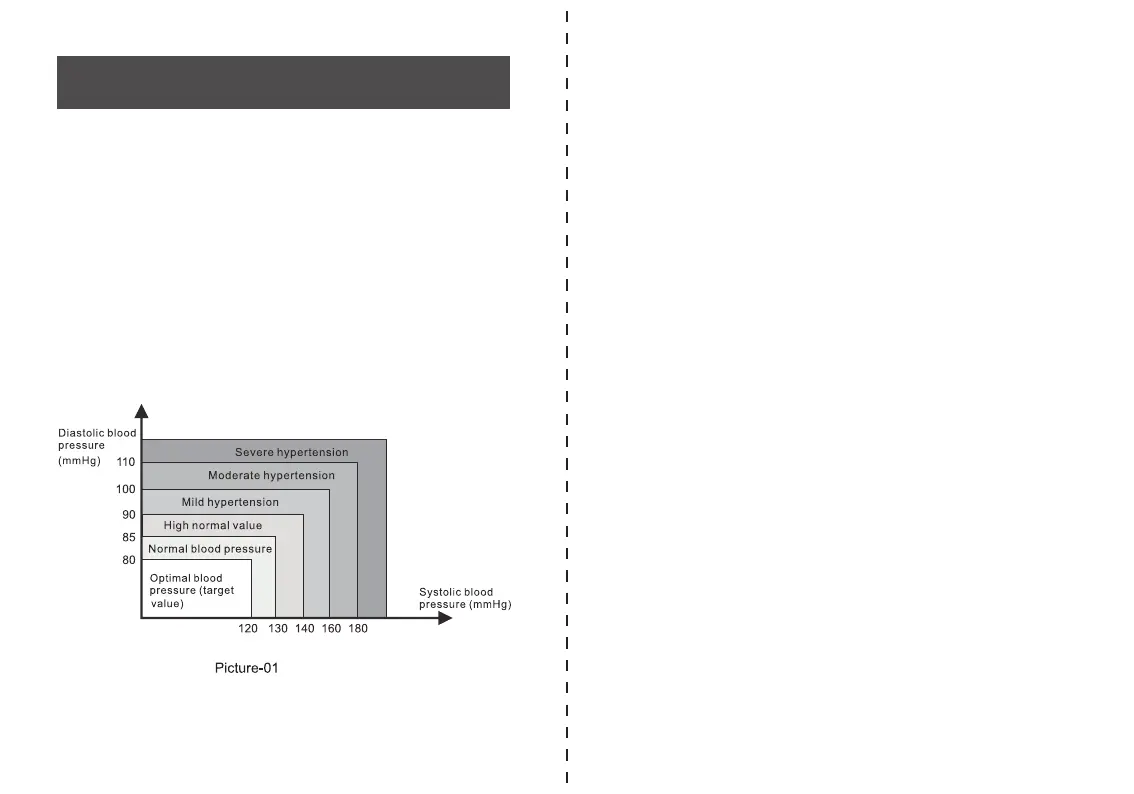
2.2. Which values are normal?
Further information
Please refer to the diagram below(Picture-01)


 To Next Page