Getting Started
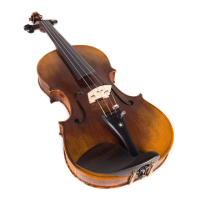
You must assemble and tune your new violin prior to playing. Violins are delicate instruments and can be
damaged easily. Handle with care. If you have a violin instructor we recommend you see him or her to
assist you with assembling, cleaning and tuning your instrument for the first time.
If can not wait, follow the steps below:
Violin Bridge
The bridge is very important in transmitting the sound of your violin. It serves as the conduit
between the strings and the body of the instrument. Many players prefer to have their bridges
“customized” by violin luthiers in order to draw out an even better tone from their instrument. If
you desire this please visit your place of purchase or your local violin repair shop for information.
The bridge is not in a fixed position. It is held in place with the tension of the strings over the top
edge. Your bridge may not be set. If it is proceed to the tuning section. If your bridge is not set
you will need to set it by following the simple instructions below:
o Loosen strings if necessary. You will need some tension on the strings in order to keep
the bridge in place.
o Position the bridge so the higher side of the bridge is under the low strings (G string
side).
o Align the feet of the bridge with the two notches on the inside of the “F” holes and evenly
with the fingerboard.
o Tilt the bridge up under the strings toward the tailpiece and set at a 90-degree angle. If
you can not tilt the bridge up because the strings are too tight, loosen them slowly and
tighten just enough so you can hold the bridge in place.
o Align the strings so they are evenly spaced on the bridge prior to tightening the string too
much.
o Tighten pegs by turning clockwise and pushing in towards the peg box in order to hold
the bridge in place.
o If the pegs are slipping please refer to Pegs section below for simple solutions.
o If the bridge begins to tilt forward you can very carefully pull it back with both hands while
resting the lower bout of the violin on your stomach.
Keep in mind that not all players have the same size hands and fingers. Some violins come with
the bridge not set at the correct height for the player and need to be adjusted. If this is the case
then a professional luthier should adjust the bridge to get it comfortable to play. Cost should be
minimal unless the pro wants to do more work on the violin. Tell them to only do what is vital to
allow the violin to be played easily, not an extensive setup to maximize its sound quality; unless,
of course, you’re ready to spend that money.
Sound Post
The sound post is vital to producing any sound from your new instrument. It serves as the conduit
between the bridge, strings, and body of the instrument and is located in the inside of the body,
visible through the “F” holes. The sound post on your instrument has been set in the correct
position prior to shipping by our skilled technicians using special tools. It is not in a fixed position
but is held in place by being custom fit to match the curvature of your instrument. During shipping
it is possible for the sound post to come loose or dislodge itself. If this happens, please see a
local luthier or repair technician. Harm can be done to your violin if the sound post is set
improperly that is not covered by Cecilio warranty.
Tuning


 To Next Page
 Loading...