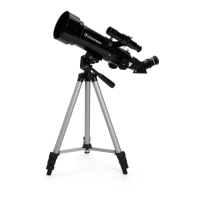
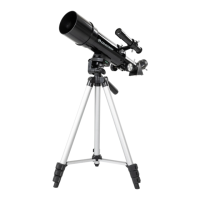
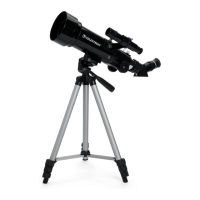
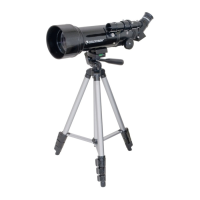
The Celestron Travel Scope 70 is a portable and user-friendly telescope designed for both terrestrial (land-based) and astronomical (sky-based) observing. This quick setup guide outlines the steps to assemble, align, and begin using your telescope, making it an ideal choice for beginners and those seeking a versatile observing instrument.
Function Description
The primary function of the Travel Scope 70 is to magnify distant objects, allowing users to observe details that are invisible or difficult to discern with the naked eye. For terrestrial viewing, it can be used to observe wildlife, landscapes, or distant landmarks. For astronomical viewing, it excels at observing the Moon, planets, and brighter deep-sky objects such as star clusters and nebulae. The telescope comes with a full-height altazimuth tripod, which provides a stable platform and allows for easy movement of the telescope in both horizontal (azimuth) and vertical (altitude) directions. The inclusion of an erect image diagonal ensures that terrestrial views are correctly oriented (not inverted or reversed), making it suitable for daytime observations.
Usage Features
The Travel Scope 70 is designed for ease of use, with a straightforward setup process and intuitive controls.
- Quick Assembly: The setup process involves unpacking the components, extending the tripod legs and central column, attaching the telescope tube to the mount, inserting the erect image diagonal, and then the eyepiece. This can be done quickly, allowing users to start observing without significant delay.
- Portable Design: The telescope is lightweight and comes with a backpack, making it highly portable. This feature is particularly beneficial for users who wish to travel with their telescope or observe from various locations.
- Altazimuth Mount: The altazimuth mount allows for simple point-and-look operation. To move the telescope horizontally, users can hold a tripod leg and use the panning handle to guide the scope. For vertical movement, rotating the pan handle counterclockwise allows for up-and-down adjustments, and rotating it clockwise locks it in place. The tension of horizontal movement can be adjusted using an azimuth locking screw.
- Finderscope Alignment: A crucial initial step is aligning the finderscope with the main telescope optics. This is done during the day by selecting a distant, easily recognizable object (e.g., a streetlight). First, center the object in the telescope's low-power eyepiece by adjusting the focus knobs. Then, without moving the telescope, use the three finger knobs on the finderscope bracket to align the finderscope's crosshairs with the same object. This alignment ensures that once an object is centered in the finderscope, it will also be visible in the main telescope's eyepiece, simplifying the process of locating celestial objects.
- Eyepieces for Varying Magnification: The telescope includes two eyepieces (20mm and 10mm), offering different levels of magnification. The 20mm eyepiece provides a wider field of view and lower magnification, ideal for locating objects and observing larger celestial bodies like the Moon. The 10mm eyepiece offers higher magnification, allowing for more detailed views of objects once they are located. Users can easily switch between eyepieces by loosening the setscrews on the focuser, removing one, inserting the other, and tightening the setscrews.
- Focusing Mechanism: The telescope features focus knobs located below the focuser. Users can turn these knobs to achieve a sharp image, which may require adjustment when changing eyepieces or observing objects at different distances.
- Erect Image Diagonal: The inclusion of an erect image diagonal is a significant feature for terrestrial observing. Unlike standard astronomical diagonals that invert or reverse the image, the erect image diagonal ensures that views are correctly oriented, making it intuitive to observe land-based targets.
- Astronomical Observing: The guide provides a step-by-step process for observing the Moon, which is recommended as a first celestial target due to its brightness and ease of location. Users are instructed to set up the telescope, point it towards the Moon, locate it in the finderscope, and then observe through the eyepiece, adjusting focus and switching eyepieces for closer views.
- Digital Assistance: Celestron offers free "Starry Night" and "SkyPortal" apps for iOS and Android. These applications can assist users in locating and identifying a wide array of celestial objects, enhancing the observing experience, especially for beginners.
Maintenance Features
While the manual primarily focuses on setup and usage, some implicit maintenance aspects are covered:
- Protective Caps: The telescope comes with plastic covers for the erect image diagonal and a lens cap for the front of the telescope. These caps should be used when the telescope is not in use to protect the optics from dust, dirt, and accidental damage. Similarly, the finderscope also has plastic caps for its front and back lenses, which should be kept on when not in use.
- Secure Fasteners: The instructions emphasize tightening knobs and setscrews to secure components in place (e.g., tripod legs, mounting platform, diagonal, eyepieces, finderscope). This ensures stability during observation and prevents components from becoming loose or falling off. However, it also advises not to overtighten, which helps prevent damage to the threads or components.
- Finderscope Alignment Stability: The manual notes that once the finderscope is aligned, it should not require realignment unless it is bumped or dropped. This suggests that the alignment mechanism is designed to hold its position, reducing the frequency of re-calibration.
- Solar Safety Warning: A critical maintenance and safety feature is the explicit "SOLAR WARNING." Users are strictly advised never to attempt to view the Sun through any telescope without a proper solar filter. This warning is paramount for preventing severe and permanent eye damage, highlighting the importance of using appropriate safety equipment for solar observation.
In summary, the Celestron Travel Scope 70 is a versatile, portable, and user-friendly telescope designed to introduce both terrestrial and astronomical observing to a broad audience. Its quick setup, intuitive controls, and included accessories make it an excellent entry-level instrument, while the emphasis on proper alignment and safety ensures a rewarding and secure observing experience.

 Need help?
 General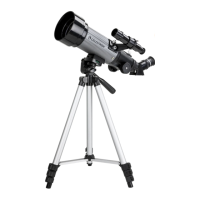


 To Next Page