
 Need help?
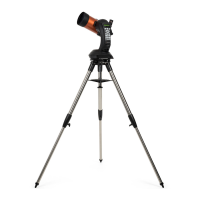
Do you have a question about the Celestron NEXSTAR 4 and is the answer not in the manual?
Entering essential date, time, and location information for telescope operation.
Activating and navigating the Tour mode to find visible celestial objects.
Step-by-step guide for aligning the telescope using alignment stars and the Star Pointer.
Instructions for removing the telescope from packaging and preparing it for setup.
Details on installing batteries and turning on the NexStar telescope.
Information on installing and understanding the function of the telescope eyepiece.
Steps for physically attaching the Star Pointer finderscope to the telescope.
How to turn on, align, and use the Star Pointer finderscope for aiming.
Description of the dual-line, 16-character backlit display on the hand controller.
Explanation of Align, Direction Keys, Catalog Keys, Info, Tour, Enter, Undo, Menu, Scroll Keys, Rate, RS-232.
Steps for aligning the telescope with the sky for accurate pointing.
Easiest method for aligning the NexStar by using guided star selection.
Method requiring user selection of two bright stars for telescope alignment.
Bypassing star slewing by modeling the sky based on entered data.
Methods for choosing objects via lists or entering catalog numbers.
Options for moving the telescope to a selected celestial object.
Options for setting telescope tracking: Alt-Az, EQ North, EQ South, or Off.
Selecting tracking rates (Sidereal, Lunar, Solar) for different celestial objects.
Displaying telescope location data and current sidereal time.
Setting altitude limits to customize displayed objects based on horizon visibility.
Saving celestial or terrestrial objects by coordinates or location.
Manually entering R.A./Dec. or Alt/Az and slewing to user-defined objects.
Displaying current telescope Right Ascension/Declination and Altitude/Azimuth.
Customizing time/location and selecting the correct NexStar model.
Compensating for backlash and setting altitude limits for accurate pointing.
Adjusting button logic and controlling display illumination.
Connecting to computer programs via the RS-232 port for remote control.
Explanation of how the eyepiece affects the orientation of the observed image.
Explanation of the R.A. and Dec system used for locating celestial objects.
Steps for performing star alignment when using an equatorial wedge.
Guide to connecting a 35mm camera body using T-adapter and T-ring.
Tips for observing the Moon during its partial phases for maximum detail.
Guide to observing planets, including Venus, Mars, Jupiter, and Saturn.
Clarity of the atmosphere affecting light transmission and object visibility.
Impact of Moon, aurorae, and light pollution on observing deep-sky objects.
Procedure for cleaning the corrector plate and lenses to avoid damage.
Details on various eyepieces and filters for enhancing observations.
Flashlights, planispheres, and sky maps for observation and guidance.
T-Adapters and T-Rings for attaching SLR cameras for astrophotography.
Tripods and vibration pads for stable telescope mounting and photography.
 General
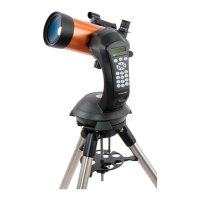
| Optical Design | Maksutov-Cassegrain |
|---|---|
| Focal Length | 1325 mm |
| Focal Ratio | f/13 |
| Eyepiece 1 | 25 mm (53x) |
| Star Diagonal | 1.25" Star Diagonal |
| Highest Useful Magnification | 241x |
| Lowest Useful Magnification | 15x |
| Limiting Stellar Magnitude | 12.5 |
| Resolution (Rayleigh) | 1.37 arc seconds |
| Resolution (Dawes) | 1.14 arc seconds |
| Light Gathering Power | 212x |
| Tracking Rates | Sidereal, Solar and Lunar |
| Tracking Modes | Alt-Az |
| Aperture | 102 mm (4 inches) |
| Mount Type | Altazimuth |
| Finderscope | StarPointer |
| Tripod | Steel tripod |
| Weight | 21 lb (9.53 kg) |
| Power Supply | 8 AA batteries (not included) |
| Database | Over 40, 000 objects |
| Alignment Procedures | SkyAlign, Auto Two-Star Align, Solar System Align |
| Communication Ports | RS-232 port |
| GPS Compatible | Optional GPS Accessory |
| Warranty | 2-year limited warranty |


 To Next Page