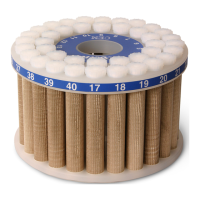
The MARSXpress is a microwave digestion vessel designed for use with the MARS 6™ with iWave® or IR temperature control. It is suitable for preparing a wide range of samples, including plant and animal tissues, environmental samples, mixed food samples, consumer products, and industrial hygiene samples. The system allows for the simultaneous preparation of up to forty vessels, meeting the high-throughput requirements of most analytical laboratories. Pre-installed One Touch™ methods simplify method creation and sample preparation, reducing guesswork. The MARS 6 instrument requires software version 1.49 or newer to operate the MARSXpress.
Important Technical Specifications:
The MARSXpress vessels are available in four sizes: 10 mL, 20 mL, 55 mL, and 75 mL. The 10 mL and 20 mL vessels are exclusively available with PFA plastic liners, while the 55 mL and 75 mL vessels offer both PFA and TFM plastic liners. A 24-place turntable is available for TFM liners.
Operating parameters for MARSXpress vessels vary by size and liner material:
- Acid Volume:
- 10 mL (PFA): Minimum 1 mL, Maximum 4 mL
- 20 mL (PFA): Minimum 2 mL, Maximum 10 mL
- 55 mL (TFM & PFA): Minimum 5 mL, Maximum 25 mL
- 75 mL (TFM & PFA): Minimum 5 mL, Maximum 55 mL
- Maximum Temperature:
- All Acids and Acid mixtures (excluding HF): 210 °C for all vessel sizes.
- HF: 180 °C for all vessel sizes.
- Maximum Hold Time:
- 200-210 °C: 45 minutes for all vessel sizes.
- 180-200 °C: 60 minutes for all vessel sizes.
- <180 °C: 90 minutes for all vessel sizes.
- Maximum Sample Weight:
- Food, Plant, and Animal Tissue: 0.1 g (10 mL), 0.2 g (20 mL), 0.5 g (55 mL), 0.75 g (75 mL)
- Oil and Plastic: 0.01 g (10 mL), 0.02 g (20 mL), 0.05 g (55 mL), 0.1 g (75 mL)
- Environmental and Regulatory: 0.1 g (10 mL), 0.2 g (20 mL), 0.5 g (55 mL), 0.75 g (75 mL)
- Pharmaceutical: 0.1 g (10 mL), 0.2 g (20 mL), 0.5 g (55 mL), 0.75 g (75 mL)
- Inorganic: 0.1 g (10 mL), 0.2 g (20 mL), 0.5 g (55 mL), 0.75 g (75 mL)
- Metallurgical: 0.1 g (10 mL), 0.2 g (20 mL), 0.5 g (55 mL), 0.75 g (75 mL)
- Clinical: 0.1 g (10 mL), 0.2 g (20 mL), 0.5 g (55 mL), 0.75 g (75 mL)
Usage Features:
The MARSXpress system emphasizes safety and proper procedure. Users must wear protective gear and follow acid manufacturer safety data sheets.
- Vessel Components: Each vessel consists of a liner, vessel plug, cap, and sleeve.
- New Liner and Plug Conditioning: All new liners and plugs must be conditioned as a set before use to ensure a proper seal. This involves cleaning with hot soapy water and a foam brush, adding a sample (e.g., tea leaves or 0.25 g ± 0.05 g of the intended sample) and 10 mL of the digestion acid (or 20 mL of water for non-acid applications), allowing for pre-digestion, assembling and torquing the vessels, and running a preprogrammed method (e.g., "Plant Material" for nitric acid or "Xpress Clean" for non-nitric acid). After the method, vessels must cool for at least 15 minutes before removal.
- Digestion Process:
- Condition liners and plugs, and ensure all components are dry.
- Place liners in a vessel liner rack.
- Add the sample (inspecting liners for abnormalities) and the appropriate acid volume, ensuring the acid covers the sample and the base of the vessel. All vessels in a run must contain similar samples, acid(s), and acid volumes. Acid blanks should not exceed 25% of the turntable when mixed with samples. Do not dilute acid with more than 25% water or add volume before digestion, as this can cause uneven heating.
- Allow 15 minutes for pre-digestion.
- Place the plug on the liner.
- Place the cap on the liner and tighten until finger-tight.
- Use the provided preset torque tool to tighten the cap until a single click is heard or felt. Keep the vent hole facing away from the user.
- Load vessel assemblies into the turntable, ensuring even distribution and a minimum of 4 vessels per run. The sleeves should remain in the turntable.
- Verify the floor mat positioning, ensuring it doesn't cover temperature sensors.
- Load the turntable into the instrument, aligning position "1" with the front. The turntable must be seated on the drive lug.
- Select and load a method (One Touch or Classic).
- Close the instrument door and select "Start."
- After the method completes, allow vessels to cool in the automated sequence for a minimum of 15 minutes before opening the microwave door.
- Vessel Removal:
- Allow vessels to cool for 15 minutes in the cavity.
- Remove the turntable, keeping vent holes away from the user.
- Remove vessel assemblies one by one and place them in a rack in a fume hood.
- Carefully loosen caps in the fume hood, with vent holes pointing away from the user, to allow venting.
- Remove the cap and plug.
- Transfer the sample from the liner.
- Wipe any liquid from the turntable or sleeves with a damp paper towel and allow to dry.
Maintenance Features:
Routine maintenance is crucial for the long-term operation of the vessels.
- After Every Use:
- Clean all vessel components as outlined in the "Cleaning and Inspection" section.
- Wipe the inside of the MARS cavity, including sensors, with a lint-free damp cloth.
- Inspect liners, plugs, caps, and sleeves for acceptable wear.
- As Needed:
- Liner Bake-out Procedure: This procedure removes residual acid vapors and trapped gases from the Teflon® material, which can cause uneven heating. It can also remove residual NOₓ gases from HNO₃ digestions or sulfur contamination.
- Place liners on their side in an air oven at room temperature.
- Set the oven to 180 °C (not exceeding 190 °C) and allow liners to warm slowly.
- Leave liners in the oven for a minimum of 6 hours (overnight is acceptable).
- Turn off the oven and allow liners to cool slowly to room temperature inside the oven.
- Remove liners; they should be white, comparable to new liners.
- Cleaning and Inspection (Liners, Vent Plugs, and Caps):
- Rinse liners with deionized water and dry.
- For ppm, ppb, or ppt analyte levels, clean with hot soapy water and a foam brush. Rinse thoroughly and dry. Micro-90® cleaning solution is recommended for Teflon; avoid detergents with potential contaminants (Na, P) or abrasive cleansers.
- Clean liners using the microwave:
- Add 10 mL of the digestion acid (HNO₃, HCl, H₂SO₄, H₃PO₄, or HF) to each liner.
- Prepare vessel and turntable.
- Run the "Xpress Clean" method.
- Wait 15 minutes for vessels to cool.
- Discard acid and rinse liners and covers with deionized water.
- Inspect liners: they should be smooth and white. Discard bowed, deformed, stretched, or compressed liners. Do not mix new and discolored liners; use the bake-out procedure to restore discolored liners.
- Sleeves:
- Wipe water or acid off sleeves with a damp paper towel and dry; never soak sleeves.
- Inspect sleeves: they should be smooth and golden brown. Discard distorted, flared, or stained sleeves (indicating liquid wicking into composite layers).
- Sleeves can be dried in a 105 °C oven for 8-12 hours. Discontinue use if a sleeve becomes wet (submerged in liquid).
- Turntable:
- Keep the turntable clean and dry. Clean the fume hood, bench top, and microwave cavity floor mat to prevent dust and dirt accumulation on the Teflon ball bearings, which can cause seizing.
- If ball bearings are dirty, clean with warm soapy water and a soft-bristled brush (do not remove bearings).
- If acid contacts the turntable, wipe it off with a damp paper towel and dry.
- Never soak sleeves.
- Annually: Contact CEM Service Department, local CEM subsidiary, or authorized dealer for information on service contracts.


 To Next Page
 General