26
I
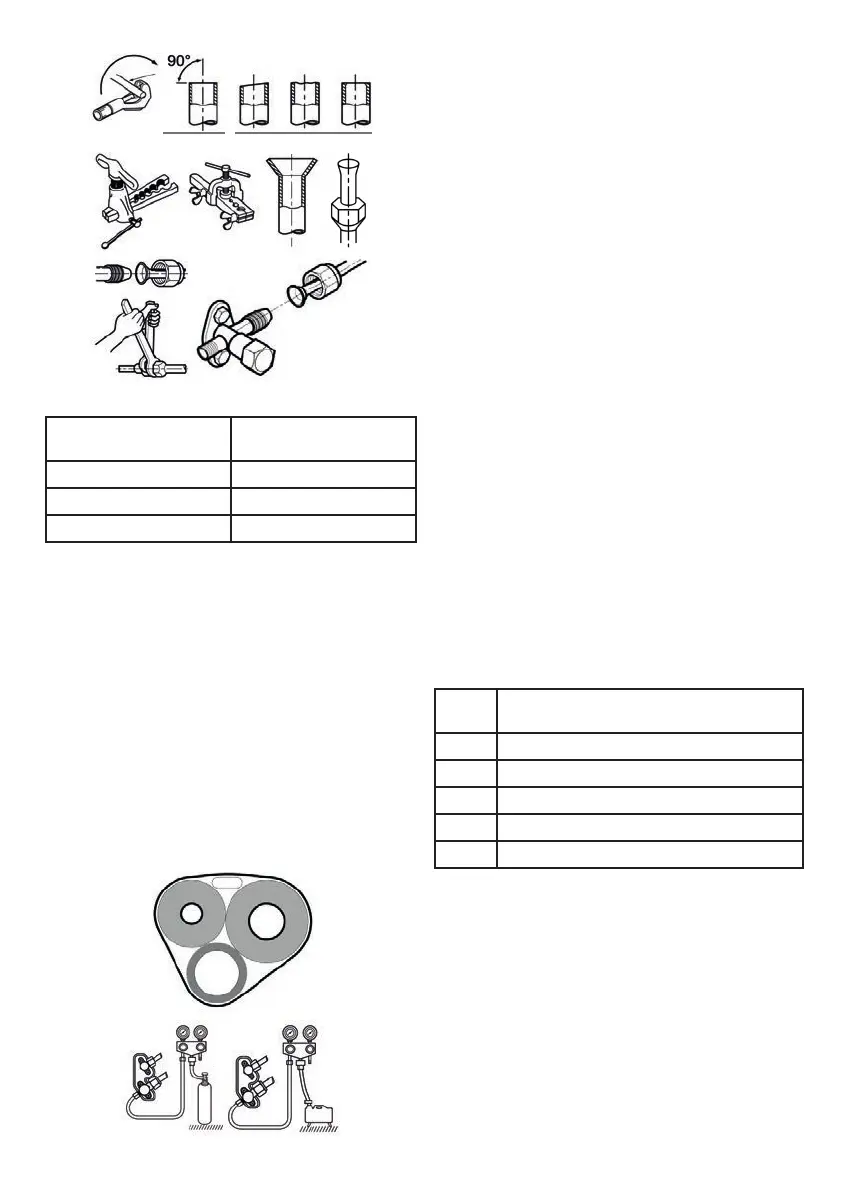
Table 2
Tube size
(mm)
Torque
(N, m)
φ 6.35 (1/4”) 15~25
φ 9.52 (3/8”) 35~40
φ 12.70 (1/2”) 45~60
Remove the maintenance panel protective covers of the indoor and outdoor units.
Loosen the terminal strip screws and properly connect the cores of the inter-unit
electrical cable and power cable to the terminals (for some models the indoor
units can be shipped with the power cable and plug already connected).
Connect the earthing wire with screws to the threaded holes located separately
on the maintenance panels. Observe the proper connection of the wires. Securely
tighten the terminal strip screws to prevent their loosening. Ensure that the
connected wires do not move by pulling on them. Fasten the inter-unit electrical
cable in the provided clamps. Reinstall the protective covers on the indoor and
outdoor unit maintenance panels.
Tube Insulation and Wrapping with Tape
The refrigerant tubes should be provided with heat insulation. The refrigerant
tube connection fittings, including the outdoor unit valves should also be
heat-insulated. The drain tube, if routed indoors, should be provided with heat
insulation. Use the supplied tape to tightly wrap the refrigerant tubes, drain tube
(hose) and inter-unit electrical cable. The drain tube (hose) should be located at
the very bottom of the bundle.
Checkup and Vacuum Testing Procedures
Ensure that the refrigerant tubes and electrical cables are properly connected.
Remove the protective caps from the gas and liquid valves in the outdoor unit
refrigerant tubes.
Ensure that the gas and liquid valves in the outdoor unit refrigerant tubes
are closed. Connect the pressure gage manifold and nitrogen bottle to the
maintenance port of the outdoor unit gas refrigerant tube. The bottle should
be connected via a pressure reducer. The use of compressed air is not allowed
because of the presence of moisture. Pressurize the system with nitrogen to 4.15
MPa. Keep the nitrogen bottle with the valve facing up to prevent liquid nitrogen
from getting into the system.
Check all pipeline connections for leaks, e.g. by applying soap suds. Repair any
revealed leaks.
Wait for 10-15 minutes and check the pressure in the system. If the pressure
drops, inspect the system to find the reason. Disconnect the nitrogen bottle from
the pressure gage manifold. Pump the nitrogen out of the system.
Connect a vacuum pump to the pressure gage manifold. Turn on the vacuum
pump. Evacuate the system to an underpressure of –0.101 MPa. Wait for 5-10
minutes and check the underpressure in the system. If the underpressure
decreases inspect the system to find that cause. Disconnect the vacuum pump
from the pressure gage manifold. Make sure that the pressure gage manifold and
vacuum pump are used properly, carefully read the operating manuals of each
device and instrument before use.
Fully open the refrigerant valves of the outdoor unit, first the liquid valve, then
the gas valve.
Disconnect the pressure gage manifold from the outdoor unit gas refrigerant tube
maintenance port. Install the protective caps on the gas and liquid refrigerant
valves of the outdoor unit.
Refrigerant Charging
These models are supplied with outdoor units charged with R410A grade
refrigerants. The systems do not require additional refrigerant charging if the
tube length do not exceed the limitations specified above.
Test Operation
Turn on AC power supply. Using the RC unit turn the AC on and check its
functionality in different modes. It should be noted that the AC efficiency test
should be performed after at least 15 to 20 minutes after the first startup.
TABLE OF FAULT CODES
Error
code
Problem
E1 Room temperature sensor fault
E2 Outdoor coil temperature sensor fault
E3 Indoor coil temperature sensor fault
E4 Indoor fan motor feedback fault
E0 Undervoltage protection
right wrong



 To Next Page