Need help?
Do you have a question about the Center 350 and is the answer not in the manual?
Instructions on using the trigger for measurement, reading hold, and auto power-off features.
Explains the D/S ratio importance for accurate measurement by matching detection area to spot size.
Defines emissivity and its effect on measurement accuracy for various material surfaces.
Details on cleaning the unit, especially the lens, using appropriate tools and methods.
Procedure for identifying low battery status and replacing the 9V battery correctly.
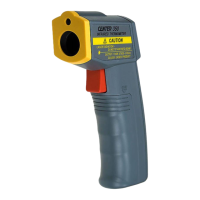
The CENTER 350 is an infrared thermometer designed for non-contact temperature measurement. This device is an essential tool for various applications where direct contact with the object to be measured is impractical or unsafe. Its primary function is to accurately determine the surface temperature of objects by detecting their emitted infrared radiation.
The core function of the CENTER 350 is to provide quick and reliable temperature readings without physical contact. It achieves this by sensing the infrared energy radiated from an object's surface. Every object with a temperature above absolute zero emits infrared energy, and the intensity of this energy is directly related to the object's temperature. The thermometer converts this detected infrared energy into an electrical signal, which is then processed and displayed as a temperature reading on its LCD screen.
A key feature enhancing its functionality is the integrated laser pointer. This laser serves as a target indicator, allowing the user to precisely aim the thermometer at the desired measurement spot. This is particularly useful when measuring small targets or objects at a distance, ensuring that the user is measuring the intended area and not surrounding surfaces. The laser radiation is classified as Class II, meaning its output is less than 1mW at 630-670mm, and users are cautioned not to stare directly into the beam or indirectly from reflective surfaces.
The device is designed for ease of use, featuring a simple trigger mechanism for measurement. When the trigger is pulled, the thermometer begins to take readings, which are continuously updated on the LCD. Upon releasing the trigger, the last measured temperature is automatically held on the display for a short period (10 seconds), allowing the user ample time to record the reading. This "data hold" function is convenient for situations where immediate recording is not possible. To conserve battery life, the thermometer is equipped with an automatic power-off function, shutting down after 10 seconds of inactivity.
The CENTER 350 is versatile in its temperature unit display, allowing users to switch between Celsius (°C) and Fahrenheit (°F) as needed. This flexibility makes it suitable for a wide range of users and applications across different regions and industries. The LCD also features a backlight, ensuring that readings are clearly visible even in dimly lit environments.
Operating the CENTER 350 is straightforward, emphasizing user convenience and safety. To initiate a measurement, the user simply points the unit at the target object and pulls the measuring trigger. The laser pointer helps in precisely identifying the measurement spot. It's crucial for users to consider the distance-to-spot ratio (D/S) to ensure accurate readings. This ratio indicates the size of the area being measured relative to the distance from the thermometer. For instance, an 8:1 D/S ratio means that at a distance of 8 units, the thermometer measures a spot size of 1 unit. Understanding this ratio is vital for obtaining correct temperature readings, especially for smaller targets, as the thermometer provides an average temperature of the detected region. The closer the thermometer is to the target, the smaller the measurement spot, leading to more precise readings for small objects.
The device is designed to be robust in various operating conditions, though certain environmental considerations are important for optimal performance. Users are advised to keep the thermometer away from strong electromagnetic fields, such as those produced by electrical welders or induction heaters, as these can interfere with readings. When moving the thermometer between environments with large or abrupt temperature changes, it's recommended to allow approximately 15 minutes for the unit to stabilize to the new ambient temperature before use. This stabilization period helps maintain measurement accuracy.
The CENTER 350 is particularly useful for measuring the temperature of various materials. Its fixed emissivity setting of 0.98 is suitable for most organic materials and painted or oxidized surfaces. Emissivity is a critical factor in infrared temperature measurement, representing a material's efficiency in emitting thermal energy. While 0.98 is a common setting, users should be aware that shiny or metallic surfaces have lower emissivities, which might lead to inaccurate readings if not accounted for. For applications involving such materials, users should note this characteristic.
Proper maintenance of the CENTER 350 is essential to ensure its longevity and continued accuracy. The most critical component requiring care is the optical lens, which is responsible for collecting infrared radiation. To clean the lens, users should first blow off any loose particles using a lens blower. For remaining debris, a gentle brush with a lens brush is recommended. Finally, the surface can be carefully wiped with a moist cotton swab, optionally moistened with water. It is explicitly stated that solvents should not be used to clean the glass lens, as they can damage the optical coating or material. Regular cleaning of the lens prevents dust and smudges from interfering with infrared detection, which could otherwise lead to inaccurate measurements.
Battery maintenance is another important aspect. The thermometer is powered by a 9V battery (006P, IEC6F22, NEDA1604). The device includes a low battery indicator, a symbol that appears on the LCD when the battery voltage drops below the level required for reliable operation. This serves as a timely reminder for the user to replace the battery. Replacing the battery is a simple process: the battery compartment cover, located on the handle, can be detached by pushing the engraved pattern and pulling it down. Once the old battery is removed, a new 9V battery can be inserted, and the cover replaced. The battery life is approximately 15 hours with alkaline batteries, providing a substantial period of use before replacement is needed.
To protect the device from environmental contaminants, especially dust, it is recommended to store the thermometer in its provided carrying case after operation. This practice helps prevent dust from accumulating on the optical lenses and other sensitive components, ensuring the instrument remains in optimal condition for future use. Adhering to these simple maintenance guidelines will help preserve the accuracy and operational life of the CENTER 350 infrared thermometer.
 General
| Resolution | 0.1°C / 0.1°F |
|---|---|
| Sensor Type | K-type thermocouple |
| Operating Temperature | 0°C to 50°C (32°F to 122°F) |
| Battery | 9V battery |
| Auto Power Off | Yes |
| Display | LCD |

 To Next Page