
 Need help?
Do you have a question about the Central Pneumatic 61615 and is the answer not in the manual?
Indicates a hazardous situation which, if not avoided, will result in death or serious injury.
Indicates a hazardous situation which, if not avoided, could result in death or serious injury.
Indicates a hazardous situation which, if not avoided, could result in minor or moderate injury.
Addresses practices not related to personal injury.
Covers general safety precautions, including work area, electrical, and personal safety.
Guidelines for the safe operation and maintenance of the air compressor.
Advice on having the compressor serviced by qualified personnel.
Precautions to prevent fire and explosion hazards during operation.
Warning against exceeding maximum pressure limits for attachments.
Instruction not to direct air stream at people or animals.
Recommendations for using extension cords with the compressor.
Warning about the importance of correct grounding wire connection.
Specific instructions for compressors with three-prong plugs.
Explanation of common symbols used in the manual.
Details on voltage, frequency, and amperage rating of the compressor.
Specifications for shut-off and restart pressure.
CFM ratings at specified pressures.
Directive to read all safety information before setup or use.
Warning to prevent serious injury from accidental operation.
Steps for the initial break-in of the new air compressor.
Instructions for connecting regulator valve and air hose.
Guidelines for setting up the compressor in a suitable work area.
Detailed steps for operating the air compressor.
Critical warning against adjusting the internal pressure switch.
Procedure for rapidly releasing stored air pressure in emergencies.
Identifying reasons for the compressor shutting off prematurely.
Procedures for cleaning, general maintenance, and lubrication.
Daily and monthly maintenance checks for the compressor.
Instructions for daily draining of moisture to prevent tank corrosion.
Diagnosing and solving issues with compressor startup.
Identifying causes and solutions for low air pressure.
Addressing problems related to compressor overheating.
Troubleshooting frequent cycling of the compressor.
Diagnosing and resolving issues causing excessive noise.
Solutions for excess moisture in the air output.
Troubleshooting the safety valve popping unexpectedly.
Methods for finding and fixing air leaks.
Addressing potential air leaks originating from the tank.
Detailed list of all parts with descriptions and quantities.
Visual representation of how the compressor parts assemble.
Information on what the 90-day warranty covers and excludes.
Instructions for returning the product for warranty claims.
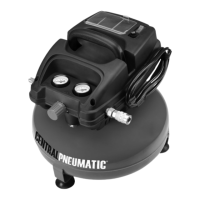
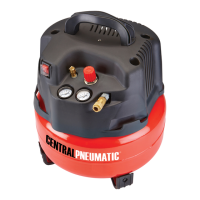
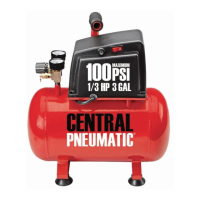
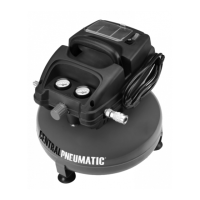
The Central Pneumatic 3-gallon oilless pancake air compressor is a portable device designed for various air-powered tasks, including inflation, stapling, brad nailing, and air brushing. This manual provides comprehensive instructions for its safe operation, setup, maintenance, and troubleshooting, ensuring users can maximize its utility while adhering to safety protocols.
The air compressor operates by drawing in ambient air, compressing it, and storing it in a 3-gallon tank. The "oilless" design means it does not require oil for lubrication, simplifying maintenance and reducing the risk of oil contamination in the output air, which is particularly beneficial for applications like air brushing.
The compressor features an automatic pressure switch that controls its operation. When the air pressure in the tank drops to 85 PSI, the compressor automatically turns on to refill the tank. It then shuts off once the pressure reaches 100 PSI. This automatic cycling ensures a consistent air supply without constant manual intervention. A red regulator knob allows users to adjust the output air pressure to match the requirements of the specific air tool being used, ensuring optimal performance and preventing over-pressurization of tools. The device includes both a tank air pressure gauge and an output air pressure gauge, providing clear visual feedback on the internal tank pressure and the regulated output pressure, respectively.
For safety, the compressor is equipped with a safety valve designed to release excess pressure if the internal pressure switch malfunctions, preventing hazardous over-pressurization. A fuse holder with a 3A fuse protects the electrical components from overcurrents, and a power switch controls the overall operation of the unit. The air outlet is a 1/4"-18 NPT connection, compatible with standard air hoses and accessories.
Before initial use, the compressor requires a "break-in" period. This involves running the unit for 30 minutes with all regulators and valves fully open, allowing air to expel freely through the coupler. This process helps to properly seat internal components and ensures optimal performance from the start.
Connecting air tools to the compressor involves a series of steps to ensure safety and efficiency. Users must connect a regulator valve, an in-line shut-off valve, and a 1/4" NPT air hose to the quick coupler. The in-line shut-off ball valve is emphasized as a critical safety device, as it allows for quick control of the air supply, even if the air hose ruptures. Depending on the air tool, additional components such as an in-line oiler, filter, or dryer may be necessary to protect the tool and ensure clean, dry air. The manual provides diagrams illustrating both lubricated and non-lubricated air supply setups, detailing the function of each component, including air hoses, filters, regulators, lubricators, couplers, leader hoses, air cleaners/dryers, and air adjusting valves.
For stationary air supply setups, the manual also illustrates a more complex system with vibration pads, anchor bolts, multiple ball valves, isolation hoses, and main/branch air lines, designed for more extensive and permanent installations. This allows for noise and vibration reduction, securing the compressor, isolating sections for maintenance, distributing air to multiple branch lines, and draining moisture effectively.
During general operation, users are instructed to turn the red regulator knob counterclockwise completely, close the drain valve, plug the power cord into a grounded 120 VAC electrical outlet, and turn the switch ON. The compressor will then build pressure until it cycles off automatically. After the compressor builds pressure and shuts off, the regulator knob can be adjusted clockwise to increase pressure or counter-clockwise to decrease it, setting the output pressure appropriate for the air tool.
The manual also addresses emergency depressurization, instructing users to turn off the power switch and pull the ring on the safety valve to quickly release stored air pressure. The automatic shut-off system is designed to protect the compressor from damage. If the compressor repeatedly shuts off before reaching its normal cutoff pressure, potential causes include using an improper extension cord (too long or narrow), or an air leak/open hose causing the compressor to cycle too often and overheat. Correcting these issues is crucial to prevent damage.
Regular maintenance is essential for the longevity and safe operation of the Central Pneumatic air compressor. The manual outlines a clear maintenance schedule, including daily and monthly checks.
The manual strongly advises against adjusting the internal pressure switch, as this can lead to excess pressure accumulation and a hazardous situation. It also warns against removing the valve cover or adjusting internal components, emphasizing that such repairs should only be performed by qualified technicians using identical replacement parts to maintain the compressor's safety.
For electrical safety, users are reminded to ensure compressor plugs match the outlet, never modify the plug, and avoid using adapter plugs with grounded compressors. The compressor should not be exposed to rain or wet conditions, and the power cord should be protected from heat, oil, sharp edges, or moving parts. If the supply cord is damaged, it must be replaced by a qualified service technician.
The manual also provides guidelines for using extension cords, although it recommends against their use. If an extension cord must be used, it should be in good condition and heavy enough to carry the current the compressor will draw, with a table provided to recommend minimum wire gauges based on length and amperage.
Overall, the Central Pneumatic 3-gallon oilless pancake air compressor is designed for user-friendly operation and straightforward maintenance, with a strong emphasis on safety to prevent injury and ensure reliable performance.
 General
| Max Pressure | 125 PSI |
|---|---|
| Pump Type | Oil-Free |
| Voltage | 120V |
| Noise Level | 78 dBA |
| Type | Portable |

 To Next Page